
19
MayCRA Tax Disputes: When to Call a Tax Lawyer in Ontario
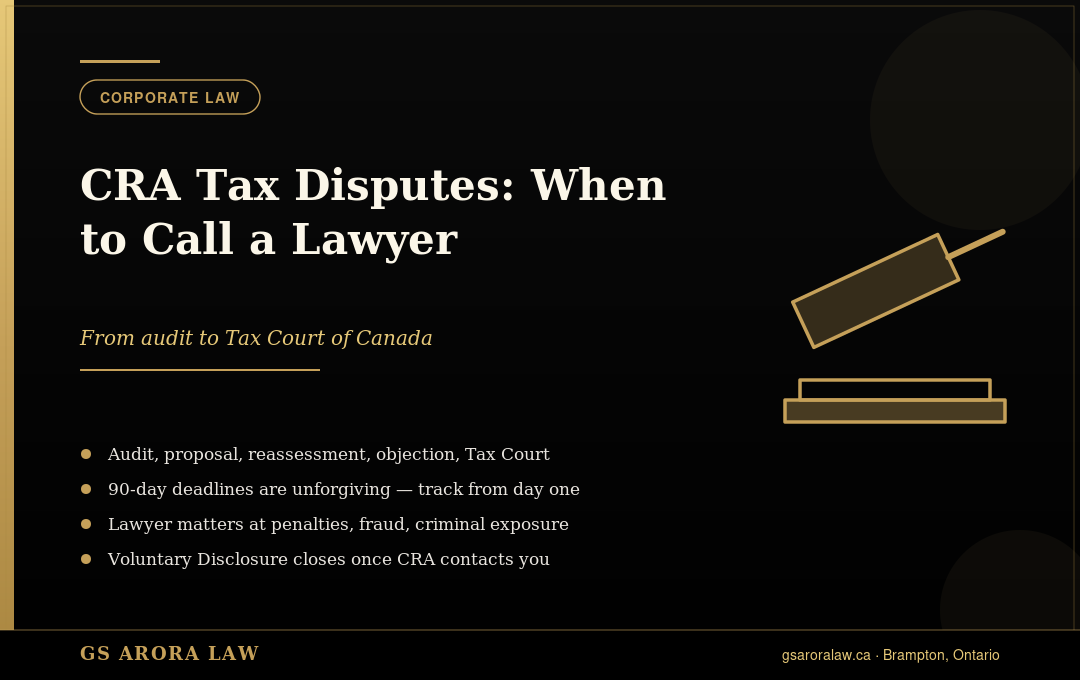
A CRA letter rarely arrives at a convenient time. For a business owner in Ontario, the first one is usually a request for documents — bank statements, T2 schedules, expense receipts, mileage logs, payroll records — covering one or two tax years. The second one, if the audit goes badly, is a "proposal letter" telling you what the auditor intends to reassess and giving you thirty days to respond. The third is the Notice of Reassessment itself, with a balance owing and interest already accruing. By the time most small business owners think about calling a tax lawyer, they are at letter two or three. The right time is usually earlier.
This guide explains how a CRA dispute moves through the system, where an accountant's work ends and a lawyer's begins, and the deadlines that matter most.
How a CRA dispute actually unfolds
A CRA tax dispute in Canada moves through a sequence with hard deadlines under the Income Tax Act and the Excise Tax Act (for HST/GST disputes). Missing a deadline can cost you the right to dispute the assessment at all, regardless of how strong your position is on the merits.
Stage 1 — Audit. A CRA auditor opens a file, requests documents, asks questions, and forms a preliminary view. Audits can be desk audits (paper-based) or field audits (the auditor visits the business). Most audits last three to twelve months. The taxpayer is required to provide records under section 231.1 of the Income Tax Act, but the way information is provided — what is volunteered, what is asked, what is privileged — shapes the file going forward.
Stage 2 — Proposal letter. If the auditor is going to make adjustments, they typically issue a proposal letter setting out the proposed reassessment and inviting a response within thirty days. This is the cheapest, fastest moment to push back — before the assessment is issued and before the file goes through the appeals system. A well-prepared response with documents, case law, and a clear narrative often results in the auditor narrowing or withdrawing some adjustments. A weak or late response leaves the taxpayer fighting the full reassessment after it is issued.
Stage 3 — Notice of Reassessment. If no response or an inadequate response is filed, CRA issues a Notice of Reassessment. The taxpayer has ninety days from the date on the notice (note: the date on the notice, not the date received) to file a Notice of Objection under section 165 of the Income Tax Act. Interest continues to accrue.
Stage 4 — Notice of Objection. The Notice of Objection is the formal challenge to the reassessment. It is filed with CRA's Appeals Division, which is functionally separate from the auditor. An appeals officer reviews the file fresh, can request more documents, and can confirm, vary, or vacate the reassessment. The appeals stage can take six months to two years.
Stage 5 — Tax Court of Canada. If the appeals officer confirms the assessment and the taxpayer disagrees, the next step is an appeal to the Tax Court of Canada. The deadline is ninety days from the date the appeals officer issues a confirmation, or one hundred and eighty days after the Notice of Objection was filed if no decision has issued. The Tax Court hears the matter de novo — fresh — and is the first independent judicial review of the assessment.
Where the accountant's work ends and a lawyer's begins
For most small files — a missed receipt, a misclassified expense, a calculation error — an accountant handles the audit and the response. The accountant knows the books, knows the tax positions, and is often the most efficient first responder. Most audits resolve at this level.
A lawyer should be involved when one or more of the following is in play:
- The auditor alleges gross negligence, civil penalties under section 163(2), or fraud. These shift the file from "math dispute" to "the taxpayer's conduct is on trial."
- A criminal investigation is open or has been referred. CRA's Criminal Investigations Program operates under different rules; statements made to a tax auditor can be used in a criminal proceeding. A taxpayer being audited and criminally investigated in parallel needs counsel from the first interview.
- The amounts at stake are material. What "material" means depends on the business — for some, six figures; for others, seven.
- The legal issue is a tax-law question, not a bookkeeping question. Examples: was the share-for-share exchange a true rollover under section 85? Was the dividend a deemed dividend or a return of capital? Did the corporation actually meet the small business deduction conditions? These are legal questions, often resolved by case law, and an accountant is generally not equipped to litigate them.
- You may need solicitor-client privilege. Communications between a taxpayer and their lawyer are privileged; communications between a taxpayer and their accountant are not. If the file is sensitive, this matters a great deal.
- You are heading to the Tax Court of Canada. The Tax Court is a court. Most non-General-Procedure files at the Tax Court are still handled by lawyers, and General Procedure (the larger files) effectively requires representation.
Two specific high-stakes situations
The Voluntary Disclosure Program (VDP). If a taxpayer has not reported income, has not filed returns, has not reported foreign holdings, or has otherwise failed to meet their obligations, the Voluntary Disclosures Program lets them come forward, pay the tax owing, and avoid most penalties (and sometimes some interest). The catch: a VDP application has to be filed before CRA contacts the taxpayer about the issue. Once an audit letter arrives, the program is usually closed for that issue. The decision to file a VDP is one of the most consequential a taxpayer makes — and it almost always benefits from a lawyer's review.
The "no-name" pre-disclosure conversation with CRA. A lawyer can speak to CRA about a hypothetical taxpayer's situation without identifying the taxpayer, to assess whether voluntary disclosure relief is likely available. This is a tool an accountant cannot use.
Deadlines, and what happens when you miss them
CRA tax deadlines are unforgiving. The thirty-day proposal-letter window can be extended by request; the ninety-day Notice of Objection window can sometimes be extended under section 166.1 if the taxpayer applies within one year of the original deadline and shows a bona fide intent to object that was prevented by something genuine. The ninety-day Tax Court window is similarly subject to limited extension under section 167. The application has to demonstrate that the failure was not the taxpayer's own neglect, and the bar is meaningful.
The cleaner approach: track the deadlines from the day each letter arrives, and have any complex response reviewed by counsel before the deadline rather than after.
Collections is a separate track
Even while a Notice of Objection is filed, CRA collections may proceed on the assessed balance. For income tax, collections is generally paused during the objection process; for HST/GST, payroll source deductions, and certain other amounts, CRA may collect even during objection. A taxpayer with a large reassessment under objection and a small bank account needs both a substantive defence and a collections strategy — often involving a payment arrangement or a request for collection hold.
How a Brampton tax and corporate lawyer fits in
The right time to involve a tax lawyer in a CRA dispute is the moment the taxpayer realizes the file is more than a bookkeeping question — usually at the proposal letter stage, sometimes earlier. The cost of early involvement is dwarfed by the cost of late involvement, especially when penalties or criminal issues are on the table. If you have a CRA audit, a proposal letter, or a Notice of Reassessment in Brampton or the GTA, book a free consultation with GS Arora Law and bring the file.
————————————————————
This article is general legal information about Canadian tax law in 2026 and is not legal advice. For advice on your specific situation, speak with a lawyer.
GS Arora, Lawyer & Notary Public. Brampton, Ontario.