
Navigating the Intersection: Religious & Cultural Marriage and Divorce in Ontario Family Law
Book Consultation Book Consultation
25
MarNavigating the Intersection: Religious & Cultural Marriage and Divorce in Ontario Family Law
Brampton is celebrated across Canada as a vibrant example of a modern, pluralistic society. As a cultural mosaic, the city is home to individuals from diverse backgrounds—South Asian, Caribbean, African, Filipino, and European—bringing with them deep-seated traditions, religious faiths, and cultural practices.
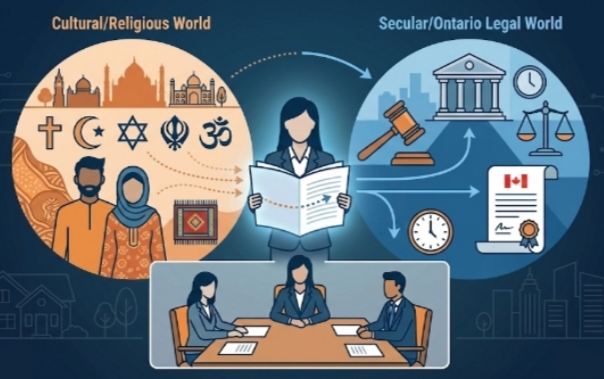
These traditions are beautiful and foundational to identity. However, when life transitions occur, such as a marriage separation or divorce, a complex collision often happens between religious or cultural requirements and Ontario’s strictly secular legal system.
Navigating this intersection is challenging. If you are part of a strongly traditional community, understanding how Ontario law treats religious or cultural marriages and divorces is crucial. Furthermore, understanding why you need a family law attorney in Brampton who possesses genuine "cultural awareness" is the single most important step you can take to protect your rights, your finances, and your familial standing.
Part 1: The Legal Hierarchy in Ontario (Civil Law Precedence)
Canada is a secular country. This is the foundational rule that dictates how all family law matters are handled in Ontario courthouses.
Ontario courts operate under the provincial Family Law Act and the federal Divorce Act. While Canadian law values multiculturalism and respects religious freedom (protected under the Charter of Rights), it maintains a strict hierarchy: Secular (Civil) law is supreme.
Religious tribunals, cultural agreements, or foreign legal codes (such as Sharia or specific caste laws) have no automatic binding legal authority within the Ontario family court system. A separation agreement drafted solely by a religious elder or a divorce granted solely by a religious body is legally non-binding.
The goal of the Ontario court is to apply provincial law uniformly to all residents, ensuring fairness regarding property division, child support, spousal support, and parenting time. Cultural traditions can supplement the process, but they cannot override statutory rights.
Part 2: Religious Marriage in Ontario
Ontario strictly regulates who can legally perform a marriage and what constitutes a valid union. Under the Marriage Act, for a marriage to be legally recognized:
- The couple must obtain a marriage license.
- The ceremony must be performed by an officiant registered with the Province of Ontario (this includes many religious leaders).
- The marriage must be officially registered with the Office of the Registrar General.
The Hybrid Reality: In practice, many religious ceremonies (such as a Sikh Anand Karaj, a traditional Christian wedding, or an Islamic Nikah) are performed by officiants who are also licensed by the Province of Ontario. In these cases, the religious ceremony is simultaneously the legal, civil ceremony. One act creates both the spiritual and legal bond.
The Potential Trap: However, it is possible (and common in some communities) to have a purely religious ceremony performed by an officiant not licensed by the province, or to omit the license entirely, mistakenly believing the religious rite alone is sufficient. In these situations, Ontario law may view the couple not as "married" but as "cohabiting," which offers vastly different property division rights (common-law couples do not automatically equalize property under the Family Law Act). A culturally aware lawyer knows to verify this legal foundation immediately.
Part 3: The Divorce Dilemma (Civil vs. Religious)
This is the most frequent and complex point of conflict. Under Ontario law, the dissolution of a legally recognized marriage requires only one thing: A Civil Divorce Order signed by an Ontario Judge.
This civil order legally terminates the marriage contract.
However, for many residents in Brampton, a civil order is spiritually insufficient. Their faith or culture may demand a separate, purely religious dissolution to allow for remarriage within the community, to avoid social stigma, or to resolve issues of religious inheritance.
The Problem of Remaining "In Limbo"
A judge can grant you a civil divorce, declaring you single in the eyes of the law. Yet, without a corresponding religious divorce, you may remain "married" in the eyes of your community or your country of origin. This creates severe social and practical issues.
Specific Examples:
- Judaism: For a Jewish divorce, the husband must grant the wife a formal document called a Get. Without the Get, the wife is known as an Agunah ("chained woman") and cannot religiously remarry.
- Islam: An Islamic Nikah (marriage) may require a corresponding Talaq (divorce by the husband) or Khula (divorce initiated by the wife) to be spiritually dissolved.
Ontario courts generally cannot force a religious leader or a spouse to perform a religious act. They cannot order a husband to grant a Get or a Talaq. The court must respect the separation of church and state.
How Lawyers Help Navigating this Impasse:
A skilled family lawyer, however, can use the secular legal tools available in the Divorce Act (Section 21.1) regarding "barriers to remarriage." A lawyer can request that a judge "strike out" (dismiss) a spouse’s pleadings or claims regarding assets if that spouse is refusing to cooperate in removing any barriers to the other spouse’s religious remarriage. A culturally aware attorney knows exactly when and how to pull this legal lever.
Part 4: Cultural Contracts (mahr, Dowries, and Separation Agreements)
In many cultural communities, marriage is seen as a union not just of two individuals, but of two families, accompanied by intricate financial arrangements. These can include a dowry (assets provided by the bride's family) or, more commonly in Brampton, an Islamic mahr (a required gift from the husband to the bride).
The Ontario courts treat these purely as contracts. They are not viewed through a lens of religious duty; they are analyzed under standard contract law. Caselaw has established that cultural agreements like the mahr are generally enforceable, provided they meet the normal requirements of a valid contract:
- No Duress: The parties were not forced or pressured into signing.
- Disclosure: Both parties knew the full extent of the financial implications.
- Reasonableness: The agreement isn't grossly unconscionable or against public policy (e.g., you cannot have an agreement that waives child support obligations).
The Lawyer's Crucial Role: The difficulty is not enforceability; it is interpretation. If your mahr states you must pay $50,000, and provincial equalization calculates you owe your ex-spouse $100,000, is the $50,000 in addition to or part of that $100,000? A generic legal approach misses this. A culturally aware lawyer knows the intent and nuance of the contract, ensuring that the final order reflects the true, fair agreement of the parties.
Part 5: Why Cultural Awareness in a Brampton Lawyer is Essential
Searching for a "family law attorney near me" in a place like Mount Pleasant or downtown Brampton means you will find hundreds of listings. You must filter these not just by "family law" but by cultural competency. Here is why:
1. Beyond the Language Barrier
Language translation is easy. Translating meaning is not. A culturally aware lawyer understands the nuances of communication, body language, and the underlying social hierarchy. They understand the different communication styles (e.g., high-context vs. low-context cultures) which can make mediation or negotiation far more efficient.
2. Understanding Familial and Social Pressure (Shame and Honor)
Generic legal advice is delivered in a vacuum: "Ontario law states X."
Culturally aware advice is delivered in your reality: "Ontario law states X, but I know this will create issues of shame within your community, so let’s explore Y to mitigate that pressure while still securing your rights."
In many communities in Brampton, the entire family structure gets involved. The pressure to "save face" or avoid communal shame can force people to accept unfair settlements to make the "mess" go away. A culturally aware attorney understands this dynamic, acts as a filter, and helps you make rational decisions, preventing the wider family from dictating the legal outcome to your detriment.
3. Mediation and Alternate Dispute Resolution (ADR)
Litigation in a courtroom is adversarial and public. Many traditional communities prefer private, respectful resolution. A culturally aware attorney is highly skilled in mediation, arbitration, and other ADR methods. They understand how to structure a resolution process (perhaps utilizing a respected elder alongside the mediator) that feels legitimate within the culture while still producing a legally binding civil outcome.
4. Avoiding Bias and Stereotypes
Sadly, unconscious bias exists. Generic advice may dismiss a request for a specific cultural asset or arrangement as "trivial" or "backward." A culturally aware attorney respects your traditions, knows that an obscure dowry item may hold immense sentimental or financial value, and ensures it is included in the final asset calculation without judgement.
Conclusion: Securing Your Future in Both Worlds
If you are facing a divorce or separation in Brampton, you are simultaneously navigating two different worlds. Do not let your emotional vulnerability and the immense social pressure from your community force you to sign away the statutory rights Ontario provides you.
Ontario law is secular, but it is flexible. A culturally aware family law attorney is the expert translator you need. They will guide you through the complexities of property division, support, and parenting, while ensuring the process is handled with the sensitivity and respect your culture demands, allowing you to secure your financial future while maintaining your place in your community.
Disclaimer: This blog post provides general legal information for residents of Ontario as of March 2026. It is not legal advice. The interplay between religious and secular law is highly factual and case-specific. Always consult a qualified family law attorney with property and cultural experience to assess your unique situation.