
21
MayAdding a Spouse to Title in Ontario: What You Need to Know
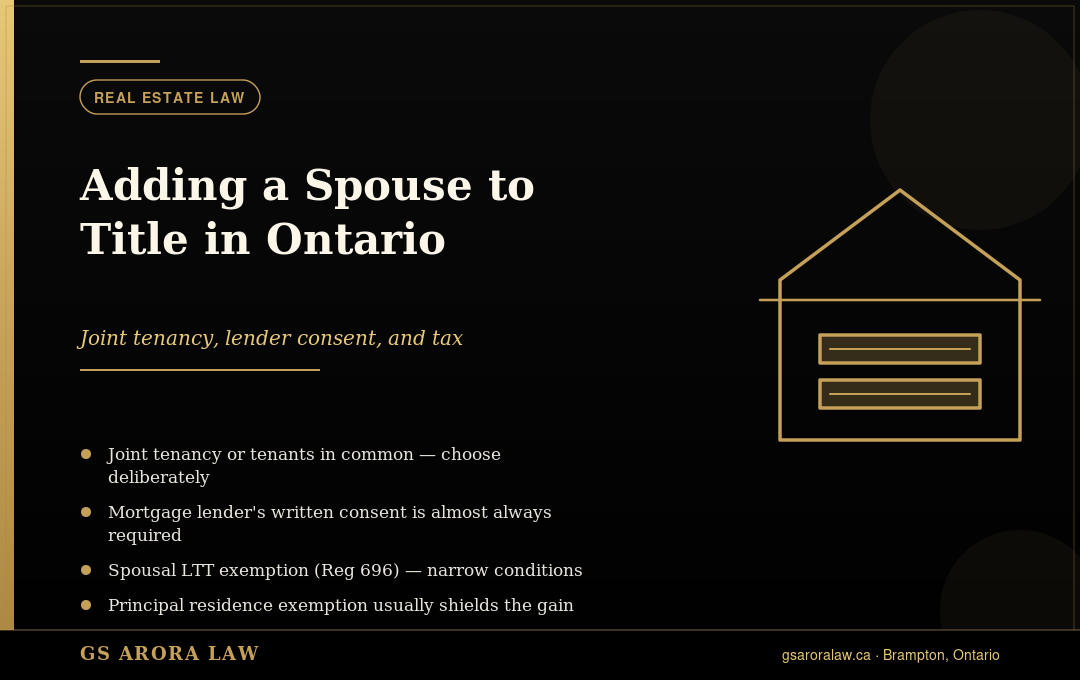
A common request a real estate lawyer in Ontario hears: "We just got married and I want to add my spouse to the title of the house." The instinct is right — for many couples, joint ownership of the family home is what they expected after the wedding. The execution is more involved than people assume. Adding a spouse to title is a registered transfer of an interest in land, and like any transfer, it interacts with mortgage lenders, the Family Law Act, the Land Transfer Tax Act, and capital gains rules under the Income Tax Act. Get the structure right and the result is what you wanted. Get it wrong and you create a tax bill or a mortgage default you did not see coming.
This guide walks through what actually happens when a spouse is added to a property title in Ontario in 2026, the choices you have to make, and the pitfalls that come up most often.
What "adding to title" really means
In Ontario's electronic land registry (Teraview), title to a property is held by named individuals (or corporations or estates) in a specific form of co-ownership. There is no "add a spouse" button. To put another person's name on title, the registered owner transfers a fractional interest in the land to that person. It is a transfer like any other — registered through Teraview by a lawyer, recorded in the parcel register, and visible to the world from the day it is registered.
The first decision is what fractional interest to transfer. Most spousal transfers move from sole ownership to a fifty-fifty split. Some move only a smaller share for tax or estate-planning reasons. Both are possible; the consequences differ.
The second decision is the form of co-ownership.
Joint tenancy vs tenants in common
Two spouses can hold a property in Ontario in two ways:
- Joint tenancy carries a right of survivorship. When one joint tenant dies, the surviving joint tenant automatically owns the whole property by operation of law. The deceased's share does not pass through their will; it does not become part of the estate; it does not go through probate.
- Tenancy in common does not carry a right of survivorship. Each owner holds a defined share that passes through their will (or, if there is no will, through Ontario's intestacy rules).
For most married spouses on a primary residence, joint tenancy is the default choice — it matches what most couples want, which is for the survivor to own the home outright when one of them dies, with no probate fees on the house. For couples in a second marriage with children from a prior relationship, tenancy in common is often the better choice, because it lets each spouse leave their share to their own children rather than to the new spouse. The right answer is family-specific. It is also reversible by registering a further transfer if the couple's plans change.
The two forms look identical on title until something happens. The difference shows up at death, on a separation, or on a sale.
Mortgage lender consent: the step people skip
If there is a mortgage on the property — and there is on most homes — adding a spouse to title is almost always a default under the standard charge terms unless the lender consents. Standard charge terms in Ontario typically require the registered owner to obtain the lender's written consent before transferring any interest in the land, including a transfer to a spouse, a child, or a corporation.
Lender consent in this situation is not unusual and not difficult — most lenders will grant it once they have signed-off documentation that includes the new spouse on the mortgage as a covenantor (someone who agrees to be personally liable on the loan). The point is that the consent step has to happen before the transfer is registered. Skipping it can technically put the mortgage into default, which most banks will not actually call in for a benign spousal transfer, but a "technically in default" loan is not what anyone wants on their record.
Your real estate lawyer should request lender consent in writing as the first step in the file, before drafting the transfer.
Land Transfer Tax: usually exempt, sometimes not
Land Transfer Tax (LTT) is calculated against the "value of the consideration" for a transfer. Ontario has a specific exemption for transfers between spouses where the only consideration is the assumption of an existing mortgage on the property and the transfer is made without payment, under Regulation 696 of the Land Transfer Tax Act. Where this exemption applies, no LTT is payable on the transfer to the spouse. Most spousal "add to title" transfers in Ontario qualify.
However, the exemption has edges:
- "Spouse" for this purpose includes married spouses and common-law partners meeting specific tests under the regulation.
- The transfer must be without payment from the spouse being added.
- If the consideration is more than the assumption of the existing mortgage — for example, the spouse pays to be added to title — LTT is payable on the value of that additional consideration.
The lawyer files a Land Transfer Tax statement on closing that captures the basis for the exemption. Get this wrong, and the Ministry of Finance can come back later with an assessment.
Capital gains and the principal residence exemption
While the home is your principal residence, capital gains on it are exempt under the principal residence exemption. Adding a spouse to title is, for income tax purposes, a disposition at fair market value — but if the property is a principal residence, the exemption usually shelters the gain. Talk to your accountant before the transfer if any of the following apply:
- The home has been rented out at any time during your ownership.
- You own a second property that has also been claimed as a principal residence in some years.
- The home has accrued substantial unrealized gains and you are transferring more than fifty percent.
- You are not a Canadian tax resident.
These are the situations where the principal residence exemption does not fully cover the disposition, and a tax bill can result from a transaction that was supposed to be a paper exercise.
What the registered transfer actually looks like
The transfer document filed in Teraview will set out:
- The names of the transferor (existing owner) and transferees (the existing owner and the new spouse).
- The fractional interest each transferee will hold (typically each holds a half).
- Whether they hold as joint tenants or tenants in common.
- The legal description of the property.
- The Land Transfer Tax statements supporting the exemption.
After registration, the title is reissued and you can see both names on the parcel register the same day.
When adding a spouse is not the right move
There are situations where adding a spouse to title is the wrong tool for what the couple is actually trying to accomplish. If the goal is to make sure the surviving spouse keeps the home if one of them dies, a will plus a Continuing Power of Attorney for Property can sometimes do the same job without registering a transfer. If the goal is creditor protection, adding a spouse to title may not protect against a future claim — and depending on the timing, may amount to a fraudulent conveyance. If the goal is "I want this to be ours," the Family Law Act's matrimonial home rules already give a non-titled spouse significant rights in a marriage; adding to title may not change as much as the couple thinks.
A short conversation with a real estate lawyer at the beginning saves a great deal of unwinding later.
How a Brampton real estate lawyer fits in
Adding a spouse to title in Ontario is a quick file when it is set up correctly: lender consent, the right form of co-ownership, the LTT exemption supported, the principal residence position confirmed with the accountant. If you are in Brampton or the GTA and considering adding your spouse to your home's title, book a free consultation with GS Arora Law and we will walk through the right structure for your situation.
————————————————————
This article is general legal information about Ontario real estate law in 2026 and is not legal advice. For advice on your specific transaction, speak with a lawyer.
GS Arora, Lawyer & Notary Public. Brampton, Ontario.