
06
JunCommon-Law vs Married in Ontario: How Property Rights Differ
A surprising number of Ontario couples who have lived together for years assume they have the same property rights as married couples. They don’t. Ontario family law treats common-law and married couples very differently when a relationship ends — particularly on property — and the gap can mean the difference between walking away with half of what was built together and walking away with nothing more than what’s in your own name.
This guide explains how property rights actually differ between common-law and married couples in Ontario in 2026 under the Family Law Act, what remedies common-law partners have when the statute doesn’t help, and where the two categories are the same (spousal support, child support, CPP credits).
What “married” and “common-law” mean in Ontario family law
In Ontario, “spouse” is defined two different ways depending on what part of the Family Law Act applies.
For property division (Part I of the Act), only legally married spouses qualify. Married means married — a valid marriage under the federal Marriage (Prohibited Degrees) Act and provincial solemnization rules. A religious-only ceremony that is not registered as a legal marriage doesn’t count for this purpose.
For spousal support (Part III of the Act) and most other parts of family law, “spouse” includes married couples plus common-law partners who have either cohabited continuously for three years or who are in a relationship of some permanence with a child together (by birth or adoption).
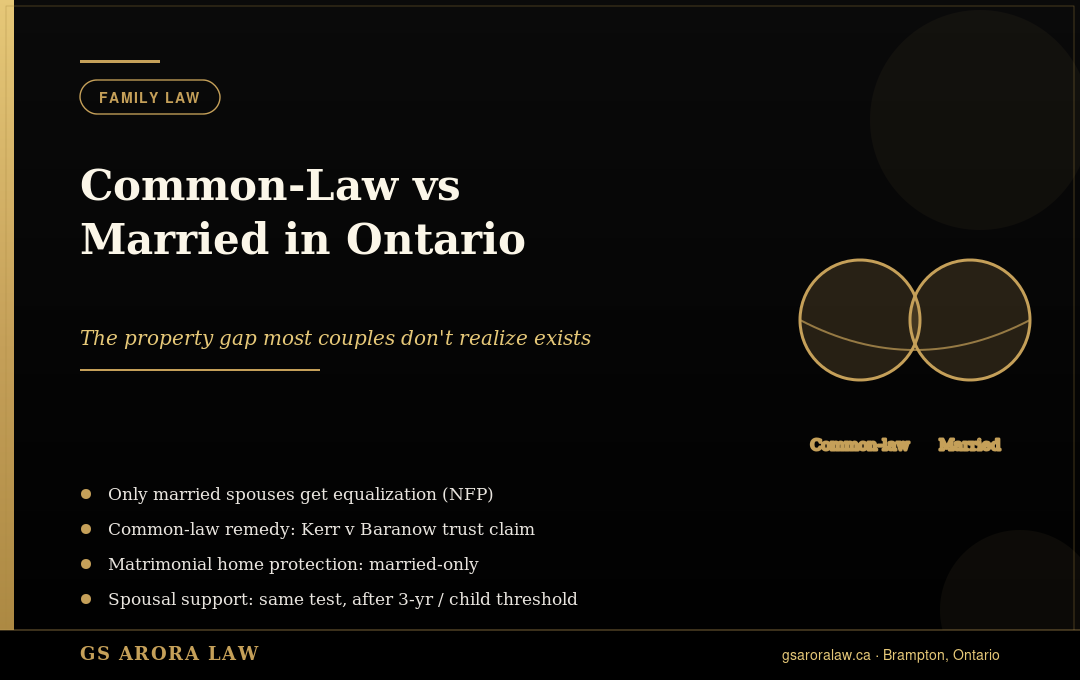
This split is the heart of the difference. Common-law partners can claim spousal support on the same footing as married spouses once they meet the three-year (or child) threshold — but they cannot claim equalization of property, which is the largest financial right married spouses have on separation.
Equalization: the right married spouses have, and common-law partners don’t
When married spouses separate in Ontario, each calculates their Net Family Property — assets owned on the valuation date (usually the date of separation), minus debts on that date, minus net worth on the date of marriage (with certain exclusions for gifts, inheritances, and damages received during the marriage from third parties, where the funds were kept separate). The spouse with the higher Net Family Property pays the other half the difference. That payment is an equalization payment.
The point of equalization is simple: it shares the economic growth of the marriage equally regardless of whose name is on the title. The spouse who stayed home and didn’t work in the market, the spouse whose business grew during the marriage, the spouse who inherited a house that became the matrimonial home — equalization adjusts for all of it within the statutory framework.
Common-law partners get none of this. There is no statutory equalization for common-law partners in Ontario, no matter how long the relationship lasted, no matter how many children, no matter how much one partner contributed to the other’s career or business.
The Supreme Court of Canada confirmed this — and the constitutionality of the gap — in Quebec (Attorney General) v A, 2013 SCC 5. The provinces are entitled to draw the line where they draw it. Ontario has chosen to draw it at marriage.
What common-law partners can claim instead: trust remedies
Common-law partners are not left with nothing. When a common-law relationship ends and one partner is left with significantly less than they contributed to, the courts have developed equitable remedies — chiefly the constructive trust based on the joint family venture framework set out by the Supreme Court of Canada in Kerr v Baranow, 2011 SCC 10.
To establish a joint family venture, the claimant has to show four factors: mutual effort, economic integration, actual intent to share, and priority of the family in the parties’ decisions. If those factors are made out, and one partner has been unjustly enriched at the other’s expense, the court can order a share of the accumulated wealth proportional to the claimant’s contributions to the joint venture.
The remedy is real, but it is not equalization. It is harder, slower, more expensive, and less predictable to litigate. Strong cases — long relationships with shared bank accounts, shared business, jointly-raised children, one partner subordinating their career to support the other’s — succeed. Marginal cases struggle. The gap between a strong Kerr v Baranow claim and a routine married-couple equalization is wide.
A simpler remedy — the resulting trust — applies where one partner directly paid for something held in the other’s name and there’s no evidence of a gift. Resulting trust claims are narrower in scope than joint-family-venture constructive trusts but easier to prove on the right facts.
The matrimonial home: a married-only protection
The matrimonial home — the home the spouses ordinarily occupied as the family residence on the date of separation — has special protections under Part II of the Family Law Act for married spouses. Both spouses have an equal right to possession of the matrimonial home regardless of which spouse owns it. Neither spouse can sell, mortgage, or otherwise encumber the matrimonial home without the other’s consent or a court order. On equalization, the value of the matrimonial home is fully included on the valuation-date side without any deduction for what the home was worth on the date of marriage, even if one spouse owned it before the marriage — a powerful and sometimes surprising rule.
None of this applies to common-law partners. The home is owned by whoever’s name is on title. The other partner can be required to leave on reasonable notice. There is no special “matrimonial home” protection for common-law couples in Ontario.
Where common-law and married are the same
Several pieces of family law treat the two categories identically:
- Spousal support — same legal test, same factors (Family Law Act s. 33, Spousal Support Advisory Guidelines), once the common-law qualifying period is met.
- Child support — entirely about the child; the parents’ marital status is irrelevant.
- CPP credit splitting — common-law partners who have cohabited for at least one continuous year are eligible to apply for credit splitting under the Canada Pension Plan.
- Survivor benefits under CPP and many private pension plans — extended to common-law partners on similar terms as spouses.
- Estate intestacy — Ontario’s Succession Law Reform Act does not treat a common-law partner the same as a spouse on intestacy. If a common-law partner dies without a will, the surviving partner has no automatic entitlement under intestate succession — only a possible dependant support claim. (Married spouses, by contrast, inherit a preferential share.)
The estate piece catches couples off guard the most. A common-law partner without a will may leave a long-term partner with nothing more than a litigation claim against the estate, while children, parents, or siblings inherit by default.
Cohabitation agreements close the gap
Common-law partners who want the certainty of equalization-like rights — or who want to opt out of the joint-family-venture exposure on the other side — sign a cohabitation agreement under section 53 of the Family Law Act. A cohabitation agreement can spell out what happens to property, debts, support, and the home if the relationship ends. Properly drafted, signed, witnessed, and supported by full financial disclosure and independent legal advice on both sides, a cohabitation agreement is enforceable in Ontario.
For couples who later marry, a cohabitation agreement automatically becomes a marriage contract under section 53(2) — no re-signing required, although a refresh is often a good idea.
How a Brampton family lawyer fits in
The common-law / married gap matters most at two moments: when a relationship is being formed (cohabitation agreement) and when one is ending (separation, support, trust claims, estate). At either moment, knowing what your real entitlements are — and what the other side’s are — is the basis for any sensible decision. If you are in a common-law or marriage relationship in Brampton or anywhere in Ontario and want to understand your property rights, book a free consultation with GS Arora Law.
This article is general legal information about Ontario family law in 2026 and is not legal advice. For advice on your specific situation, speak with a lawyer.
GS Arora, Lawyer & Notary Public. Brampton, Ontario.