
04
JunNumbered vs Named Corporation in Ontario: Which to Pick
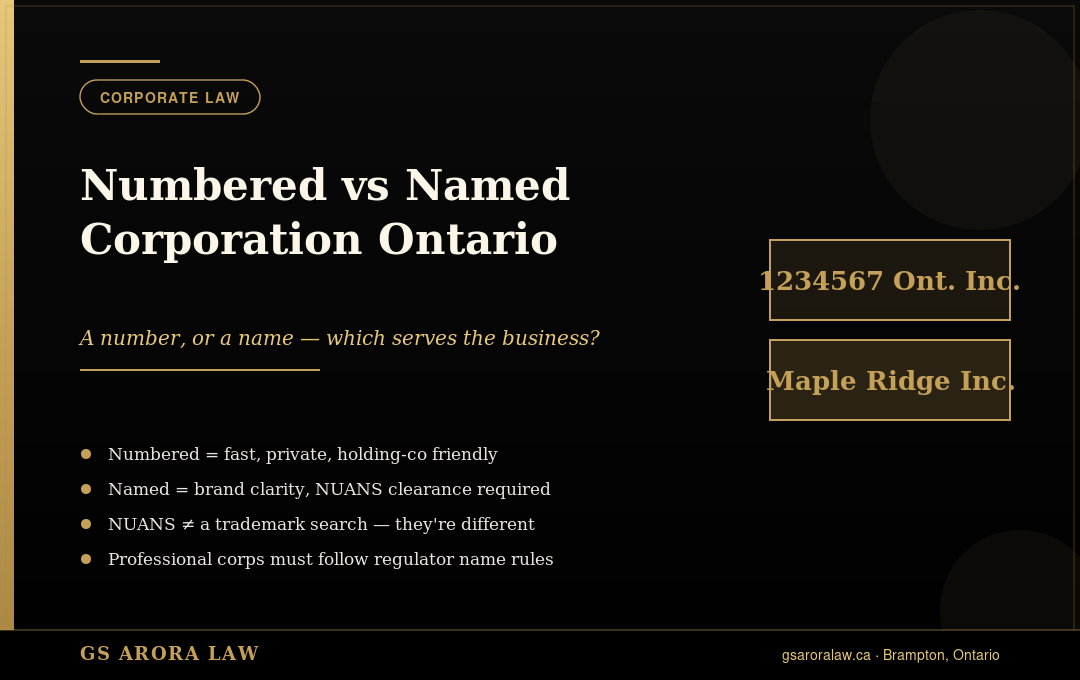
When a client incorporates an Ontario business, one of the first questions on the articles of incorporation is also one of the most underestimated: pick a name, or take a number. A numbered company like “1234567 Ontario Inc.” and a named company like “Maple Ridge Logistics Inc.” are legally identical the day they’re formed — same statute, same shareholders, same liability shield — but they create very different operational and branding realities afterwards. The right choice depends on what you’re actually building.
This guide walks through the difference between a numbered and a named corporation in Ontario in 2026, what the Ontario Business Corporations Act and the federal Canada Business Corporations Act actually require, what a NUANS search does and doesn’t do, and how lawyers and accountants typically advise clients to choose.
What a numbered corporation actually is
A numbered corporation has a name automatically assigned by the corporate registry. In Ontario, that’s a seven-digit number followed by “Ontario Inc.”, “Ontario Ltd.”, or “Ontario Corp.” — for example, 1234567 Ontario Inc. Federally, the format is similar: 1234567 Canada Inc.
The corporation has a name in the legal sense — it must use that name when it contracts, sues, opens a bank account, or files tax returns — but it has no descriptive name to market with. Most numbered companies operate under a business name registered under the Business Names Act: “1234567 Ontario Inc. operating as Maple Ridge Logistics.” The registered business name is a public-facing trade name; the corporation behind it is still the numbered entity.
The big advantage of a numbered company is speed. There is no name to clear, no NUANS report to review, no risk that the proposed name conflicts with an existing one. The corporation can be incorporated the same day, and the trade name can be added later — or never, if it isn’t needed.
What a named corporation actually is
A named corporation has a distinctive name that the incorporator proposes — “Maple Ridge Logistics Inc.”, “Northern Forge Holdings Ltd.” — and that the corporate registry approves before incorporation. The name has three required parts: a distinctive element (the brand part), a descriptive element (optional but common — “Logistics”, “Holdings”, “Consulting”), and a legal element (“Inc.”, “Ltd.”, “Limited”, “Corp.”, “Corporation”, or the French equivalents).
Before a named corporation is approved, the incorporator orders a NUANS report — a Canada-wide search that lists existing corporations, business names, and trademarks with similar names. The registry reviews the NUANS and decides whether to allow the proposed name. Names that are too generic, too similar to an existing corporation, deceptively descriptive, scandalous, or that suggest a connection to a government or regulated body are refused.
The big advantage of a named corporation is brand. The corporation’s legal name and its market name are the same, which is cleaner for marketing, contracting, and customer trust. The big disadvantage is process — clearing the name takes time, and the incorporator may have to fall back to a numbered corporation if the preferred name isn’t available.
NUANS isn’t a trademark search
This is the most common misunderstanding. A NUANS search reveals corporate and business-name conflicts. It does not clear trademarks. A corporation can be approved with a name that infringes someone else’s registered trademark, and the trademark owner can still come after the corporation to force a name change and pay damages.
If a name matters for branding — if it’s going on signage, packaging, advertising, or a domain — a trademark search and (often) a trademark registration application through the Canadian Intellectual Property Office belongs alongside the NUANS. Many lawyers and most accountants will not raise this on their own. It’s worth asking.
Name protection is narrower than people think
Approval of a corporate name in Ontario is not a monopoly on the name. The Ontario registry only blocks identical or confusingly similar corporate names. It does not block business names, trade names used by unincorporated businesses, names used in other provinces, or names that someone is using without registering anything.
A named Ontario corporation can wake up to a competitor using a similar name in another province, a sole proprietor operating under a similar registered business name in Ontario, or a numbered company doing business under a trade name that looks identical. The remedy in those cases is trademark law, passing off, or unfair competition — not corporate-name law. The corporate name buys time and a presumption, not full protection.
Privacy: a real but limited advantage
A numbered corporation hides nothing that is otherwise public. The directors, the registered office, and the corporate filings are all available through Ontario’s Business Registry. What a number does is decouple the public-facing trade name from the legal entity. If the business name is “Maple Ridge Logistics”, a competitor looking it up sees the trade name, then traces it to a numbered Ontario corporation. The numbered corporation behind it can be a holding company, a sister company, or a future acquisition target without telegraphing the relationship to anyone reading signage.
This matters more in holding-company and joint-venture contexts than in operating-company contexts. Most operating businesses gain more from brand clarity than from numbered privacy.
Professional corporations: special rules
If the business is a professional corporation under the LSO, CPSO, RCDSO, or another regulator, the naming rules tighten dramatically. The name must include the professional’s surname (and sometimes initials) and the words “Professional Corporation” — for example, “Smith Law Professional Corporation” or “Dr. J. Patel Medicine Professional Corporation”. Numbered professional corporations are generally not permitted. The trade-name route — operating under a different name — is also restricted by the governing professional body’s rules.
For doctors, dentists, lawyers, and other regulated professionals incorporating in Ontario, the name decision is usually made for them by the regulator’s rules.
Changing later
A numbered corporation can change to a named corporation at any time by filing articles of amendment and ordering a NUANS report. A named corporation can change its name the same way, or change to a numbered corporation if that becomes useful. The change costs a filing fee and some lawyer time — meaningful for a tight start-up, modest for an established business.
The practical implication is that the initial choice is not irreversible. Incorporating quickly as a numbered company while a brand is being developed, then renaming once the brand is set, is a normal and reasonable path.
How most clients should think about it
For a holding company, a single-purpose vehicle, a real-estate-holding entity, or a corporation that will never have public-facing branding — numbered is almost always the right choice. It’s faster, cheaper to keep, and avoids name-search risk.
For an operating business with a brand the owners are committed to — named is usually worth the extra steps. Brand clarity, customer trust, and contracting all favour a single name rather than a “X operating as Y” structure.
For a regulated professional — the regulator decides.
For an unsure-yet start-up — incorporating as a numbered corporation, adding a registered business name to operate under, and renaming once the brand is finalized is a clean path.
How a Brampton corporate lawyer fits in
The naming decision is usually made in five minutes at the start of the incorporation. Getting it wrong — picking a name that turns out to infringe a trademark, picking a structure that the regulator won’t approve, picking a numbered company without the trade-name registration that the bank will demand — costs real time and money downstream. If you are incorporating in Brampton or anywhere in Ontario, book a free consultation with GS Arora Law and let us walk through the name decision before the articles are filed.
This article is general legal information about Ontario corporate law in 2026 and is not legal advice. For advice on your specific incorporation, speak with a lawyer.
GS Arora, Lawyer & Notary Public. Brampton, Ontario.