
The Matrimonial Home in Ontario: Special Rules Every Spouse Should Know
Book Consultation Book Consultation
11
MayThe Matrimonial Home in Ontario: Special Rules Every Spouse Should Know
Ontario family law treats the matrimonial home differently from every other asset a couple owns. The distinctions matter most at separation, but they also matter while the marriage is intact — when one spouse wants to sell, refinance, or rent it out. Understanding what the Family Law Act actually says about the matrimonial home is one of the most useful pieces of family-law literacy a married couple in Ontario can have, because the rules are not intuitive and they are not the same rules that apply to common-law couples.
This guide explains how the matrimonial home is defined under Ontario law in 2026, the special protections it carries, and the issues that come up most often at separation.
What counts as a matrimonial home
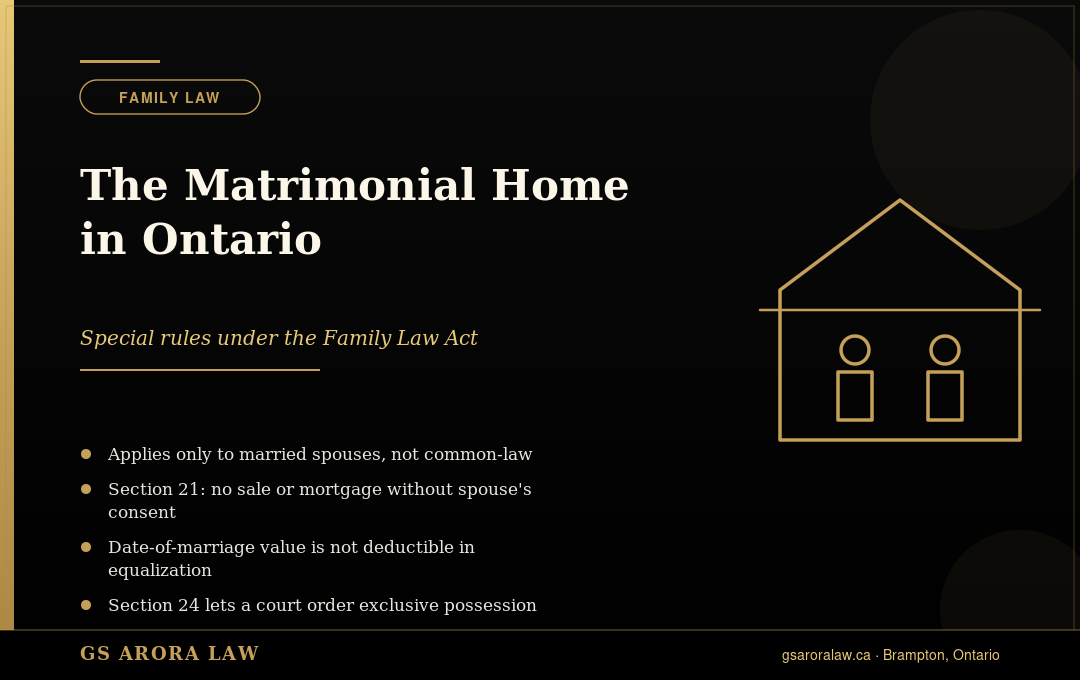
Section 18 of the Family Law Act defines the matrimonial home as a property in which a person has an interest and that is, at the time of separation, ordinarily occupied by the person and their spouse as their family residence. Three points follow from that definition:
- The home does not have to be jointly owned. A house in one spouse's name only is still a matrimonial home if the family lives there.
- A couple can have more than one matrimonial home. A cottage, a vacation property, or a second home that is regularly used as a family residence can each be a matrimonial home, all simultaneously.
- The matrimonial home test is "ordinarily occupied at the time of separation," not at the time of purchase. A property purchased before the marriage but lived in as the family home becomes a matrimonial home at the moment it is occupied.
The status as a matrimonial home is automatic. Spouses do not have to register anything for the rules to apply.
The matrimonial home rules apply only to married spouses
This is the single most important thing to understand about the matrimonial home regime in Ontario: the special rules in the Family Law Act apply only to legally married spouses. Common-law partners — including long-term cohabiting partners with children — are not "spouses" under Part I or Part II of the Family Law Act for matrimonial home purposes.
Common-law partners can still have property claims against a shared home through the law of unjust enrichment and constructive trust, as set out by the Supreme Court of Canada in Kerr v. Baranow. But they do not get the matrimonial home protections — no automatic exclusive possession rights under Part II, no consent-to-disposition rule under section 21, and no special equalization treatment.
If you are common-law and the home is in your partner's name only, you have very different rights than you would as a married spouse. This is one of the most common surprises in Ontario family law.
Section 21: neither spouse can sell or mortgage without the other's consent
For married spouses, section 21 of the Family Law Act says that no spouse can dispose of or encumber an interest in a matrimonial home unless the other spouse joins in the instrument or consents in writing, or unless a court has ordered otherwise. This rule applies even if only one spouse is on title. A husband who solely owns the family home cannot sell it, refinance it, or place a new mortgage on it without his wife's written consent — full stop.
Banks, lenders, and real estate lawyers in Ontario know this rule and ask for spousal consent in writing as a routine part of any sale, refinance, or new charge on a residential property occupied by a married couple. The consent is a real, registered document, not a casual signature.
The consequence of a transaction that breaches section 21 is significant. A sale or mortgage made without the required consent can be set aside by the court, and the non-consenting spouse has standing to bring the application.
Equalization treatment: the no-deduction rule
Ontario uses an equalization model under Part I of the Family Law Act. Each spouse calculates their "net family property" (NFP) — the increase in the spouse's net worth from the date of marriage to the date of separation — and the spouse with the larger NFP pays half the difference to the other.
The matrimonial home gets special treatment in this calculation, in two specific ways:
- The "no-deduction" rule. Property a spouse owned at the date of marriage is normally deducted from their NFP, so they are credited with what they brought into the marriage. But if a spouse owned the matrimonial home at the date of marriage and the parties still occupy it as a matrimonial home at separation, the date-of-marriage value of that home is not deductible. The whole value at separation goes into the NFP — the spouse loses the credit for what they brought in.
- Excluded property does not include the matrimonial home. Inheritances, gifts from third parties, and certain damage awards that come into the marriage from outside are normally "excluded property" — kept out of NFP. But if the spouse uses excluded property to acquire or improve a matrimonial home, the excluded amount loses its protected status to the extent it is reflected in the home.
These rules surprise many spouses who assumed their pre-marriage home was protected. A spouse who owned a paid-off house worth a substantial amount at the date of marriage and lives in it through the marriage with their spouse is treated, for equalization purposes, as if they brought zero value into the marriage with that asset.
Exclusive possession orders
Section 24 of the Family Law Act lets a court order that one spouse has exclusive possession of the matrimonial home for a defined period — meaning the other spouse must stay out, even if both names are on title. The court considers the best interests of any children, the spouses' financial positions, available alternative accommodation, family violence (which carries significant weight), and any existing orders.
Exclusive possession is a possessory remedy, not an ownership remedy. The non-possessing spouse still owns their share of the home; they just cannot live in it. Exclusive possession does not transfer title and does not waive equalization claims; it just decides who lives in the house while everything else gets sorted.
For families dealing with conflict at separation, an exclusive possession order is often one of the first things sought.
What happens to the home at separation
Separating spouses with a matrimonial home typically end up in one of three places:
- Sell the home and split the net proceeds. This is the cleanest outcome. The proceeds are held in trust by the lawyers and applied against the equalization payment.
- One spouse keeps the home and buys out the other's interest. This requires the keeping spouse to refinance and pay out the other's share, often funded by the equalization payment owing.
- Defer the decision. Some couples agree to keep the home for a defined period — until children finish school, for instance — and then sell. This is set out in a separation agreement or court order.
Each option has tax, mortgage, and equalization implications that have to be worked through together. The principal residence exemption, the Family Law Act's section 4(1) excluded property rules, and the timing of the buyout all matter.
Domestic contracts can change the rules — within limits
A marriage contract or cohabitation agreement under Part IV of the Family Law Act can alter how the matrimonial home is treated on equalization. Section 52(2), however, makes one rule unbreakable: a marriage contract cannot waive the right to possession of a matrimonial home under Part II. Spouses can contract about ownership and equalization, but not about possessory rights to the matrimonial home itself.
This is one of the most important guardrails in Ontario family law and is the reason that even the most carefully drafted marriage contract in Ontario cannot fully isolate a matrimonial home from the family-law system.
How a Brampton family lawyer fits in
The matrimonial home rules in Ontario are technical, counterintuitive, and have outsized financial consequences at separation. A spouse who understands them before they sign a marriage contract, before they put a property in one name, or before they receive an inheritance is far better positioned than one who learns them afterwards. If you have questions about the matrimonial home in Brampton or the GTA — at any stage of the relationship — book a free consultation with GS Arora Law.
————————————————————
This article is general legal information about Ontario family law in 2026 and is not legal advice. For advice on your specific situation, speak with a lawyer.
GS Arora, Lawyer & Notary Public. Brampton, Ontario.