
Claiming Childcare Expenses in Canada: What Parents Need to Know About Eligibility and Tax Rules
Book Consultation Book Consultation
13
OctClaiming Childcare Expenses in Canada: What Parents Need to Know About Eligibility and Tax Rules
Introduction
Parents often wonder whether they can claim childcare expenses on their tax returns, especially when family circumstances don’t fit the typical “two parents working full-time” model. The rules in Canada can be genuinely confusing, and misunderstandings are common. A recurring question: if one parent is working while the other stays home, can the family still claim daycare or childcare costs?
This guide unpacks the rules in detail, highlights common misconceptions, and provides practical guidance for parents navigating this deduction.
The Purpose of the Childcare Expense Deduction
The childcare expense deduction exists to help parents who need to pay for care so they can work, attend school, or actively search for employment. The underlying policy goal is straightforward: if both parents are tied up with income-generating activities, the government allows a deduction for the cost of childcare so parents aren’t financially penalized simply for working.
This explains why the deduction isn’t meant to apply in every situation. If one parent is at home and not working, the government generally assumes that parent is available to provide care, so daycare costs during that period typically won’t qualify.
Who Can Claim Childcare Expenses?
The deduction must usually be claimed by the lower-income spouse. This is a common point of confusion for families. Even if the higher-income parent is the one who actually paid the daycare bill, the deduction is tied to the lower earner’s tax return, not the payor.
There are a few narrow exceptions where the higher-income parent may claim instead — covered below — but outside of those specific circumstances, the rule is not optional or elective.
The 2026 Deduction Limits
For the 2026 tax year, the maximum deductible amount per child is:
- $8,000 per child under age 7
- $5,000 per child aged 7 to 16
- $11,000 per child of any age who is eligible for the Disability Tax Credit
Your actual deduction is the lesser of three figures: your total eligible expenses paid, the annual per-child limit added up across all your eligible children, or two-thirds of the claiming spouse’s earned income for the year. “Earned income” for this purpose means employment income, self-employment business income, and certain research grants — it does not include investment income or EI benefits.
Key Eligibility Criteria
To claim childcare expenses, the following must generally be true:
- The expense was paid so that you (or your spouse, where an exception applies) could work, run a business, attend school, or actively look for employment
- The child was under 16 at some point during the year, or was dependent on you and had a mental or physical impairment, regardless of age
- You have official receipts from the childcare provider, including their name and, in most cases, their Social Insurance Number
- The care was provided in Canada by an eligible provider — a licensed daycare, an individual caregiver, a day camp, or in some cases a boarding school or overnight camp (subject to weekly limits)
Exceptions to the General Rule
There are limited circumstances where the higher-income spouse can claim the deduction instead of the lower earner:
- The lower-income spouse was enrolled in school, either full-time or part-time, during the period the expense was claimed
- The lower-income spouse was confined to a bed or wheelchair, or was otherwise incapable of caring for the child due to a mental or physical infirmity, certified by a medical practitioner
- The lower-income spouse was in prison or a similar institution for at least two weeks during the year
- The spouses were separated for at least 90 days during the year due to a breakdown in the relationship (though this typically restarts the calculation of who counts as the “lower-income spouse” for that period)
Outside of these specific situations, the higher-income spouse cannot claim the expenses, even if they were the one who actually wrote the cheque to the daycare provider.
Example: One Parent Working, One Parent at Home
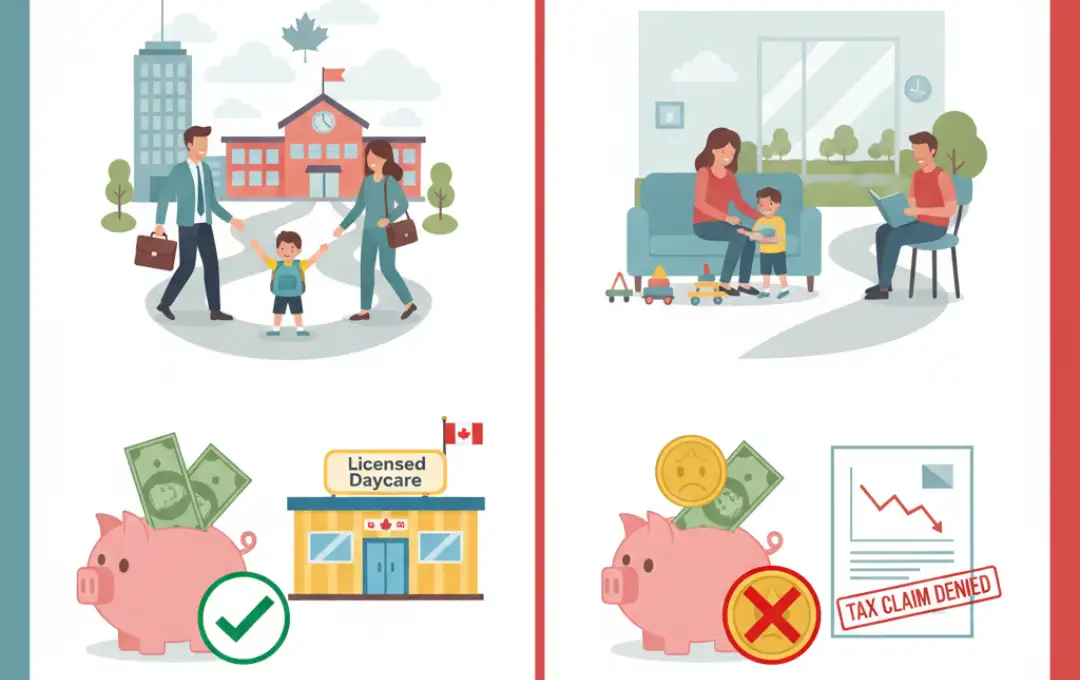
Consider a common scenario: Parent A works full-time earning $75,000. Parent B stays home with the children all year and has no employment income. The family pays $10,000 in daycare fees for their 4-year-old.
Result: the childcare expenses generally cannot be claimed. The CRA’s position is that Parent B, being at home and not working, is available to provide care, so the daycare costs are not considered necessary for either parent to earn income.
This often surprises parents who pay for daycare even though one parent is home — perhaps to maintain a hard-to-get daycare spot, to give the child socialization and early education, or because Parent B genuinely cannot manage full-time care alongside other responsibilities. Unless Parent B falls into one of the specific exceptions above (school enrollment, disability, etc.), the deduction remains unavailable regardless of the underlying reason for choosing daycare.
Example: Parent Returns to Work Mid-Year
Now consider a variation: Parent B stays home from January through September, then returns to work in October. The family continues paying for the same daycare spot throughout the entire year, at $1,000 per month.
Result: childcare expenses can only be claimed for October through December — the three months when both parents were working. The nine months when Parent B was at home and not working do not qualify, even though the family paid for the same ongoing daycare spot the entire year. Only $3,000 of the $12,000 in total annual daycare fees would be eligible for the deduction in this scenario, subject to the applicable per-child limit and the two-thirds earned income cap.
Why the CRA Takes This Approach
The logic behind these rules can feel frustrating to parents, but it’s consistent with the underlying tax policy goal: childcare expenses are deductible only when they were necessary to earn income. If a parent is at home and not working, the CRA’s position is that the expense wasn’t necessary for that purpose, regardless of how genuinely useful the daycare arrangement was for the family.
That said, the CRA does not second-guess a family’s personal choice to use daycare. Families may choose daycare for many entirely valid reasons — routine, early education, socialization, or parental stress relief. These remain personal choices, but they simply don’t translate into a tax deduction outside the eligibility rules described above.
Common Misconceptions
- “Whoever pays the bill gets to claim it.” Not necessarily — the deduction generally must be claimed by the lower-income spouse regardless of who wrote the actual payment.
- “If we’re both working part of the year, we can claim the whole year.” No — only the specific months when both parents genuinely met the eligibility criteria count, as shown in the mid-year example above.
- “Any daycare cost qualifies, no matter the reason.” The expense must be tied to enabling work, business activity, school attendance, or an active job search — not simply a parent’s personal preference for daycare while at home.
- “We can split the claim however we want between spouses.” Outside the specific exceptions listed above, the lower-income spouse must claim the deduction; this isn’t a matter of tax planning preference.
Documentation Requirements
If you’re eligible to claim childcare expenses, keep proper records, including:
- Official receipts from every childcare provider, showing the provider’s name, the amount paid, and the specific period covered
- The provider’s Social Insurance Number, required for individual caregivers (such as a nanny or babysitter) rather than licensed institutional daycares
- Proof of the other spouse’s qualifying status during any period you’re relying on an exception — school enrollment confirmation, a medical certificate confirming infirmity, or similar supporting documentation
The CRA may request this documentation during an audit, and claims lacking proper receipts — particularly for informal caregivers without a documented SIN — are a common source of reassessment.
How This Affects Real Estate and Financial Planning
This issue connects to real estate law more directly than it might initially seem. Many families time their home purchases around childcare needs and the resulting tax savings.
A family expecting a childcare deduction as part of their annual cash flow may be budgeting for a tax refund that partially offsets mortgage carrying costs. If one parent plans to stay home after a move — closer to family for support, for example — that family should understand in advance that the childcare deduction may disappear entirely during that period, which can materially affect the actual affordability of a larger mortgage than initially planned.
A real estate lawyer in Brampton won’t prepare your tax return, but experienced counsel will often flag affordability concerns like this when reviewing your mortgage instructions and closing costs, particularly where a family’s stated household income assumptions depend on both parents working.
Practical Tips for Parents
- Track your actual working months carefully if either parent’s employment status changes mid-year, since the deduction is calculated on a monthly basis tied to eligibility, not a simple annual total.
- Get proper receipts from every provider, including informal caregivers, and obtain their SIN at the time of payment rather than trying to track it down at tax time.
- Don’t assume a change in family structure automatically preserves the deduction — confirm which spouse qualifies as the lower earner each year, since this can shift.
- Factor the deduction’s actual availability into your household budget before relying on it for major financial decisions, including a home purchase.
How a Lawyer or Advisor Can Help
While most parents think of childcare expenses as purely a tax matter, the issue can have real ripple effects on family budgeting, real estate decisions, and estate planning. A lawyer or advisor can:
- Help you understand how a planned change in employment status will affect your available deductions and overall household cash flow
- Coordinate with your accountant to ensure your family’s tax planning aligns with any major purchase, like a new home, you’re planning around that cash flow
- Flag documentation gaps — such as a missing caregiver SIN — before they become a problem during a CRA review
For families in Ontario, particularly those planning to buy homes in Brampton, Mississauga, or Toronto, getting this advice upfront can prevent costly surprises later in the process.
Final Takeaway
The childcare expense deduction in Canada is a valuable tax tool, but it comes with strict rules. Both parents must generally be working, in school, or otherwise unavailable to provide care for the expenses to qualify, and the deduction is usually claimed by the lower-income spouse regardless of who actually paid the bill. Months when one parent is at home and not working simply don’t count, even if the family continued paying for the same daycare spot throughout.
For families planning major expenses like buying a home, this distinction genuinely matters. Misunderstanding the deduction could leave you with less available cash flow than expected, directly affecting your ability to manage mortgage payments and closing costs comfortably.
Before claiming childcare expenses, or relying on them in your broader financial plan, make sure you understand the CRA’s current rules. When in doubt, seek advice from a qualified lawyer or accountant.
If you’re planning a home purchase and want to understand how your family’s tax picture fits into your closing budget, contact GS Arora Law to speak with our real estate law team.
Disclaimer: The information provided in this blog is for general informational purposes only and should not be considered legal, tax, financial, or professional advice. Regulations and procedures may change over time and vary by jurisdiction. For guidance tailored to your specific situation, please consult a qualified professional.