
The 2026 Guide to Legalizing Your Brampton Basement Apartment: Requirements, Zoning, and Safety
Book Consultation Book Consultation
29
JunThe 2026 Guide to Legalizing Your Brampton Basement Apartment: Requirements, Zoning, and Safety
Introduction
A legal basement apartment in Brampton is one of the most financially rewarding decisions a homeowner can make in 2026 — but it also carries serious legal obligations. A properly legalized secondary suite earns consistent rental income, increases your property’s resale value, and protects you from the severe financial consequences of operating a brampton illegal basement: fines up to $100,000, forced evictions, and voided home insurance. If you’re already wondering whether your situation warrants legal advice, knowing when to seek legal help for a property transaction in Brampton is worth reading first.
The path to a legal basement in Brampton requires navigating the City of Brampton’s zoning bylaws, the Ontario Building Code (OBC), fire safety standards, and a formal registration process — all before a tenant can legally occupy a brampton legal basement. This is not a renovation you can self-certify. Every step involves City approvals, professional inspections, and a paper trail that ends with a Certificate of Occupancy.
This 2026 guide covers everything: how to legalize a basement in Brampton, how to check if an existing unit is already legal, what the Brampton legal basement registry is, the legal basement requirements in Brampton under the building code, the complete Brampton basement registration process, costs, consequences of illegal units, and an in-depth FAQ targeting the most common questions homeowners ask. The term Additional Residential Unit (ARU) is now the official Ontario designation for what most people call a secondary suite or basement apartment.
How to Check If a Basement Is Legal in Brampton
Before buying, renting, or investing in a Brampton property with a finished basement, you must verify its legal status. A finished basement with a kitchen, bathroom, and separate entrance is not automatically legal — it must be on the City’s registry. Here are the three ways to check:
Option 1 — Search the Brampton Legal Basement Registry
The Brampton legal basement registry — officially called the City of Brampton Two-Unit Dwelling Registry — is a public list of every property that has completed the full legal registration process for a secondary suite. This is the definitive Brampton legal basement list:
- Go to brampton.ca and search “Two-Unit Dwelling Registry”
- Enter the full civic address of the property
- A result = the unit passed all building, fire, and ESA inspections and holds a Certificate of Occupancy — it is legally registered
- No result = the unit is either unregistered, was permitted under a much older system, or may be illegal — verify directly with the City of Brampton Building Department before proceeding
Option 2 — Request a Zoning Certificate from the City of Brampton
Submit a formal request to the City of Brampton Building Department for a zoning and permit history search on the specific property address. This gives you authoritative confirmation of what permits and registrations are on file. It is the strongest method for buyers conducting due diligence before a closing date.
Option 3 — Hire a Brampton Real Estate Lawyer
A real estate lawyer in Brampton can conduct a full title search, review all City permits on file, and identify any outstanding orders or bylaw violations registered on title against the property. This is the most comprehensive verification method and is strongly recommended for any buyer purchasing a Brampton property that has an existing basement unit. If you are buying such a property, contact GS Arora Law before closing. We confirm the legal status of the unit, review its permit history, and ensure you are not inheriting someone else’s bylaw violation. Also read: legal steps when buying a home in Brampton for the full checklist of what your lawyer reviews before your closing.
Phase 1: Zoning & Feasibility — The Legal Basement Requirements in Brampton
Before spending a dollar on construction, you must confirm that your property meets the legal basement requirements in Brampton for zoning and physical feasibility. Zoning requirements and building code requirements are two separate categories — your property must satisfy both.
As-of-Right Permissions — Brampton’s New Basement Apartment Rules Under Bill 23
Under Ontario’s Bill 23 (More Homes Built Faster Act), most detached, semi-detached, and townhouse properties in Brampton are now permitted one ARU in Brampton as-of-right — meaning no formal rezoning application is required. This was a significant change to the Brampton basement new rules that expanded homeowners’ rights. However, as-of-right does not mean without conditions:
- The ARU must be secondary to the main dwelling — smaller in gross floor area and not the primary unit
- Properties in TRCA or Credit Valley Conservation floodplain designations may be completely barred — check this before any other step
- Condominium, leasehold, and certain heritage overlay properties have different or additional restrictions — confirm with the City
Parking — The Most Common Rejection Reason for ARU Applications in Brampton
Parking is the most common reason Brampton basement apartment applications are rejected or delayed. The City’s rules are strict:
- One dedicated off-street parking space is required for the secondary unit — in addition to any parking required for the main dwelling
- Tandem parking (one car parked directly behind another in a single driveway lane) is permitted to satisfy this requirement
- You cannot simply pave your entire front yard — maximum driveway width bylaws apply and minimum soft landscaping percentages must be maintained
- Any driveway widening requires its own separate permit application
Unit Size Limits
The secondary unit generally cannot exceed approximately 45% of the total gross floor area of the main dwelling. The exact applicable percentage depends on your property’s specific zoning classification. Confirm this with a BCIN-qualified designer before finalising any plans. Getting this wrong at the design stage delays your Brampton basement registration significantly.
Phase 2: Ontario Building Code Requirements for a Legal Basement Apartment
Once zoning is confirmed, construction must meet the Ontario Building Code (OBC) for new secondary suites or the Ontario Fire Code for retrofitting an existing space. Professional architectural drawings by a BCIN-qualified designer are required in virtually every case.
1. Fire Separation — The Most Critical Structural Requirement
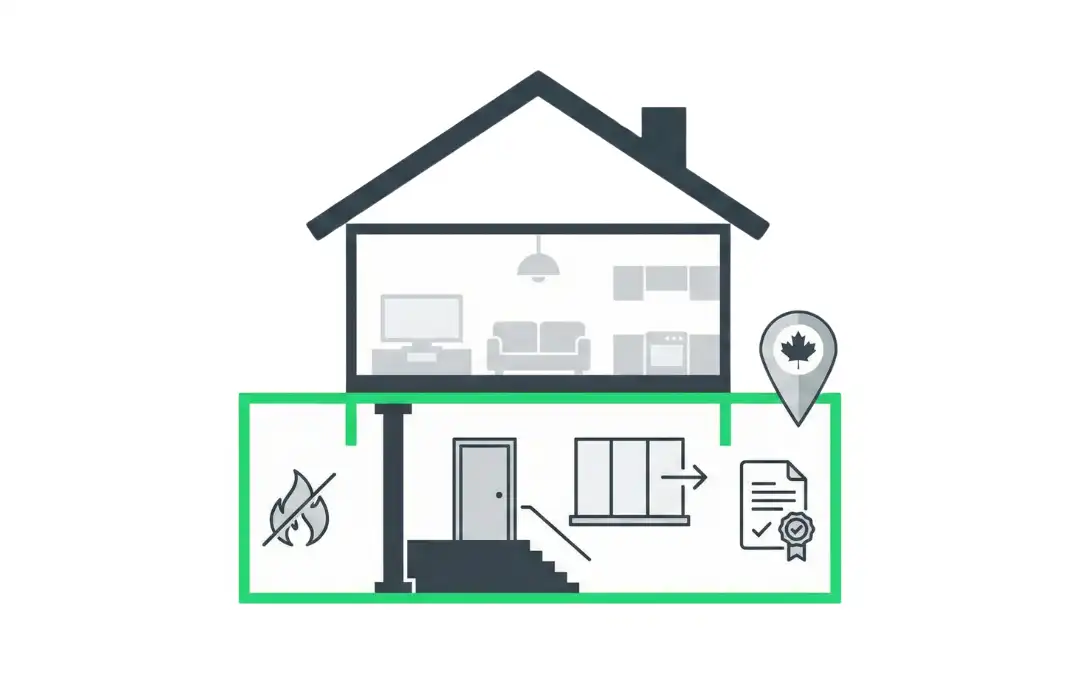
A continuous fire separation between the basement unit and the upper dwelling is the foundational requirement for a legal basement apartment in Brampton. Every penetration — pipes, wires, ducts — must be sealed:
- Ceiling and wall assemblies must use specific drywall types and thicknesses — typically minimum 5/8” Type X gypsum board throughout
- All doors connecting the basement to the upper unit must be fire-rated (20-minute rating minimum) with a self-closing device
- The fire separation must be completely continuous with zero gaps around plumbing penetrations, electrical conduit, or HVAC ductwork
2. Egress — Safe Exit in an Emergency
Legal basement window size requirements in Brampton: the Ontario Building Code requires every bedroom in a legal basement apartment to have an egress window with a minimum net clear opening of 0.35 m², minimum height 380 mm, and minimum width 450 mm. These dimensions apply to the opened, clear opening — not the window frame size. Below-grade windows require a window well of sufficient dimensions for escape and emergency access. Missing or undersized egress windows are among the most common reasons basement apartments fail Brampton’s final inspection.
- Primary exit: a separate exterior entrance door leading directly outside — not through the upper unit
- Egress window in every bedroom: 0.35 m² net clear opening, 380 mm min height, 450 mm min width
- Window wells: for below-grade windows must be sized to allow unobstructed escape
3. Minimum Ceiling Height
Minimum ceiling height of 1.95 m (6’5”) is required continuously across the required floor area of the unit. Bulkheads for ductwork and beams may be lower but are subject to strict limits on percentage of floor area coverage. Older Brampton bungalows most commonly fail on this requirement.
4. HVAC, Ventilation, and Electrical
- Fire dampers required at every point where HVAC ductwork passes through the fire separation
- The simplest compliant solution: completely separate heating for the basement unit (electric baseboard or ductless mini-split) to avoid complex shared-ductwork modifications and fire damper requirements
- Dedicated bathroom and kitchen exhaust ventilation required (HRV or ERV fans)
- ESA inspection: The Electrical Safety Authority inspects electrical work separately from the City. A 200-amp service panel is typically required. ESA approval must be received before the City issues the Certificate of Occupancy
Phase 3: The Brampton Basement Registration Process (Step-by-Step)
Building to code alone does not make a unit legal. The City of Brampton requires every secondary suite to complete the formal Two-Unit Dwelling Registration process. Here is how to register a basement apartment in Brampton in 2026:
Step 1 — Commission professional drawings: Hire a BCIN-qualified designer or architect to prepare site plans, floor plans, and elevations demonstrating full compliance with zoning bylaws and the OBC. These are mandatory for the building permit application — no drawings, no permit.
Step 2 — Submit your building permit application: File with the City of Brampton Building Department with completed drawings and the applicable basement permit in Brampton fees (calculated based on estimated construction value).
Step 3 — Receive permit approval and begin construction: Once the City issues the building permit, construction can begin. Do not begin any structural work before permit issuance.
Step 4 — Call for mandatory City inspections: The Brampton Building Department must inspect at each required stage: framing, insulation, drywall (before covering the fire separation), and final. Do not proceed past any stage without inspection sign-off.
Step 5 — ESA electrical inspection: Schedule and pass the Electrical Safety Authority inspection. Obtain the ESA electrical safety certificate.
Step 6 — Receive your Certificate of Occupancy: Once all inspections are passed, the City issues the Certificate of Occupancy and adds the property to the Brampton legal basement registry. Only after this point is the unit legally available for a tenant.
Timeline: 4 to 8 months from permit application to Certificate of Occupancy is typical. City permit review alone can take 6 to 12 weeks. Do not advertise a rental start date or sign a lease until the Certificate of Occupancy is in hand.
Once your unit is registered, protect yourself with a legally sound tenancy agreement. Our guide on what to include in a tenant lease agreement in Ontario covers every clause that matters in 2026. You should also know your rights if the tenancy goes wrong. Read what to do if your Brampton tenant stops paying rent before you ever need it. And after registration, understand the full Peel Region regulatory picture: the Peel Region rental licensing rules for basement apartments in 2026 covers what additional licences and compliance obligations apply to your registered unit.
How Much Does It Cost to Legalize a Basement Apartment in Brampton? (2026)
Cost varies significantly based on the current condition of the space. A basement that already has plumbing roughed in and adequate ceiling height will cost far less to legalize than a raw concrete shell. Here are the realistic 2026 ranges:
| Cost Item | Typical 2026 Range | Notes |
|---|---|---|
| BCIN designer / architect drawings | $1,500 – $4,000 | Mandatory for permit application |
| City of Brampton building permit fee | $1,000 – $3,500 | Based on construction value |
| Construction (fire separation, egress, HVAC, electrical) | $25,000 – $75,000+ | Highest variable — depends on existing conditions |
| ESA inspection + panel upgrade (if needed) | $200 – $3,500+ | 200-amp panel upgrade adds significant cost if not already in place |
| Legal fees (title + permit review) | $800 – $1,500 | Essential when buying a property with an existing basement unit |
| TOTAL estimated range | $30,000 – $85,000+ | Higher end for full renovation from unfinished basement |
Is it worth it? A legal basement apartment in Brampton rents for $1,400 to $2,000 per month in 2026 depending on size and finish quality. At $1,600/month, a $50,000 renovation pays for itself in under 32 months — and the registered unit increases your property’s market appraisal value permanently. For questions about how a secondary suite affects your property transaction, speak with a Brampton real estate lawyer before making any decisions.
The Real Consequences of Operating an Illegal Basement in Brampton
The City of Brampton actively enforces against illegal secondary units in 2026. Most investigations begin with a neighbour complaint about parking, noise, garbage, or unusual activity. When enforcement officers find an illegal basement apartment, the response is fast and expensive.
For the full enforcement picture — what an investigation looks like, what orders are issued, and what homeowners can do when caught — read what happens when Brampton finds your illegal basement.
Frequently Asked Questions — Legal Basement Apartments in Brampton
How do I know if a basement is legal in Brampton?
Search the City of Brampton Two-Unit Dwelling Registry at brampton.ca using the property address. A result means the unit has a Certificate of Occupancy and is legally registered. No result means you need to verify with the City Building Department or hire a real estate lawyer to review the permit history and title. Never assume a finished basement with a kitchen is a legal apartment.
What is the Brampton legal basement registry?
The Brampton legal basement registry is the City of Brampton’s Two-Unit Dwelling Registry — a public database of all properties that have legally registered a secondary suite. Search it at brampton.ca by property address. Properties on the registry have received a Certificate of Occupancy and passed all required City, fire, and ESA inspections. The registry is also referred to as the Brampton legal basement list or the registered two-unit dwelling list.
What are the legal basement requirements in Brampton?
Legal basement apartment requirements in Brampton cover three categories. Zoning requirements: ARU eligibility under Bill 23, one dedicated off-street parking space, and the unit must be smaller than the main dwelling. Building code requirements: continuous fire separation (minimum 5/8” Type X drywall), egress in every bedroom (minimum 0.35 m² window opening), minimum 1.95 m ceiling height, separate HVAC, and 200-amp electrical service. Registration requirements: approved building permit, all City inspections passed, ESA certificate, and Certificate of Occupancy from the City of Brampton.
How do I legalize a basement apartment in Brampton?
To legalize a basement apartment in Brampton in 2026: (1) confirm ARU zoning eligibility including the parking requirement; (2) hire a BCIN-qualified designer to prepare OBC-compliant permit drawings; (3) submit a building permit application to the City of Brampton; (4) complete construction and call for all mandatory City inspections at each stage; (5) pass the ESA electrical inspection and receive the certificate; (6) receive your Certificate of Occupancy from the City. The property is then added to the Brampton Two-Unit Dwelling Registry and the unit is legally occupiable.
How long does Brampton basement registration take?
The complete Brampton basement registration process — from building permit application to Certificate of Occupancy — typically takes 4 to 8 months. City building permit review alone takes 6 to 12 weeks depending on application volume. Do not sign a lease or advertise a rental unit until the Certificate of Occupancy is issued by the City.
How much does it cost to get a basement permit in Brampton?
The City of Brampton building permit fee for a secondary suite is calculated based on estimated construction value and typically ranges from $1,000 to $3,500 for most basement legalizations. This is only one component of the total cost — designer drawings ($1,500–$4,000), construction ($25,000–$75,000+), and ESA inspection fees ($200–$3,500+) all add to the total. Contact the City of Brampton Building Department or a BCIN designer for a project-specific estimate.
What is an ARU in Brampton?
ARU stands for Additional Residential Unit — the official Ontario term (used by the City of Brampton and in provincial legislation) for a legal secondary suite or basement apartment. Under Bill 23 (More Homes Built Faster Act), most detached, semi-detached, and townhouse properties in Brampton are now permitted one ARU as-of-right, subject to meeting zoning, Ontario Building Code, and City of Brampton registration requirements. A garden suite (a detached ARU in the backyard) is a separate ARU category.
Can I rent out my basement in Brampton without a permit?
No. Renting a basement apartment in Brampton without a valid building permit, ESA certificate, and City of Brampton Two-Unit Dwelling Registration is illegal. The City enforces actively in 2026. Consequences include fines up to $100,000, immediate vacate orders, forced removal of the kitchen and entrance, and full voiding of your home insurance policy. There are no exemptions or grace periods — the only legal path to rental income from a basement unit is through the complete registration process.
What are the basement window size requirements in Brampton?
The legal basement window size requirements in Brampton under the Ontario Building Code are: a minimum net clear opening of 0.35 m², minimum height 380 mm (approximately 15 inches), and minimum width 450 mm (approximately 18 inches) — measured in the fully open position, not the window frame dimensions. Below-grade bedroom windows must also have a window well of sufficient size to allow an adult to escape and emergency responders to access the opening. Non-compliant egress windows are one of the most common reasons a Brampton basement fails its final City inspection.
How do I report an illegal basement in Brampton?
Report an illegal basement apartment in Brampton through the City’s 311 service — call 311 or submit online at brampton.ca. Complaints can be made anonymously. Common triggers include unauthorized parking, visible construction without a permit, noise from excessive occupants, or garbage suggesting multiple households. Investigations typically begin within a few business days of a complaint being logged.
Do I need a lawyer when buying a Brampton property with a basement apartment?
You do not legally need a lawyer to file a building permit application. But if you are purchasing a Brampton property that already has a basement apartment, a real estate lawyer is essential — not optional. Your lawyer will confirm whether the unit is on the Brampton Two-Unit Dwelling Registry, review all permits on file, and check for outstanding bylaw orders or violations that would transfer to you as the new owner. Before you close, read the property due diligence checklist for Brampton buyers and the full guide to legal steps when buying a home in Brampton. Then contact GS Arora Law to speak with a real estate lawyer before you sign.
Conclusion: The Only Legal Path to Rental Income in Brampton
A legal basement apartment in Brampton is one of the highest-return investments a homeowner can make in 2026 — but only when the process is followed completely. The Brampton legal basement requirements, the Ontario Building Code fire separation standards, the ESA electrical inspection, and the City of Brampton Two-Unit Dwelling Registration are all mandatory, non-negotiable steps.
Whether you are starting from scratch to legalize a basement in Brampton, checking the Brampton legal basement registry on a property you are considering buying, verifying legal basement requirements before hiring a contractor, or dealing with an enforcement complaint about a brampton illegal basement — the right legal advice at the right moment costs far less than the consequences of getting it wrong.
Need legal advice on a Brampton property with a basement apartment?
Whether you’re buying, selling, or legalizing a secondary suite — GS Arora Law can help.
☎ (905) 287-1304 · gsaroralaw.ca/contact
About the author: Gagandeep Singh Arora is a Barrister & Solicitor licensed with the Law Society of Ontario, practising Real Estate Law at GS Arora Law in Brampton, Ontario.
This post is for informational purposes only and does not constitute legal, architectural, or engineering advice. Laws and bylaws are subject to change. Always consult qualified professionals for your specific project.