
22
OctClaiming Family-Related Legal Fees the Right Way
Introduction
Family and financial matters often intersect in complicated ways. Whether it involves resolving support payments, dividing assets, or enforcing an existing court order, the legal costs involved can be significant — and clients naturally ask a fair question: can any of these legal fees be claimed on my taxes?
The short answer is: sometimes. The longer answer depends entirely on the exact nature of the legal work performed and how it connects to taxable income under Canada’s tax rules. This is where things get genuinely tricky — most lawyers aren’t tax specialists, and most accountants aren’t trained to interpret a detailed legal invoice.
Having access to a professional who understands both law and accounting changes the entire equation. It allows clients to receive advice that is legally sound, financially accurate, and genuinely defensible if ever questioned by the Canada Revenue Agency.
Why Legal Fees Can Sometimes Be Deducted
The Income Tax Act allows certain legal expenses to be deducted where they were incurred for the purpose of earning or enforcing income. In family-related matters, this generally applies to legal costs that help a person establish, collect, or increase support payments — since support payments are treated as taxable income to the recipient.
Typical Examples of Eligible Legal Expenses
- Legal fees incurred to obtain a court order for spousal or child support for the first time
- Legal fees incurred to increase an existing support amount already being received
- Legal fees incurred to enforce an existing support order or separation agreement when the paying party has stopped or fallen behind on payments
- Legal fees incurred to respond to an application by the paying spouse seeking to reduce support you are currently receiving
What Does Not Qualify
The CRA is clear that not every family law expense qualifies for this deduction. You generally cannot deduct legal fees for:
- Negotiating or obtaining a divorce itself
- Child custody or access arrangements
- Division of family property or matrimonial assets
- Legal fees incurred by the paying spouse to establish, negotiate, or reduce their own support obligation (this asymmetry matters — the deduction generally runs only to the recipient seeking to secure or enforce support, not the payor)
In essence, only legal costs tied directly to pursuing or enforcing taxable support income are eligible for deduction.
The Problem Most People Face
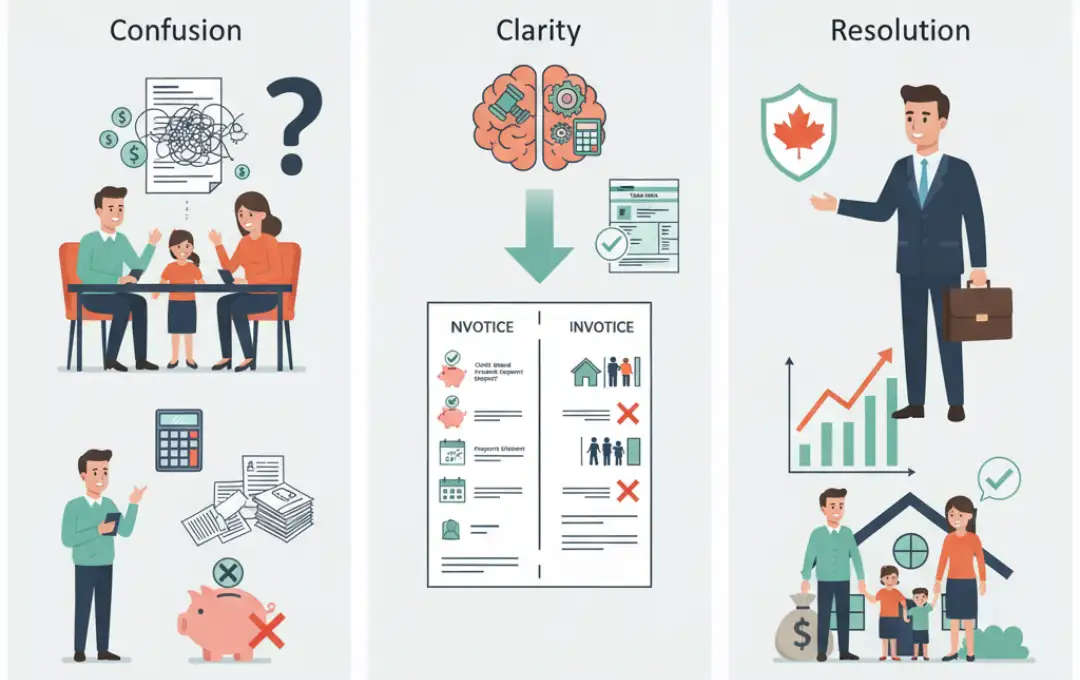
Clients often receive invoices listing every call, email, and court appearance in a single running narrative — with nothing specifying which portions relate to support issues versus which relate to custody or property matters. Accountants reviewing those invoices often can’t reliably tell what qualifies, and lawyers may not have categorized their own work with CRA’s deductibility rules in mind at the time they billed it.
This leads to genuine confusion and missed opportunities. Some clients simply give up on claiming anything at all, while others take a risky guess that can later trigger a CRA reassessment. The CRA itself has recommended that family lawyers “bifurcate,” or clearly separate, eligible from ineligible legal services on their invoices — but many lawyers are reluctant to do this, or charge an additional fee for the extra administrative work involved.
This is where a tax-trained lawyer, or a corporate tax lawyer who also understands accounting principles, can provide real clarity.
The Lawyer-Accountant Advantage
When legal and accounting expertise combine in a single professional, the process becomes considerably more efficient and defensible. Here’s how an integrated practitioner typically approaches the issue:
- Reviewing the underlying legal work itself, not just the invoice line items, to understand what each stage of the matter actually accomplished
- Mapping each category of work against CRA’s published technical interpretations, rather than applying a rough estimate
- Requesting or preparing a properly bifurcated invoice that clearly separates support-related legal work from custody, access, or property division work
- Documenting the connection between the legal work and the taxable support income it was intended to establish, increase, or enforce, since this documentation is what would support the claim if the CRA later asks questions
In short, a taxation lawyer with accounting expertise bridges the gap that typically exists between a lawyer’s invoice and an accountant’s tax return.
A General Example
Consider someone who spent $15,000 in legal fees over the course of a family law dispute. Their lawyer’s invoice covers three broad categories of work: negotiating parenting time and access arrangements, dividing the matrimonial home and other family property, and pursuing an increase in child support after the other parent’s income rose significantly.
A closer review of the file shows that roughly one-third of the total work directly related to pursuing the support increase — the negotiations, the financial disclosure review, and the court motion specifically tied to that issue. That portion, properly documented and clearly separated from the custody and property work, may qualify as a deduction, while the remaining two-thirds tied to custody and property division would not.
Without someone able to read both the legal narrative and its tax implications, the client might have lost that eligible deduction entirely — or, worse, claimed an incorrect portion of the total fee and faced a CRA reassessment later, along with potential penalties and interest.
Understanding the CRA’s Position
The CRA’s published technical guidance draws a clear distinction between legal costs incurred to obtain or enforce income versus those tied to personal or capital matters. In its technical interpretations, the CRA has stated that legal costs incurred to obtain or enforce an order for support payments under a separation agreement or court order are deductible, while legal costs connected to child custody, access, or the division of family property are not.
The real challenge lies in applying these relatively abstract rules to an actual invoice from an actual case. A single family law matter can span multiple intertwined issues, court motions, and negotiations simultaneously — which is precisely why professional judgment grounded in both law and accounting is genuinely essential here, rather than a mechanical reading of the invoice total.
Integrating Legal and Tax Planning Early
The best time to think about tax deductibility is before the invoices pile up, not after the matter has concluded. An integrated professional can:
- Advise you at the outset of a support-related matter on how to structure your instructions to your lawyer so the resulting invoices are naturally easier to categorize later
- Request itemized, bifurcated billing from day one, rather than trying to reconstruct the categorization retroactively from a year’s worth of combined invoices
- Flag which stages of the matter will likely generate deductible fees as the case progresses, so you understand the tax implications of each phase in real time rather than as a surprise at filing
When legal and accounting strategy are aligned from the beginning of a matter, clients not only maximize their legitimate deductions but also maintain cleaner, genuinely audit-ready records from the outset.
Beyond Family Matters: The Broader Lesson
The intersection of law and accounting isn’t limited to support-related deductions. Many financial and business issues require this same dual understanding, including:
- Structuring a business sale to optimize between an asset sale and a share sale for tax purposes
- Determining the deductibility of legal fees incurred in a commercial dispute or contract negotiation
- Navigating the tax consequences of a corporate reorganization or estate freeze
- Assessing whether legal fees incurred defending a CRA audit or reassessment are themselves deductible
Each of these areas requires both statutory interpretation and precise numerical application. A business or tax lawyer who speaks the language of both disciplines can identify opportunities others overlook, and prevent costly compliance errors others might miss entirely.
How a Taxation Lawyer Adds Value
For individuals and business owners alike, a lawyer with genuine tax and accounting fluency brings several key advantages:
- Accurate classification of legal expenses at the source, rather than a rough estimate applied after the fact
- Defensible documentation prepared with CRA’s specific technical criteria in mind from the outset
- Coordinated advice between your legal matter and your broader tax filing, rather than two professionals working in isolation with no visibility into each other’s work
- Proactive planning that positions you to maximize legitimate claims as a matter unfolds, rather than reconstructing the analysis after the fact
This holistic approach turns what is usually a confusing grey area into a clear, structured, and genuinely defensible plan.
Final Takeaway
Claiming legal fees on a tax return isn’t about finding loopholes — it’s about understanding the relationship between why the money was actually spent and how the tax system views that specific purpose. When legal and accounting disciplines operate in complete isolation from each other, clients end up with uncertainty, missed deductions, or real compliance risk. When the two come together properly, decisions become logical, transparent, and considerably better protected.
Whether the matter involves family-related support issues, business structuring, or broader corporate compliance, the underlying principle remains the same: every financial event carries both a legal foundation and a tax consequence. Professionals who genuinely understand both create stronger outcomes and greater peace of mind for their clients.
If you need help understanding whether your family law legal fees qualify for a deduction, or want your invoices properly reviewed and categorized, contact GS Arora Law to speak with our team.
Disclaimer: The information provided in this blog is for general informational purposes only and should not be considered legal, tax, financial, or professional advice. Regulations and procedures may change over time and vary by jurisdiction. For guidance tailored to your specific situation, please consult a qualified professional.