
The 2026 Guide to Ontario Employment Contracts: Non-Competes, Non-Solicits, and Confidentiality
Book Consultation Book Consultation
29
OctThe 2026 Guide to Ontario Employment Contracts: Non-Competes, Non-Solicits, and Confidentiality
Introduction: The Fine Print That Defines Your Future
Signing a new employment agreement is a milestone. For employers, it’s the start of a relationship you hope will grow your business. For employees, it’s an exciting new chapter in your career. But in the rush to get started, it’s easy to skim past the “legal” sections — specifically, the restrictive covenants.
These clauses — non-competition, non-solicitation, and confidentiality provisions — are among the most critical and most misunderstood terms in any Ontario employment contract. They dictate what you can and cannot do after the employment relationship ends.
For employers in Brampton, a poorly drafted clause can mean zero real protection for your clients and trade secrets. For employees, signing an overly broad clause can seriously limit your ability to earn a living in your chosen field.
In 2026, Ontario’s legal landscape in this area remains dramatically different from what it was just a few years ago. Understanding these rules is not just good practice — it’s essential before you sign anything, or ask anyone else to.
1. The Non-Compete Clause: A Ban With Very Few Exceptions
What Is a Non-Compete Clause?
A non-competition clause — a “non-compete” — is a term in an employment agreement that attempts to restrict an employee from working for a competitor, or starting a competing business, for a set period of time within a specific geographic area after they leave their job.
Are Non-Competes Legal in Ontario in 2026?
For the vast majority of employees, the answer remains no.
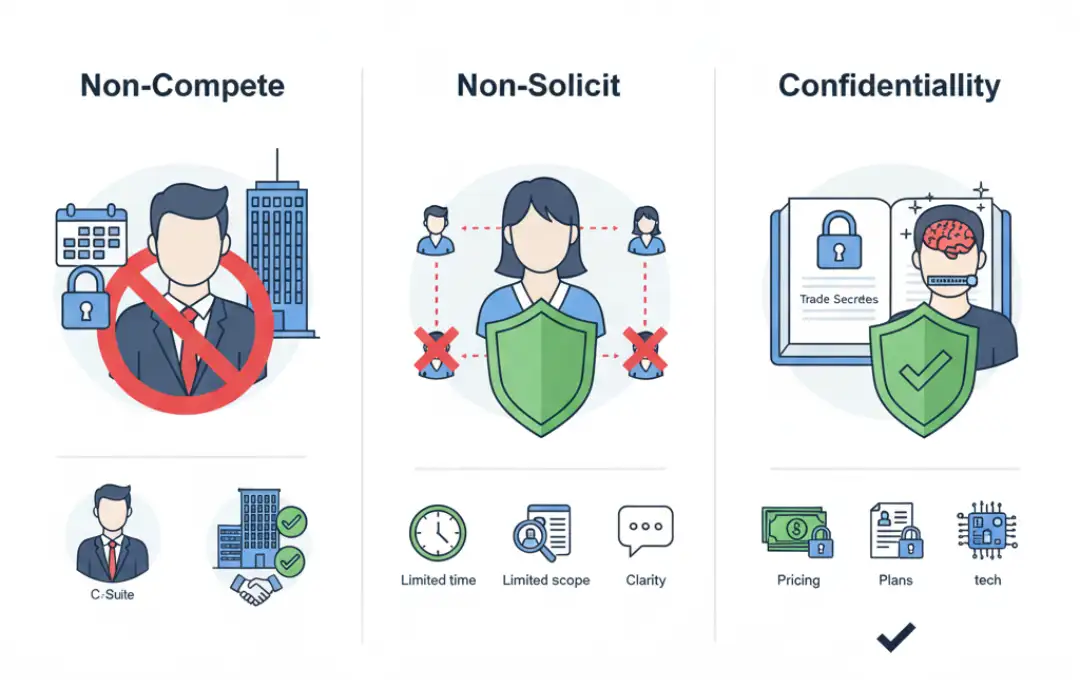
In late 2021, Ontario passed the Working for Workers Act, 2021 (Bill 27), which officially banned employers from including non-compete clauses in employment contracts. This remains the most significant change to this area of Ontario law in decades, and it has not been reversed. If you are a software developer, a sales professional, a marketing manager, or nearly any other non-executive employee in Ontario, a non-compete clause in an agreement signed after October 25, 2021, is void and legally unenforceable.
The Only Two Exceptions
The Working for Workers Act provides exactly two narrow exceptions where a non-compete clause may still be permissible:
- Executive employees: the ban does not apply to individuals holding a genuine executive-level position — typically defined as president, CEO, or another C-suite-level title with corresponding authority — as opposed to an employee who merely carries a senior-sounding job title without the actual scope of an executive role.
- Business sale transactions: a non-compete clause remains enforceable where it is entered into in connection with the sale of a business (or a significant part of one), and the seller becomes an employee of the purchaser immediately following the sale, provided the clause is genuinely tied to the transaction itself.
For Brampton employers, this means an audit of your existing contract templates is essential. Relying on an old template still containing a standard non-compete clause is not simply useless — it can signal bad faith to a court and complicate your ability to enforce the other, genuinely legitimate clauses in the same agreement.
2. The Non-Solicitation Clause: Protecting Your Client List
With non-competes effectively banned for nearly all employees, the non-solicitation clause has become the single most important tool available to employers.
What Is a Non-Solicitation Clause?
A non-solicitation clause does not stop a former employee from working for a competitor at all. Instead, it prevents them from actively soliciting — “poaching” — clients, customers, or in some cases other employees, away from the former employer for a defined period after departure.
Example: you leave your sales role at a Brampton logistics company. A properly drafted non-solicitation clause would likely prevent you from calling your former client list to persuade them to move their business to your new employer, even though it wouldn’t stop you from working in the same industry.
Are They Enforceable? Yes — If “Reasonable”
Unlike non-competes, non-solicitation clauses remain legal in Ontario, but only where they are reasonable. Canadian courts remain genuinely cautious about restricting a person’s ability to earn a living, so an enforceable clause must be narrowly drafted and protect only the employer’s legitimate business interests.
The Reasonableness Test
Courts generally examine a non-solicitation clause against several factors:
- Duration: is the restricted period — commonly 6 months to 2 years — proportionate to how long it genuinely takes the employer to rebuild the relevant client relationships?
- Scope of restricted clients: does the clause target only clients the employee actually had meaningful contact with, or does it overreach to cover the employer’s entire client base regardless of any real connection?
- Geographic scope, where relevant: is any geographic limitation tied to where the employer legitimately operates, rather than an unreasonably broad territory?
- Clarity of drafting: is the clause specific and unambiguous, or so vague that an employee couldn’t reasonably know what conduct it actually prohibits?
Watch out for “non-dealing” clauses, which go further and are more restrictive. These attempt to prevent a former employee from even accepting business from a former client who initiates contact on their own, without any solicitation at all. Courts are considerably more skeptical of non-dealing clauses, and they are more frequently struck down as unreasonable restraints on trade.
3. The Confidentiality Clause (NDA): Protecting Your Secrets
This is the one restrictive covenant that is, and will very likely always remain, highly enforceable in Ontario.
What Is a Confidentiality Clause?
Also known as a Non-Disclosure Agreement or NDA, this clause prevents an employee from using or disclosing the employer’s confidential information or trade secrets, both during employment and after it ends.
What Counts as “Confidential Information”?
This is the key drafting question — a confidentiality clause is only as strong as how precisely it defines what it’s actually protecting. This typically includes:
- Client and customer lists, contact details, and pricing arrangements
- Proprietary processes, formulas, or methods used in the business
- Financial information, including margins, budgets, and internal projections
- Marketing strategies and unreleased product plans
- Employee compensation structures and internal personnel information
A critical limitation: this clause cannot protect information that is already publicly available, and it cannot stop a former employee from using the general skills, knowledge, and experience they genuinely acquired during their employment. For example, a confidentiality clause cannot stop a mechanic from applying their general knowledge of how engines work at a new job — but it absolutely can stop them from taking the dealership’s private customer list with them.
A properly drafted confidentiality clause is the most powerful and durable protection an employer has. For employees, it represents a serious, ongoing obligation that continues long after your last day of work.
How the Three Clauses Compare in Ontario (2026)
| Clause Type | Legal Status | Key Limitation |
|---|---|---|
| Non-compete | Banned for nearly all employees | Only enforceable for genuine executives or business-sale transactions |
| Non-solicitation | Legal, if reasonable | Must be narrowly tied to actual client relationships and a proportionate duration |
| Non-dealing | Legal, but heavily scrutinized | Courts are skeptical of restricting unsolicited client contact |
| Confidentiality (NDA) | Fully enforceable | Cannot cover public information or an employee’s general skills and experience |
Conclusion: Read Before You Sign, Draft Before You Hire
The rules of this game changed substantially in Ontario, and they remain changed in 2026.
For employees, the good news is that your mobility is genuinely protected. You can no longer be sidelined by a standard non-compete clause in the vast majority of employment situations. That said, you should still pay close attention to non-solicitation and confidentiality clauses — a breach of either can lead to real and costly litigation. Never assume a clause is unenforceable simply because it appears broad on its face; that determination depends on the specific facts and drafting.
For employers in Brampton, it remains time to review and update your employment agreement templates if you haven’t already. Relying on an old template containing an unenforceable non-compete clause is a genuine liability, not a neutral leftover. Your focus should be on drafting carefully tailored, reasonable non-solicitation and confidentiality clauses that actually protect the business you’ve worked to build, rather than an illegal clause that protects nothing and undermines the rest of the agreement.
Whether you are an employee reviewing a new offer or an employer looking to protect your business, the specific language in your contract genuinely matters.
If you need an employment contract drafted or reviewed, contact GS Arora Law to speak with our business law team.
Disclaimer: The information provided in this blog is for general informational purposes only and should not be considered legal, tax, financial, or professional advice. Regulations and procedures may change over time and vary by jurisdiction. For guidance tailored to your specific situation, please consult a qualified professional.