
Ontario Renoviction Rules 2026: What Landlords Must Know Before Issuing an N13
Book Consultation Book Consultation
06
FebOntario Renoviction Rules 2026: What Landlords Must Know Before Issuing an N13
Introduction: The Renoviction Crackdown Is Now Law
For years, the term “renoviction” defined one of Ontario’s most bitter landlord-tenant disputes. Tenant advocates argued that landlords were using minor cosmetic upgrades as a pretext to evict long-term, low-rent tenants and re-list units at current market rates. Landlords argued that essential repairs to aging housing stock were being blocked by outdated protections. In 2026, the debate has been settled by legislation.
With the full implementation of the Helping Homebuyers, Protecting Tenants Act and its 2025 amendments, Ontario now has the strictest renovation eviction rules in its history. The path to renovating a tenanted property still exists — but the paperwork is heavier, the timelines are enforced, and the penalties for getting it wrong have doubled.
This guide is for the honest landlord who genuinely needs to gut a basement, remove asbestos, or replace failing infrastructure. If your motivation is cosmetic upgrades to achieve a rent increase, this guide will explain clearly why that strategy is now legally and financially untenable in Ontario.
Phase 1: The New “Qualified Person” Requirement
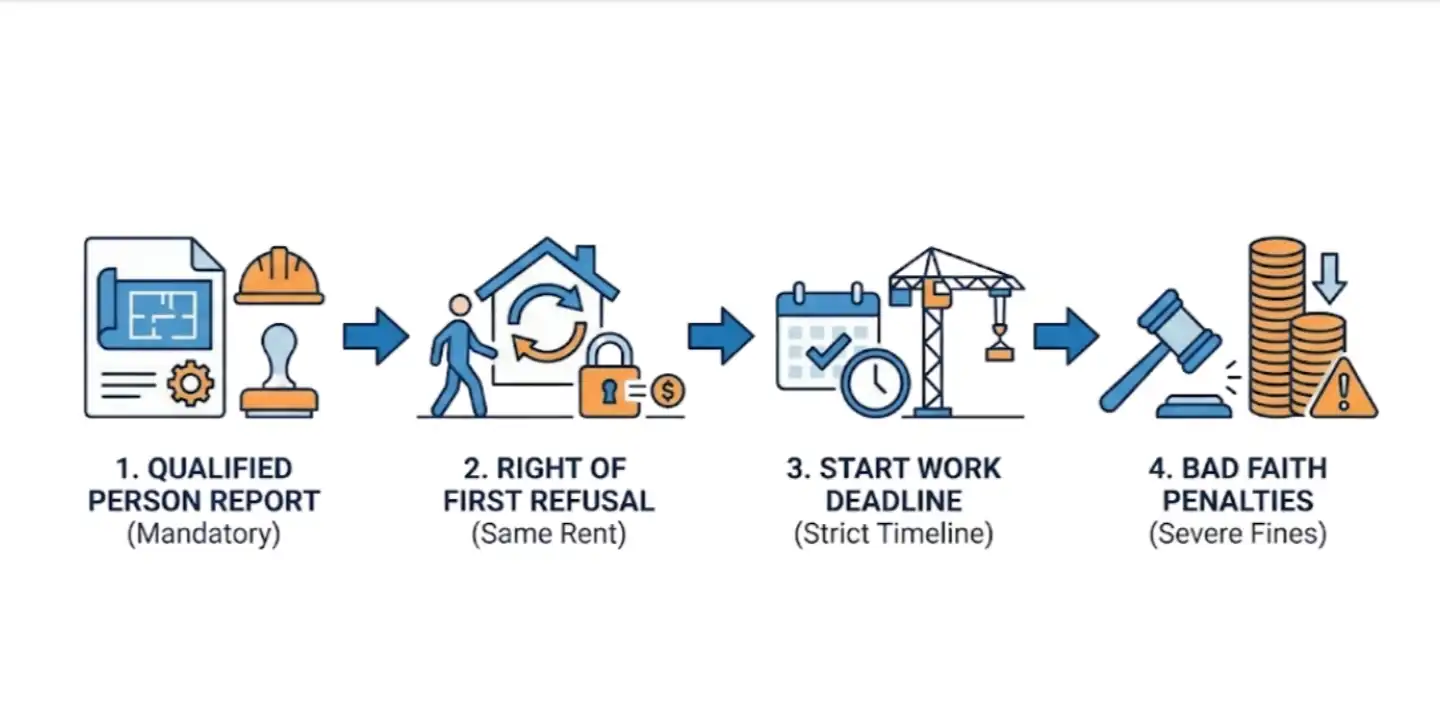
The most significant change introduced in late 2025 is the mandatory Qualified Person Report before an N13 notice can be issued.
The Old Way
A landlord could serve an N13 based on their own assessment that “vacant possession is necessary” — including for work as minor as replacing flooring or repainting.
The 2026 Rule
To issue an N13 for extensive renovations under Section 50 of the Residential Tenancies Act (RTA), you must now obtain a written report from a Qualified Person — typically a licensed Architect or Professional Engineer (P.Eng.). A general contractor’s quote or your own assessment is no longer sufficient.
The report must explicitly state that the renovation is so extensive that the unit must be vacant for the work to proceed safely. If you want to replace kitchen cabinets, update flooring, or repaint walls, a licensed engineer will almost certainly refuse to sign such a report. This effectively eliminates evictions for cosmetic upgrades.
What qualifies under the new rule:
- Full electrical rewiring of the property
- Structural work involving load-bearing walls
- Asbestos or mold remediation requiring vacated access
- Foundation replacement or major plumbing system overhaul
What no longer qualifies:
- Flooring replacement
- Kitchen or bathroom cosmetic updates
- Painting or drywall patching
- Appliance replacement
Obtaining the Qualified Person Report is Step 1. Do not approach the tenant, do not issue the N13, and do not apply for permits until this report is in your hands in writing.
Phase 2: The Right of First Refusal — The Forever Tether
Even if you secure the N13 eviction and complete the renovation, your legal relationship with the displaced tenant is not necessarily over. This is the provision that catches most Ontario investors off guard.
Under the RTA, a tenant evicted for renovations has an absolute right to move back into the unit once the work is complete — at the exact same rent they were paying before, adjusted only by the standard annual rent increase guideline (2.5% for 2026).
What the 2026 Updates Added
The new rules have significantly strengthened enforcement of this right:
- Mandatory written updates: You must keep the displaced tenant informed in writing at defined milestones — when the permit is issued, when work reaches approximately 50% completion, and when the unit is ready for occupancy.
- 60-day notification window: Once the unit is ready, you must give the tenant a strict 60-day window to exercise their right of return before listing on the open market.
- No rental lift: If the tenant exercises this right, your $80,000–$150,000 renovation results in zero increase in rental income. You have improved the asset but not the cash flow.
The Strategic Reality
If your primary motivation for renovating is to increase rent, the N13 process is now a high-risk, low-reward strategy. It is only appropriate for landlords whose genuine priority is long-term asset preservation — fixing a leaking roof, removing a fire hazard, or addressing structural failure — rather than immediate income growth.
Phase 3: The “Start Work” Deadline
One of the most common abuses under the old rules was landlords evicting tenants, then leaving units empty for months — or indefinitely — while pursuing new tenants at higher rents. The 2026 rules eliminate this gap entirely.
The New Requirements
- Permits before vacancy: You must obtain building permits — or demonstrate that your application is actively in process — before the tenant vacates. The LTB will expect to see a permit number at any hearing.
- Work must commence promptly: Once the unit is vacated, work must generally begin within 30 to 60 days. “Reasonable time” is the statutory standard, and the LTB applies it strictly.
- The Bad Faith Trigger: If a displaced tenant drives by the property three months after vacating and sees no active construction — no permits posted, no dumpster, no contractors — they can file a T5 Bad Faith application. Under the current rules, the absence of commenced work creates a presumption of bad faith, shifting the burden of proof entirely onto the landlord to explain the delay.
Do not issue an N13 unless your permits are in process and your contractor is confirmed. Any gap between vacancy and work commencement is a legal vulnerability.
Phase 4: The Cost of Getting It Wrong — Bad Faith Penalties in 2026
If the LTB determines your renovation was a sham — or that you rented to a new tenant without offering the unit back to the original tenant — the 2026 penalties are severe.
1. General Damages — Maximum Doubled
The maximum fine the LTB can levy against an individual landlord has doubled to $100,000. For corporations, the maximum is $500,000.
2. The 12-Month Rent Differential
The LTB can order you to pay the displaced tenant the difference between their previous rent and their new rent for one full year.
Example: Your tenant paid $1,500/month. Their new unit costs $2,500/month. The difference is $1,000/month. You owe them $12,000 — in addition to any other penalties.
3. General Compensation for Pain and Suffering
In a significant shift, the LTB can now order an additional general compensation amount for the tenant’s pain and suffering, loss of community, and disruption — entirely independent of their measurable financial loss. There is no fixed ceiling on this amount in the current framework.
Getting the N13 process wrong in 2026 is not an administrative inconvenience. It is a five- or six-figure liability exposure.
Phase 5: How to Renovate a Tenanted Property Legally in 2026 — The Full Checklist
If you genuinely need to renovate — failing plumbing, hazardous wiring, structural deterioration — the process remains available. Follow it precisely.
Step 1: Feasibility Assessment (Before Approaching the Tenant)
Hire a licensed Architect or Professional Engineer. Ask directly: “Is this renovation structural or safety-critical? Does it strictly require the unit to be vacant?” Obtain their answer in writing as the Qualified Person Report. Do not proceed without it.
Step 2: Building Permit Application
Apply for your building permits before issuing the N13. The LTB will expect to see the permit number or active application reference. Issuing the N13 before permits are in process is a significant procedural vulnerability.
Step 3: Issue Form N13
Once the Qualified Person Report is obtained and permits are in process:
- Reason: Reason 2 — Repairs or Renovations
- Notice Period: 120 days minimum
- Compensation: You must pay the tenant 1 to 3 months’ rent (depending on unit size), or offer them a comparable unit acceptable to them
- Right of First Refusal checkbox: If the tenant checks “Yes,” plan your renovation budget on the assumption that rent will not increase on completion. Factor this into your financial decision before you issue the notice.
Step 4: Consider the “Cash for Keys” Alternative (Form N11)
Because the N13 process carries substantial risk and guarantees no rental lift if the tenant exercises their right of return, many Ontario landlords in 2026 are opting for the N11 — Mutual Agreement to End Tenancy instead.
How it works: You offer the tenant a negotiated lump sum — often equivalent to 6 months’ rent or more — to sign an N11 and formally waive their right of first refusal. Once the N11 is properly signed, the tenancy ends with certainty. You can renovate and re-rent at market rates without ongoing legal exposure.
Important: Ensure the tenant has independent legal advice before signing. An N11 signed without adequate consideration or under perceived pressure can later be challenged as coerced, which reactivates the tenant’s rights and exposes you to the same bad faith penalties.
For a broader view of how these rules interact with Peel Region’s licensing requirements, see our guide on the 2026 landlord playbook for Ontario’s new rental rules and Peel Region’s licensing crackdown.
The Strategic Conclusion: Renovation Is Now an Asset Strategy, Not a Rental Strategy
The 2026 rules have effectively ended the “renoviction” business model where cosmetic upgrades were used to reset rents. The economics no longer work, and the legal exposure is now too significant to ignore.
For the genuine landlord, the mindset shift is straightforward:
Roof is leaking, foundation is failing, electrical is a fire hazard? Follow the N13 process precisely. The path exists. The guardrails are higher, but the destination is reachable.
Want quartz countertops and a rent increase? Wait for natural turnover. The N13 route in this scenario is a strategy that now costs more — in legal fees, compensation, and penalties — than the rental lift it could ever produce.
The legal risk is no longer proportionate to the reward for anything short of genuine structural necessity.
If you are a landlord in Brampton, Mississauga, or anywhere in Ontario and need to navigate a legitimate renovation, our real estate law team can guide you through the N13 process step by step — or help you structure an N11 agreement that protects you from future challenge.
Contact GS Arora Law before you issue any notice to a tenant regarding renovation.
Disclaimer: The information provided in this blog is for general informational purposes only and should not be considered legal, tax, financial, or professional advice. The RTA rules are complex and fact-specific. For guidance tailored to your specific situation, please consult a qualified paralegal or lawyer before issuing an N13 notice.