
The $50,000 Mistake: CRA Contractor vs. Employee Rules for 2025 & The High Cost of Misclassification
Book Consultation Book Consultation
01
DecThe $50,000 Mistake: CRA Contractor vs. Employee Rules for 2025 & The High Cost of Misclassification
Introduction: The CRA's New Target in 2026
For years, Ontario businesses have relied on independent contractors to stay agile and keep overhead low. It's a standard playbook: hire a "consultant" or "freelancer," pay their invoice, and skip the hassle of payroll deductions, vacation pay, and severance.
In 2026, that playbook has become dangerous. With the federal government's continued push to close gaps in gig-economy tax reporting, the Canada Revenue Agency (CRA) has intensified its audits of worker classification, using expanded information-sharing protocols between the CRA and Employment and Social Development Canada (ESDC) to identify misclassified workers.
If you are a business owner in Brampton or elsewhere in the GTA, simply having a worker sign a contract that says "I am an Independent Contractor" offers zero protection if the day-to-day reality of the relationship says otherwise. The CRA looks past the label to the substance of how the work actually happens.
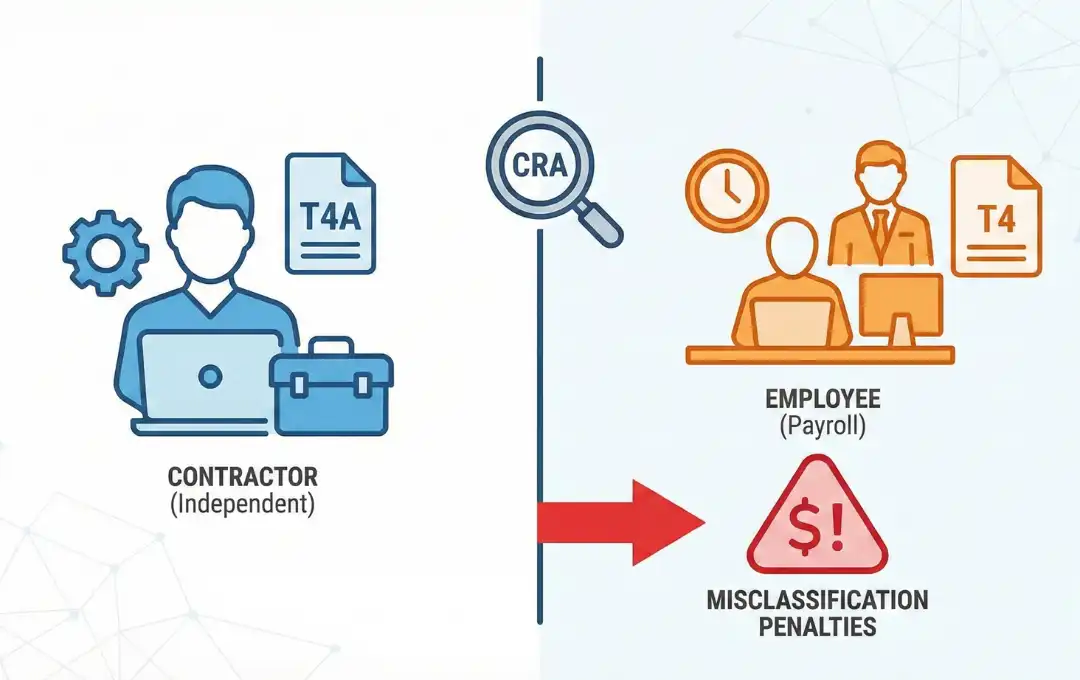
A worker is a CRA contractor rather than an employee when they control how, when, and where the work gets done, supply their own tools, and carry genuine financial risk on the job — not simply because a contract calls them one. If the underlying relationship looks like employment, the CRA will tax it as employment, regardless of what the paperwork says.
This guide explains the CRA's current tests for 2026, the rise of the Personal Services Business (PSB) risk, and the financial penalties Ontario employers face when classification goes wrong.
Consultant vs. Contract Employee: What's the Difference in Ontario?
The CRA does not care about the label on your contract. It cares about the economic reality of the relationship. In 2026, it continues to apply a four-factor common law test — often called the Wiebe Door test — to determine whether someone is genuinely in business for themselves or is, in substance, an employee.
1. Control: Who Is Actually the Boss?
Control is usually the single most heavily weighted factor. If you set a worker's hours, dictate how the work must be performed, require them to be available at a specific location (even virtually), and supervise their daily activities, that relationship looks like employment — regardless of what the contract calls them. A true contractor has autonomy: you care about the deliverable, not the method, and they can set their own schedule and decline specific tasks without consequence.
With remote work now standard across the GTA, "control" in 2026 is less about physical presence and more about digital oversight. If you require a contractor to be logged into Slack from 9 a.m. to 5 p.m., attend daily standups, or seek approval before working on other clients' projects, that pattern of supervision looks like employment to a CRA auditor.
2. Tools and Equipment
Employees typically use equipment supplied by the employer — a laptop, licensed software, office space, or a company vehicle. Contractors bring their own tools and absorb that cost themselves, including any specialized software needed to complete the work. One detail employers frequently miss: if you "reimburse" a contractor for a laptop or software subscription, the CRA treats that as you having provided the tool, which weakens the contractor classification even though no equipment physically changed hands.
3. Chance of Profit and Risk of Loss
This is the strongest single indicator the CRA looks at. An employee is paid a steady salary or hourly wage regardless of whether the company profits, and they carry no financial risk — they cannot lose money by doing the job. A genuine contractor can increase their profit by working efficiently, negotiating rates, or subcontracting parts of the work, but can also lose money if they underquote a project, if equipment fails, or if a client disputes an invoice. A worker who is paid a fixed amount every two weeks with no invoice and no possibility of financial loss looks, functionally, like a salaried employee.
4. Integration Into the Business
If a worker's function is integral to your core business — for example, a full-time driver for a logistics company or a permanent front-desk staffer for a clinic — that points toward employment. Work that is ancillary, project-based, or specialized, such as an IT consultant fixing a server for that same logistics company, points toward a genuine contractor relationship.
The Personal Services Business (PSB) Trap
This is the sharpest risk for 2026, particularly for IT professionals, truck drivers, and consultants who have incorporated.
Many companies ask contractors to incorporate as a way to "protect" themselves from misclassification liability. However, if that incorporated worker would look like an employee once you set the corporate structure aside — same control, same tools, same lack of financial risk — the CRA can designate the corporation a Personal Services Business (PSB) under the Income Tax Act.
The practical effect of a PSB designation is severe. The worker's corporation loses almost all standard business deductions, including expenses for vehicles, meals, and home offices, and its income is taxed at a punitive combined federal-provincial rate that can exceed 44%, since it no longer qualifies for the small business deduction. For the paying business, the tax exposure falls primarily on the worker's corporation, but a PSB ruling frequently triggers a broader CRA review of your other contractor relationships, exposing you to reclassification risk across your entire workforce rather than a single file.
What Are the Misclassification Penalties in Canada?
If the CRA rules that your "contractors" are, in substance, employees, the consequences are retroactive and can be severe enough to threaten a small business. This is not a warning letter — it is a bill.
Businesses that misclassify employees as contractors in Ontario can be held liable for 100% of the unremitted CPP and EI premiums for both the employer and employee share, plus penalties of 10-20% of the amount owing, daily compounding interest, and back-pay for vacation, overtime, and termination entitlements under the Employment Standards Act, 2000.
Unpaid CPP and EI Premiums
Under the Canada Pension Plan and Employment Insurance Act, you are liable for both the employer and employee portions of CPP and EI premiums that should have been deducted. You cannot go back to the worker and recover their share after the fact — the full cost lands on the business, typically covering the last two to three years of the relationship, or longer if the CRA suspects deliberate misclassification.
Unwithheld Income Tax
If a misclassified worker did not remit their own income tax — common among gig and contract workers who assume their "contractor" status means the business is handling deductions — the CRA can pursue the business for the income tax that should have been withheld from every paycheque.
Penalties and Interest
On top of the unpaid amounts, the CRA applies a penalty of 10% of the total you failed to deduct, rising to 20% for a second failure within the same calendar year, plus daily compounding interest calculated from the original due date. On a worker earning $70,000 annually over three years, this can realistically total tens of thousands of dollars once penalties and interest are included — which is where the "$50,000 mistake" framing for a single misclassified worker comes from in practice. If a reassessment reaches this scale, it is usually the point at which employers should understand when it's time to call a tax lawyer rather than negotiate the audit alone.
Employment Standards Act Liability
The Ontario Ministry of Labour, Immigration, Training and Skills Development can add a second layer of liability under the Employment Standards Act, 2000. If a worker is found to have been an employee all along, they were entitled to statutory minimums including vacation pay of at least 4% of wages, public holiday pay, overtime pay for hours beyond 44 per week, and termination pay on top of any CRA reassessment. For a single long-term worker, this can mean tens of thousands of dollars in back-pay stacked on top of the tax liability.
How a Brampton Business Lawyer Can Help
Getting worker classification right is not just a bookkeeping exercise — it requires reviewing how a contractor relationship actually functions day to day and structuring the contract, invoicing practices, and level of control to match. Our Business & Tax Law team regularly reviews contractor agreements for GTA businesses, flags PSB risk before the CRA does, and helps employers restructure relationships that have drifted toward employment without anyone intending it to happen.
2026 Action Plan for Ontario Employers
You cannot afford to be passive about this. Take these steps to reduce audit risk before the CRA reviews your workforce.
Start by reviewing how much day-to-day control you exercise over each contractor. Stop micromanaging schedules and daily tasks, and shift your oversight to deliverables and deadlines rather than "hours in the seat" — this single change addresses the factor the CRA weighs most heavily. Next, check your invoicing practices: contractors earning more than $30,000 annually should be registered for GST/HST and submitting proper invoices with their registration number, since paying a fixed, salary-like amount every two weeks with no invoice is one of the clearest red flags in a CRA audit. Your contracts should also explicitly permit the contractor to subcontract or hire help to complete the work, since an employee must perform work personally while a genuine business can delegate it. Finally, make sure you are issuing T4A slips for all contractor fees paid — failing to file them is a penalty in its own right and is often what alerts the CRA to a relationship in the first place. For a fuller breakdown of what the CRA expects businesses to retain and for how long, see our overview of CRA record-keeping requirements for Ontario businesses.
If you are building or revising contractor agreements from scratch, it's worth reviewing our guide to safely hiring contractors in Brampton in 2026, which walks through the contract language that supports a genuine contractor classification.
Frequently Asked Questions
What is the difference between a consultant and a contract employee in Ontario?
A consultant is genuinely self-employed: they control how the work is done, use their own tools, invoice for their services, and carry real financial risk[cite: 4]. A "contract employee" is a misleading term — under Ontario and federal law, a worker is legally either an employee or an independent contractor based on the substance of the relationship, not a hybrid label used in a contract[cite: 4].
What are the misclassification penalties in Canada if the CRA reclassifies a contractor as an employee?
The business becomes liable for 100% of the unremitted CPP and EI premiums, penalties of 10-20% of the amount owing, daily compounding interest, and any unwithheld income tax, typically going back two to three years[cite: 4]. Ontario employers may also face separate Employment Standards Act liability for vacation pay, overtime, and termination pay[cite: 4].
Does having a signed independent contractor agreement protect my business from a CRA reassessment?
No[cite: 4]. The CRA looks at how the relationship actually functions — control, tools, financial risk, and integration — not the label used in the contract[cite: 4]. A well-drafted agreement helps, but only if the day-to-day relationship genuinely matches what the contract describes[cite: 4].
What is a Personal Services Business (PSB) and why does it matter?
A PSB is an incorporated worker whom the CRA determines would be an employee if the corporation were disregarded[cite: 4]. The worker's corporation loses most business deductions and faces a combined tax rate that can exceed 44%, and a PSB finding often triggers a wider CRA review of the paying business's other contractor relationships[cite: 4].
How far back can the CRA go when reassessing worker classification?
The CRA typically reassesses the previous two to three tax years, but this period can extend further if the CRA determines the misclassification was deliberate or involved misrepresentation, which removes the normal reassessment time limit[cite: 4].
Who should be worried about contractor misclassification risk in 2026?
Any Ontario business that pays individuals as contractors on a recurring basis — particularly in IT, construction, trucking, consulting, and the gig economy — should review its classifications, since these are the sectors the CRA and ESDC have specifically flagged in their expanded information-sharing initiatives[cite: 4].
Final Takeaway: Clarity Is Your Best Defence
In 2026, the grey area around worker classification in Ontario is shrinking. The CRA is using data matching and coordinated audits with ESDC to find misclassified workers, and the financial cost of getting it wrong — payroll tax liability, penalties, interest, and Employment Standards Act back-pay — can be enough to threaten a small business.
Don't wait for a CRA auditor to tell you who your employees are. Book a free consultation with GS Arora Law to have your contractor agreements and working relationships reviewed before they become a liability.
Disclaimer: The information provided in this blog is for general informational purposes only and should not be considered legal, tax, financial, or professional advice. Regulations and procedures may change over time and vary by jurisdiction. For guidance tailored to your specific situation, please consult a qualified professional.