
The Ironclad Lease: 7 Key Clauses Every Ontario Landlord Needs in 2026
Book Consultation Book Consultation
07
FebThe Ironclad Lease: 7 Key Clauses Every Ontario Landlord Needs in 2026
Introduction: The Standard Lease Is Just the Skeleton
In Ontario, using the Standard Form of Lease (Form 2229E) is mandatory for most residential tenancies. If you are a landlord and you hand a tenant a generic “office store” lease instead, your tenant can legally withhold one month’s rent until you provide the proper Standard Lease. That alone should tell you how seriously Ontario law treats this document.
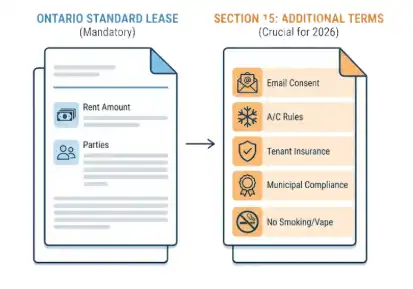
The problem is that the Standard Lease is intentionally bare-bones. It covers the basics — rent amount, names, address — but leaves massive gaps around day-to-day conflicts: air conditioning, insurance, communication, overcrowding, and payment methods. Those gaps become expensive disputes.
The only place to fix this is Section 15: Additional Terms. This is where landlords can add custom, enforceable rules — provided they do not violate the Residential Tenancies Act (RTA). In 2026, with mortgages exceeding $1.5M, strict renoviction penalties, and aggressive municipal enforcement in Brampton and Mississauga, getting Section 15 right is not optional.
Here are the 7 essential lease clauses every Ontario landlord must include in every new tenancy agreement in 2026.
Why Section 15 Is Your Only Real Protection
The Standard Lease protects the tenant. Section 15 protects the landlord.
Most landlords download the Standard Lease, fill in the rent amount, sign it, and consider the job done. That is a mistake that surfaces the first time a tenant smokes cannabis on the balcony, floods the unit below without insurance, or installs a window AC unit that falls three stories. None of those situations are addressed in the Standard Lease. All of them can be addressed in Section 15 — if you draft it correctly.
One important limitation: you cannot add Section 15 clauses to an existing tenancy unilaterally. These clauses only take effect when both parties sign a new agreement. If your current leases are missing these protections, include them in every new tenancy from this point forward.
7 Essential Lease Clauses for Ontario Landlords in 2026
1. The “Speed Dial” Clause — Consent to Service by Email
The new rules in 2026 allow landlords to serve a 7-day N4 Notice for non-payment of rent. That speed advantage disappears entirely if you serve by mail, which legally requires adding 5 additional days for deemed delivery — turning your 7-day notice into a 12-day process.
The fix is a written consent to email service in Section 15:
“The Tenant consents to the service of all notices and documents, including Notices of Termination (N4, N12) and LTB applications, via email at the address provided: [Tenant Email]. The Tenant agrees to check this email regularly and notify the Landlord immediately of any changes to their email address.”
Also check “Yes” to email communication in the Standard Lease itself. With both in place, a notice sent at 11:59 PM is legally served that moment — not five business days later.
2. The Air Conditioning Clause
Following the implementation of Bill 97 and subsequent 2025 regulations, tenants have a statutory right to install window or portable AC units. Landlords cannot unreasonably refuse. What landlords can do is set conditions around safety and cost recovery.
Without a clause, you have no documented basis to prevent a dangerous DIY installation or recover the hydro costs of a unit running continuously from June through September.
Add this to Section 15:
“The Tenant may install a portable or window air conditioning unit only with prior written consent from the Landlord, which shall not be unreasonably withheld. The Tenant agrees to use a professional installation method to prevent safety hazards or structural damage. Where electricity is included in the rent, the Tenant agrees to pay a seasonal electricity surcharge of $[Amount] per month from June to September, based on the estimated usage of the device.”
This protects your window frames, your hydro bill, and your liability exposure — all in one clause.
3. The Tenant Insurance Clause
Tenant insurance is not legally mandatory under the RTA. However, you can make it a mandatory condition of the lease as a material term. In 2026, with liability costs rising sharply, allowing a tenant to occupy your unit without coverage is an unacceptable financial risk.
A tenant who floods the unit below and carries no insurance leaves you — and your neighbours — absorbing the cost.
The clause:
“The Tenant agrees to obtain and maintain a comprehensive tenant liability insurance policy with a minimum coverage of $2,000,000. Proof of insurance (Certificate of Insurance) must be provided to the Landlord prior to key release and annually upon renewal. Failure to maintain this insurance policy is considered a breach of a material term of this tenancy agreement.”
If a tenant lets their policy lapse, the material term breach gives you grounds to issue an N5 Notice for substantial interference. Without the clause, you have no documented basis to act.
4. The Municipal Compliance Clause (Essential for Peel Region Landlords)
If you are renting a basement unit in Brampton or Mississauga, your property is subject to Residential Rental Licensing (RRL) requirements. Passing the required municipal inspections depends partly on conditions inside the unit — conditions only the tenant controls.
Without a lease clause requiring cooperation, a tenant who blocks an egress window with a dresser or stores materials in the stairwell can cause you to fail an inspection and absorb a significant fine, with no documented obligation to pursue.
Add this:
“The Tenant acknowledges that the rental unit is subject to municipal licensing requirements. The Tenant agrees to cooperate fully with all municipal inspections required for the renewal of the Residential Rental Licence, and to maintain the unit in a condition that complies with the Ontario Fire Code and municipal Property Standards bylaws, including keeping all exits and egress windows clear of obstruction at all times.”
This creates a documented breach of the lease if the tenant’s conduct causes an inspection failure — and gives you a defensible position at the LTB. See our guide on the 2026 landlord playbook for Ontario’s new rental rules and Peel Region’s licensing crackdown for the full licensing picture.
5. The Smoke and Vape Prohibition Clause
“No smoking” is standard. In 2026, it is not enough. The smell of cannabis is among the most common causes of “loss of reasonable enjoyment” complaints between neighbours, and without a clause that specifically names cannabis, enforcement becomes a legal argument rather than a clear breach.
Indoor cannabis cultivation is a separate but related problem — humidity from even a small number of plants creates mold damage that costs thousands to remediate.
The clause:
“The entire premises, including the rental unit, balcony, patio, and all common areas, is designated as 100% smoke-free. This prohibition applies to the smoking, vaping, or combustion of tobacco, cannabis, or any other substance. The cultivation of cannabis plants within the unit is strictly prohibited due to the humidity and mould risks associated with such activity.”
Specificity is what makes this enforceable. A clause that says “no smoking” does not, on its face, prohibit cannabis vaping or cultivation. Name everything.
6. The Unauthorized Occupant Clause
The RTA is clear: you cannot restrict a tenant’s guests. A tenant’s partner, friend, or family member can stay every night if the tenant chooses. What you can address is overcrowding — which creates genuine fire code and insurance liability issues.
The clause:
“The rental unit is to be occupied by the persons named in this agreement. Guests are permitted. However, any person who stays at the unit for more than [14] consecutive days without prior written consent from the Landlord may be deemed an unauthorized occupant where their continued presence results in overcrowding contrary to municipal bylaws or insurance capacity limits.”
This is a legally nuanced area — the LTB will scrutinize unauthorized occupant claims carefully — but having a documented clause is far better than having no basis at all when six people are living in a one-bedroom unit.
7. The Rent Payment Method Clause
Ontario law does not allow landlords to require tenants to pay by post-dated cheques or pre-authorized debit. However, landlords can document the agreed payment method in the lease, which eliminates “I didn’t know how you wanted it paid” as a dispute on day one.
The clause:
“The Tenant agrees to pay rent via [e.g., Interac e-Transfer] to [Email Address]. Rent is due on the 1st of each month. Where the Tenant elects to provide post-dated cheques, the Tenant acknowledges this is done voluntarily and for their convenience.”
A clear written record of the payment method and due date removes ambiguity and strengthens your position if rent arrives late and you need to serve an N4.
Summary: Your Lease Is Your Legal Shield
In 2026, a residential lease is not a receipt for a key. It is your primary legal document in every LTB dispute, every insurance claim, and every municipal inspection. A properly drafted Section 15 is the difference between a documented breach you can act on and an unenforceable handshake agreement.
The clauses above address the most common and most expensive landlord-tenant conflicts in Ontario right now. None of them violate the RTA. All of them must be in place before the tenancy begins — they cannot be added unilaterally to an existing agreement.
If you are a landlord in Brampton, Mississauga, or anywhere in Ontario and your current lease template does not include these protections, our real estate law team can draft a custom Section 15 Schedule for your specific property — compliant with the latest 2026 RTA amendments and Peel Region bylaws.
Contact GS Arora Law to review or draft your tenancy agreement before your next tenant moves in.
Disclaimer: The information provided in this blog is for general informational purposes only and should not be considered legal, tax, financial, or professional advice. Regulations and procedures may change over time and vary by jurisdiction. For guidance tailored to your specific situation, please consult a qualified professional.