
What Are the Tax Consequences of Incorporating in Ontario in 2026? SBD and Passive Income Rules Explained
Book Consultation Book Consultation
10
DecWhat Are the Tax Consequences of Incorporating in Ontario in 2026? SBD and Passive Income Rules Explained
Introduction: The 11.2% Advantage vs. the 50% Trap
For business owners in Brampton and across Ontario, the decision to incorporate often comes down to a single number.
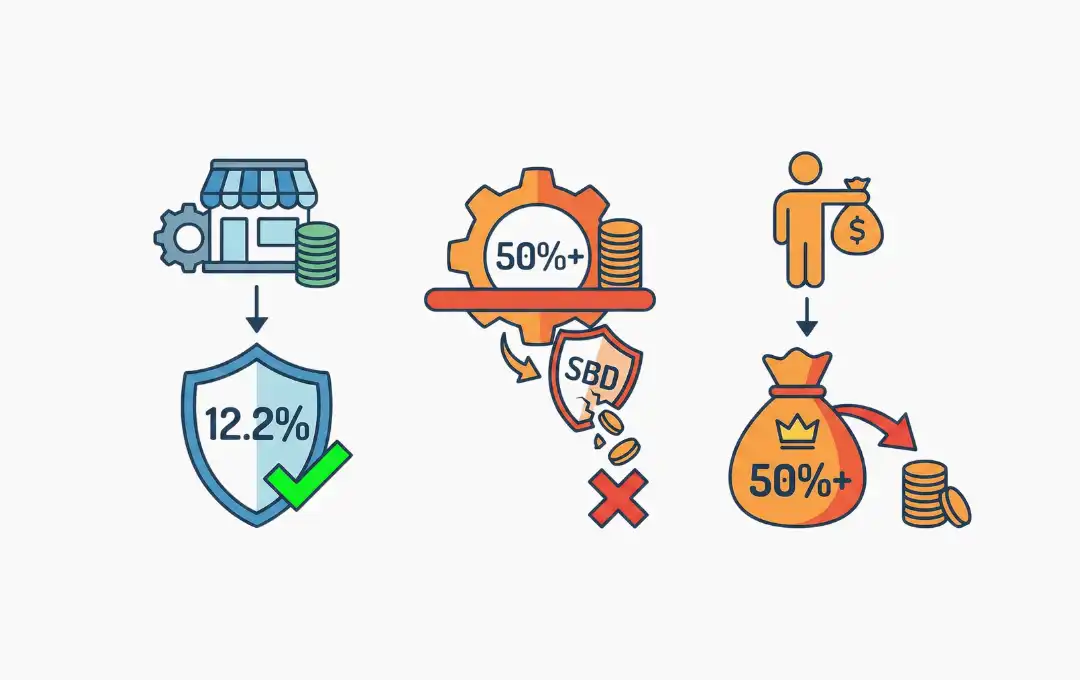
As of July 1, 2026, the combined federal and Ontario small business corporate tax rate dropped to 11.2% — down from 12.2% — on the first $500,000 of active business income. Compared to the top personal marginal tax rate, which exceeds 53% for high earners, incorporating still offers a substantial opportunity to defer tax and reinvest capital in the business.
However, the government maintains strict guardrails to ensure this low rate benefits growing, active businesses — not corporations used purely to shelter personal investment wealth. If you hold significant passive investments inside your corporation, you can trigger the Passive Income Grind, which sharply increases your effective tax rate on active income.
This guide details the tax consequences of incorporating in Ontario for the 2026 tax year, including the mid-year rate cut, the Small Business Deduction, and the passive income rules.
1. The 2026 Ontario Corporate Tax Rates: The Breakdown
When you incorporate, you stop paying personal income tax on business profits and start paying corporate tax — a combination of a federal rate and an Ontario provincial rate.
The Confirmed 2026 Rates
- Federal small business rate: 9% (on the first $500,000 of active business income for a qualifying CCPC)
- Ontario small business rate: 3.2% until June 30, 2026, then 2.2% effective July 1, 2026
- Combined small business rate: 12.2% before July 1, 2026 → 11.2% from July 1, 2026 onward
- General combined rate (income above the limit): 26.5% (15% federal + 11.5% Ontario) — unchanged
The Mid-Year Proration Detail
Because the cut takes effect on July 1 rather than January 1, a corporation with a December 31 fiscal year-end must prorate the two rates across the year. The blended Ontario provincial rate for a full 2026 calendar year works out to approximately 2.7%, giving a blended combined rate of roughly 11.7% for that transition year. The full 11.2% rate applies cleanly starting with fiscal years that begin on or after July 1, 2026.
The Tax Deferral Advantage
The core benefit of incorporating remains the gap between the personal marginal rate (up to roughly 53.5%) and the small business rate.
Example: Your business earns $200,000 in active profit.
- Sole proprietor: You may pay upward of $80,000 in personal tax, depending on your other income.
- Corporation (post-July 2026 rate): You pay approximately $22,400 in corporate tax at the 11.2% rate.
Result: Your corporation retains roughly $57,600 more in immediate cash flow — available to buy equipment, hire staff, or reinvest in the business. You only pay personal tax when you eventually withdraw the money as a dividend, which is when the deferral advantage is realized (or given back, depending on timing).
2. The Small Business Deduction: Use It or Lose It
The reduced small business rate is technically a deduction from the general corporate rate — the Small Business Deduction (SBD).
To Qualify in 2026, Your Corporation Must Be:
- A Canadian-Controlled Private Corporation (CCPC)
- Earning active business income — not passive income from rent, dividends, or investments alone
The Limit
The SBD applies to the first $500,000 of active business income annually. This limit is shared among associated corporations — if you own two companies, you do not get two separate $500,000 limits; the single limit must be split between them according to the rules in the Income Tax Act.
3. The Passive Income Grind: The Trap for Wealthy Corporations
This remains the most critical rule for profitable Ontario corporations in 2026. The federal government wants profits reinvested into active business activity — employees, inventory, equipment — not parked in passive investments like stocks, bonds, or real estate holdings.
If your corporation, together with any associated companies, earns too much passive investment income (interest, dividends, capital gains), your access to the reduced small business rate is reduced.
The Federal “Grind” Formula for 2026
- Threshold: The first $50,000 of passive income annually is safe and has no effect on your SBD.
- The reduction: For every $1 of passive income above $50,000, your Small Business Limit ($500,000) is reduced by $5.
- The elimination point: If your corporation earns $150,000 or more in passive income in a year, your federal Small Business Limit is reduced to $0.
The Consequence
If you hit the elimination point, all of your active business income is taxed at the general combined rate of 26.5% instead of the small business rate — a substantial tax increase on your active business profits, triggered purely by holding too many investments inside the corporation.
The Ontario Exception — A Critical Detail That Still Applies
Unlike the federal government, Ontario has not paralleled this passive income grind for the provincial portion of the Small Business Deduction.
This means that even if your federal limit is ground down to zero because of high passive income, you can still claim the Ontario provincial small business rate — now 2.2% as of July 1, 2026 — on your first $500,000 of active income. This is a meaningful buffer for Ontario CCPCs that hold significant investments, and it becomes slightly more valuable in relative terms now that the federal general rate remains fixed while the Ontario small business rate has dropped further.
Conclusion: Strategic Structure Is Still Mandatory
Incorporating in Ontario in 2026 offers a genuinely improved rate — 11.2% combined, down from 12.2% — but it is not a “set it and forget it” strategy. The rules around associated corporations and passive income mean your corporate structure requires active, ongoing management, not a one-time decision made at incorporation.
If you are approaching the $50,000 passive income threshold, it may be time to consider separate holding companies, individual pension plans (IPPs), or other purification strategies to protect your access to the reduced small business rate before the grind erodes it.
If you are incorporating a new business or restructuring an existing corporation to manage the passive income rules, contact GS Arora Law to speak with our business law team. We recommend pairing this legal review with your accountant’s input on your specific numbers.
Disclaimer: The information provided in this blog is for general informational purposes only and should not be considered legal, tax, financial, or professional advice. Tax rates and rules referenced here, including the July 1, 2026 Ontario small business rate change, are subject to legislative confirmation and may be adjusted. Regulations and procedures may change over time and vary by jurisdiction. For guidance tailored to your specific situation, please consult a qualified CPA and business lawyer.