
Why Corporate Minute Books Matter in Real Estate Transactions: A Lawyer's Perspective
Book Consultation Book Consultation
22
OctWhy Corporate Minute Books Matter in Real Estate Transactions: A Lawyer's Perspective
Introduction
In Ontario, many small and mid-sized corporations own real estate — from investment properties and commercial units to family-run businesses operating out of their own premises. When these corporations buy, sell, or refinance property, lawyers are routinely asked to act on their behalf. Yet one issue keeps surfacing on file after file: the corporation’s minute book is missing, outdated, or badly incomplete.
Some clients — and, occasionally, even some lawyers — treat the corporate minute book as a formality. When a real estate transaction is involved, that “formality” can become an outright deal-breaker. This guide explains why an up-to-date minute book is legally essential, what risks arise when it’s neglected, and how a business lawyer in Brampton ensures your corporation stays compliant and genuinely ready to transact when opportunity arrives.
What Is a Corporate Minute Book?
A corporate minute book is the official legal record of a corporation’s existence and internal governance. It contains all the key documents that prove the company’s legal status, ownership structure, and authority to act.
A complete minute book typically includes:
- Articles of Incorporation and any subsequent Articles of Amendment
- Corporate bylaws governing how the company operates internally
- Minutes of directors’ and shareholders’ meetings, documenting every significant corporate decision
- Directors’ and shareholders’ resolutions, including those authorizing major transactions like a property purchase or sale
- The share register, recording who owns what percentage of the corporation and when those shares were issued or transferred
- Share certificates issued to each shareholder
- Registers of directors and officers, current and historical
- Annual return filings confirming the corporation remains in good standing with the province or federal government
Essentially, the minute book is the legal DNA of the corporation. Without it, there is no verified, documented proof of who actually owns or controls the company — which becomes a serious problem the moment that company needs to sign a real estate transaction.
Why Real Estate Lawyers Care About Minute Books
When a corporation buys or sells property, the real estate lawyer must confirm two things: that the entity signing the agreement is properly and currently incorporated, and that the specific individual signing on its behalf actually has legal authority to bind the corporation to that agreement.
If the minute book is incomplete, missing, or badly outdated, the lawyer cannot confidently issue a solicitor’s opinion or complete the transaction without meaningful risk. Here’s why this matters in practice:
- Verifying signing authority: without a current directors’ resolution or an up-to-date bylaw provision naming who can sign on the corporation’s behalf, a lawyer has no reliable way to confirm the person in front of them can actually bind the company.
- Confirming the shares are properly issued: if a corporation is selling shares as part of a transaction (rather than the underlying real estate itself), the share register must accurately reflect who owns what — you cannot legally sell shares no one can prove you own.
- Protecting the lender: mortgage lenders require confirmation of proper corporate authority before releasing funds, and a lawyer who cannot verify this puts the entire financing at risk of collapsing at the last moment.
- Avoiding a later challenge to the transaction’s validity: if it later emerges that the signing individual never had actual authority, the transaction itself could be challenged by other shareholders or directors who never approved it.
Simply put, no prudent business lawyer in Brampton, or anywhere in Ontario, will act for a corporate client on a real estate transaction without first confirming minute book compliance.
The Real Estate Lawyer’s Perspective: A Matter of Liability
Many experienced real estate lawyers view this as fundamentally a “cover your authority” issue. If a lawyer completes a transaction without confirming corporate authority, and it later emerges that the person who signed lacked the legal authorization to do so, the lawyer themselves can face a professional negligence claim.
As one lawyer put it plainly: how else would you actually know who has authority to sign, if not through the bylaws, resolutions, and government filings that document it?
Even when some clients find these requirements excessive or bureaucratic, the reality is that lawyers are bound by their professional obligations under the Law Society of Ontario’s Rules of Professional Conduct to verify the legal capacity and authority of every client before acting on their behalf. Proceeding without this documentation isn’t simply cautious practice — it’s a genuine ethical obligation the lawyer cannot skip.
The Risks of Skipping Corporate Compliance
When a corporation operates without an updated minute book, several serious risks can surface, often at the worst possible moment:
- Transaction delays or complete collapse: a deal can stall for weeks while a lawyer scrambles to reconstruct missing corporate records, sometimes causing the corporation to miss a firm closing date entirely.
- Inability to prove clear title to shares: in a share sale, you cannot legally transfer ownership you cannot document, which can derail an otherwise-agreed transaction at the final stage.
- Lender financing falling through: a lender who cannot get comfortable with the corporation’s authority to sign will simply decline to release mortgage funds, regardless of how strong the deal otherwise is.
- Personal liability exposure for directors: where corporate formalities have not been maintained, courts have in some circumstances been willing to “pierce the corporate veil,” exposing directors personally to liabilities that incorporation was meant to shield them from.
- CRA and regulatory complications: a poorly maintained minute book can also create complications in tax filings and other regulatory matters tied to corporate structure.
Why Many Corporations Neglect Their Minute Books
Small businesses and family-run corporations often incorporate specifically to gain tax benefits and limited liability protection, but never revisit their corporate records again afterward. Common reasons this happens include:
- The initial incorporation was handled by a low-cost online service that provided the Articles of Incorporation but no ongoing minute book maintenance
- Directors assume their accountant is tracking this, when in fact accountants generally focus on tax filings, not corporate governance documentation
- No transaction has required it yet, so the gap in records simply goes unnoticed year after year until one finally does
- Turnover in legal counsel over the years, with no single lawyer taking ownership of ensuring the minute book stays current after the initial incorporation
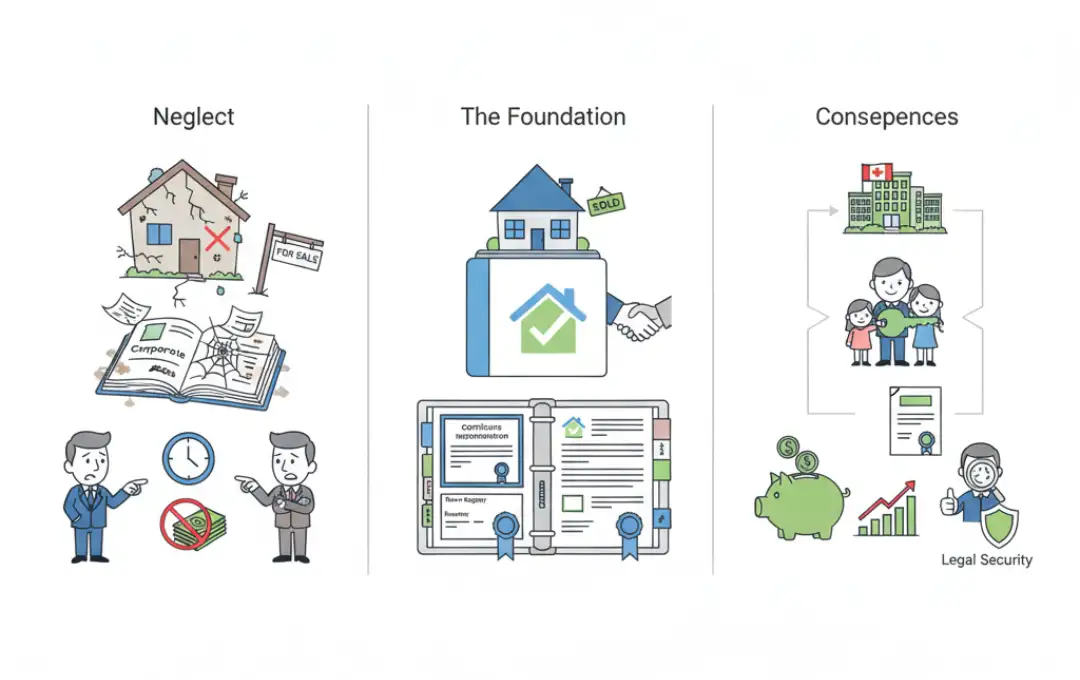
Over time, this neglect compounds into a genuinely bigger problem — especially when a sale, refinancing, or partnership opportunity suddenly arises. The missing documentation can delay or derail a deal that otherwise would have closed smoothly.
The Lawyer’s Role: Preventing Problems Before They Start
A diligent business lawyer in Brampton doesn’t just help clients react to compliance issues once they surface — they work to prevent them from arising in the first place. This typically includes:
- Conducting a minute book review as a standard part of onboarding any corporate client, well before a transaction is on the horizon
- Reconstructing missing records where gaps exist, drafting the resolutions and documentation that should have been created historically
- Maintaining the minute book on an ongoing basis, ensuring annual resolutions, director changes, and other corporate updates are documented as they happen rather than reconstructed later
- Flagging compliance gaps proactively well before a real estate transaction or sale is on the table, so the corporation isn’t scrambling under a closing deadline
The Client’s Perspective: “Why Should I Care?”
From a client’s standpoint, insisting on minute book compliance can initially feel like excessive caution from a lawyer. But the minute book is not a technicality — it is the actual proof that your corporation legally exists, legitimately owns its assets, and can properly act through its directors.
Without a properly maintained minute book, you may find you’re unable to:
- Close a real estate purchase or sale on your intended timeline
- Secure mortgage financing for a corporate-owned property
- Sell shares in the corporation to a buyer, investor, or family member
- Demonstrate clean corporate governance during a due diligence review, whether for a sale of the business or an unrelated financing transaction
In short, your corporation is only as credible, in a legal and financial sense, as its records actually are.
How a Business Lawyer in Brampton Can Help
For corporations buying or selling real estate, a business lawyer in Brampton can make the entire process considerably smoother by:
- Reviewing your existing minute book and identifying exactly what’s missing or outdated before it becomes an obstacle
- Drafting the required resolutions authorizing a specific transaction, ensuring signing authority is documented cleanly and correctly
- Reconstructing historical records where gaps exist, bringing the corporation’s compliance fully up to date
- Establishing an ongoing maintenance process so the minute book stays current after the immediate transaction closes, rather than falling back into neglect
This not only ensures the transaction proceeds without delay, but also protects the corporation from future legal disputes, financing complications, or tax-related issues tied to unclear corporate governance.
Final Takeaway
When a corporation buys or sells property, its minute book is not optional paperwork — it is the foundation of its legal authority to act at all. Proceeding without verifying corporate records is, in practical terms, like buying real estate without ever checking the title.
Lawyers who insist on an up-to-date minute book aren’t being difficult for the sake of it — they are protecting both their clients and themselves from real, foreseeable risk. Clients who maintain proper corporate records are rewarded with faster transactions, stronger legal standing, and considerably fewer surprises at the worst possible moment.
Whether you operate a single investment property or a growing franchise network, keeping your minute book current is a small, ongoing step that prevents genuinely large problems later. Working with an experienced business lawyer in Brampton ensures your records, resolutions, and filings stay in order — so when opportunity knocks, your company is ready to sign confidently and legally.
If your corporation’s minute book needs review or reconstruction before a transaction, contact GS Arora Law to speak with our business law team.
Disclaimer: The information provided in this blog is for general informational purposes only and should not be considered legal, tax, financial, or professional advice. Regulations and procedures may change over time and vary by jurisdiction. For guidance tailored to your specific situation, please consult a qualified professional.