23
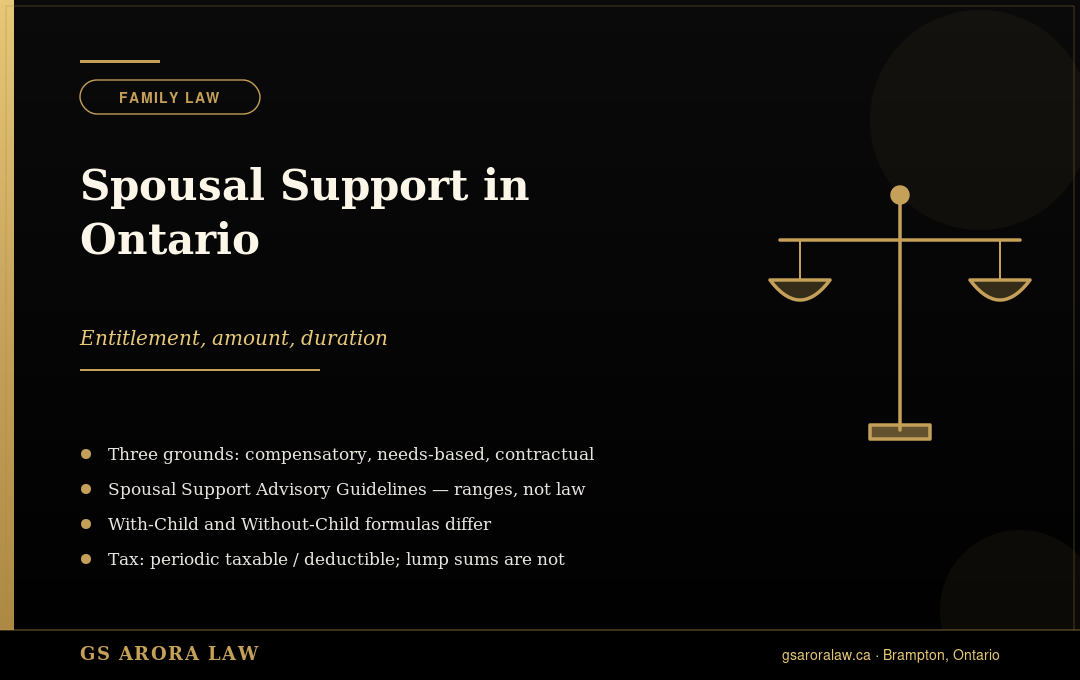
MaySpousal Support in Ontario: Entitlement, Amount, and Duration
If child support is the most mechanical part of family law in Ontario, spousal support is one of the most discretionary. Two cases that look similar on paper — same length of marriage, same income gap, same number of children — can produce different outcomes depending on the role each spouse played in the relationship, what they gave up, and what their post-separation circumstances actually are. The Spousal Support Advisory Guidelines bring some structure to the analysis, but they are not law — they are a tool the court uses, not a table the court is bound by.
This guide explains how spousal support works in Ontario in 2026, the three grounds for entitlement, how the SSAG calculates a range, how duration is determined, and the situations where the answer is no support at all.
Two statutes, similar results
Like child support, spousal support claims in Ontario flow from one of two statutes:
- The federal Divorce Act, for married spouses who are separating with a divorce in view.
- The Ontario Family Law Act, for unmarried spouses (after a qualifying period of cohabitation) and married spouses not seeking a divorce.
Both statutes use similar tests and both rely on the SSAG as the starting point for amount and duration. The principal differences relate to who counts as a "spouse" and the rare cases where the legislative purposes diverge.
For unmarried partners, eligibility under the Family Law Act requires either continuous cohabitation in a "spouse"-equivalent relationship for at least three years, or cohabitation in a relationship of some permanence with a child of the relationship. Without one of these, the Family Law Act spousal support regime does not apply.
Step 1: entitlement, before amount
A common misunderstanding: spousal support is not automatic just because there is an income difference. The first question is entitlement — is this spouse entitled to support at all? Three grounds support an entitlement claim:
- Compensatory entitlement is rooted in the role the spouse played during the marriage. A spouse who left or scaled back work to raise children, who relocated for the other spouse's career, who supported the other through professional training, or who lost economic opportunities because of the partnership is compensated for those decisions. The leading Supreme Court of Canada decision is Moge v. Moge.
- Non-compensatory (needs-based) entitlement is rooted in the spouses' actual financial circumstances at separation. Where one spouse has a real economic need and the other has the means to assist, support may be ordered even where there is no compensatory basis. Bracklow v. Bracklow is the leading authority.
- Contractual entitlement flows from a marriage contract, cohabitation agreement, or separation agreement that creates the right to support.
Most Ontario spousal support cases involve a mix of compensatory and non-compensatory grounds. Identifying which grounds are in play matters because they often pull in different directions on amount and duration.
Step 2: the Spousal Support Advisory Guidelines
Once entitlement is established, the next question is amount. The Spousal Support Advisory Guidelines provide ranges of monthly support based on each spouse's income, the length of the relationship, and the presence (or absence) of children.
The SSAG has two formulas:
- The "Without Child Support" formula applies where there is no concurrent child support obligation. The amount is a percentage of the income difference, scaled by the years of cohabitation (with marriage years and pre-marriage cohabitation typically counted together).
- The "With Child Support" formula applies where there is a concurrent child support obligation. The math is more complex — it works from each spouse's individual net disposable income (INDI) and produces a range that reflects the family's total economic picture, taking into account taxes, government benefits, and child support flows.
For each formula, the SSAG produces a low, mid, and high range. Where in the range a particular case falls depends on the strength of the entitlement, the spouses' circumstances, the recipient's needs, and whether the recipient is making efforts toward self-sufficiency.
The SSAG is advisory only. Courts can — and sometimes do — order amounts outside the range, with reasons. But in practice, the Court of Appeal for Ontario has signalled that judges should explain departures from the SSAG, and most awards now fall inside the range.
Step 3: duration
The "Without Child Support" formula sets a duration range, typically expressed as a band of years pegged to the length of the relationship. Long marriages of twenty years or more often produce indefinite (but reviewable) support; medium-length marriages produce time-limited support roughly proportional to the length of cohabitation; short relationships produce short-duration support if any.
The "With Child Support" formula is more nuanced because the receiving spouse's economic picture changes as children become independent. Duration ranges in the With Child formula are anchored to either the length of the marriage or the age of the youngest child reaching majority — whichever produces the longer duration in compensatory cases.
A "rule of 65" applies in the SSAG: where the recipient's age plus the length of the relationship is sixty-five or more, indefinite support is more likely to be appropriate.
Spousal support can be reviewed, varied, or terminated
Unlike a property equalization payment, which is final, a spousal support order is generally subject to review and variation under section 17 of the Divorce Act and section 37 of the Family Law Act. The most common triggers for variation:
- A material change in either spouse's income.
- A change in employment circumstances (retirement, disability, job loss).
- The recipient's failure to make reasonable efforts toward self-sufficiency, where compensatory entitlement is exhausted.
- The recipient's remarriage or new cohabitation, which may reduce or terminate need-based support.
Indefinite support is not the same as permanent support. "Indefinite" means the order does not specify an end date — it does not mean the order cannot be varied or terminated when circumstances warrant. Many indefinite orders are eventually varied or terminated.
Lump sum vs periodic support
Spousal support is most often paid as periodic monthly amounts. In some cases, however, a lump sum is preferred. Lump-sum orders are appropriate when:
- The payor is not creditworthy or is likely to be a difficult payor.
- The parties want a clean break.
- The payor has substantial assets but unstable cash flow.
- A lump sum can be funded from existing equalization or asset division.
The tax treatment of a lump sum is fundamentally different from periodic support. Periodic spousal support is taxable in the recipient's hands and deductible by the payor under sections 56 and 60 of the Income Tax Act. A lump sum is generally neither — it does not come with the income tax consequences of monthly payments. The negotiation of a lump-sum amount has to factor in the tax difference, or the payor effectively pays significantly more than the periodic equivalent.
Where the answer is no support
There are real cases where the right answer in Ontario is no spousal support, even with an income difference:
- Short-duration relationships without children, where there is no compensatory basis and the lower-earning spouse has employment and self-sufficiency.
- Cases where both spouses have similar earning capacities and the gap at separation reflects temporary circumstances.
- Cases where a domestic contract validly waives spousal support — though courts will not enforce such a waiver if it would produce a result inconsistent with the underlying purposes of the support regime in Miglin v. Miglin.
A "no support" outcome is uncommon in mid-to-long marriages, but it happens. The fact pattern matters.
How a Brampton family lawyer fits in
Spousal support in Ontario is where the case-specific analysis matters most. Two spouses negotiating without legal advice often miss the entitlement step entirely, miscalculate the SSAG, or settle on a number that does not account for tax. If you are dealing with spousal support — paying or receiving — in Brampton or the GTA, book a free consultation with GS Arora Law.
————————————————————
This article is general legal information about Ontario and Canadian family law in 2026 and is not legal advice. For advice on your specific situation, speak with a lawyer.
GS Arora, Lawyer & Notary Public. Brampton, Ontario.