
The 2026 Guide to Legalizing Your Brampton Basement Apartment: Requirements, Zoning, and Safety
Book Consultation Book Consultation
29
DecThe 2026 Guide to Legalizing Your Brampton Basement Apartment: Requirements, Zoning, and Safety
Introduction
In 2025, the Brampton real estate market continues to face intense pressure. Homeowners are looking for ways to offset high mortgage rates, and renters are desperate for affordable housing inventory. The solution for many is right downstairs: the basement apartment.
However, the "wild west" days of throwing a kitchenette into a basement and renting it out for cash are over. The City of Brampton, backed by provincial mandates, is heavily focused on increasing housing stock safely. While Ontario legislation now broadly permits up to three units on most residential lots "as-of-right" (e.g., main house + basement unit + garden suite), the municipal implementation of these rules is strict.
For Brampton homeowners in 2025, the path to rental income must go through City Hall. Operating an illegal unit carries immense risks, from massive fines and insurance cancellation to civil liability if a tenant is injured.
This guide breaks down the current legal, zoning, and safety requirements for establishing a legal secondary suite (now often referred to as an Additional Residential Unit or ARU) in Brampton.
Phase 1: The Prerequisites (Zoning and Feasibility)
Before hiring a contractor, you must determine if your property can physically and legally support a second unit according to Brampton’s specific bylaws.
1. "As-of-Right" but Not "As-of-Anything"
Thanks to recent provincial changes (Bill 23), most detached, semi-detached, and townhouse properties in Brampton are permitted to have a secondary suite without a difficult rezoning application. However, this is subject to specific criteria:
- Location: The unit must be secondary to the main dwelling.
- Floodplains: If your property is in a designated floodplain (regulated by the Toronto and Region Conservation Authority or Credit Valley Conservation), you may be completely barred from having a basement apartment due to flood risk. This is a critical first check.
2. The Brampton Parking Crunch
Parking is often the biggest hurdle for Brampton homeowners. The city has strict rules to prevent streets from becoming overcrowded car parks.
- The Requirement: You generally must provide one dedicated off-street parking space for the secondary unit, in addition to the parking required for the main house.
- Tandem Parking: Brampton usually allows "tandem parking" (one car parked behind another in a single driveway lane) to fulfill this requirement.
- Driveway Width: You cannot simply pave your entire front lawn to create space. You must adhere to zoning bylaws regarding maximum driveway width and soft landscaping percentages. Driveway widening requires its own permit process.
3. Unit Size and Configuration
The secondary unit must be smaller than the main dwelling unit. It generally cannot exceed a certain percentage of the total gross floor area of the house (often around 45%, though this can vary based on specific zoning definitions).
Phase 2: The Ontario Building Code (OBC) and Fire Safety
Once zoning is cleared, the focus shifts to the physical structure. Whether you are building new or retrofitting an existing illegal unit, it must meet the current Ontario Building Code or the Fire Code (for retrofits).
Note: These requirements are complex. Professional architectural drawings are almost always required.
1. Fire Separation (The "Firewall")
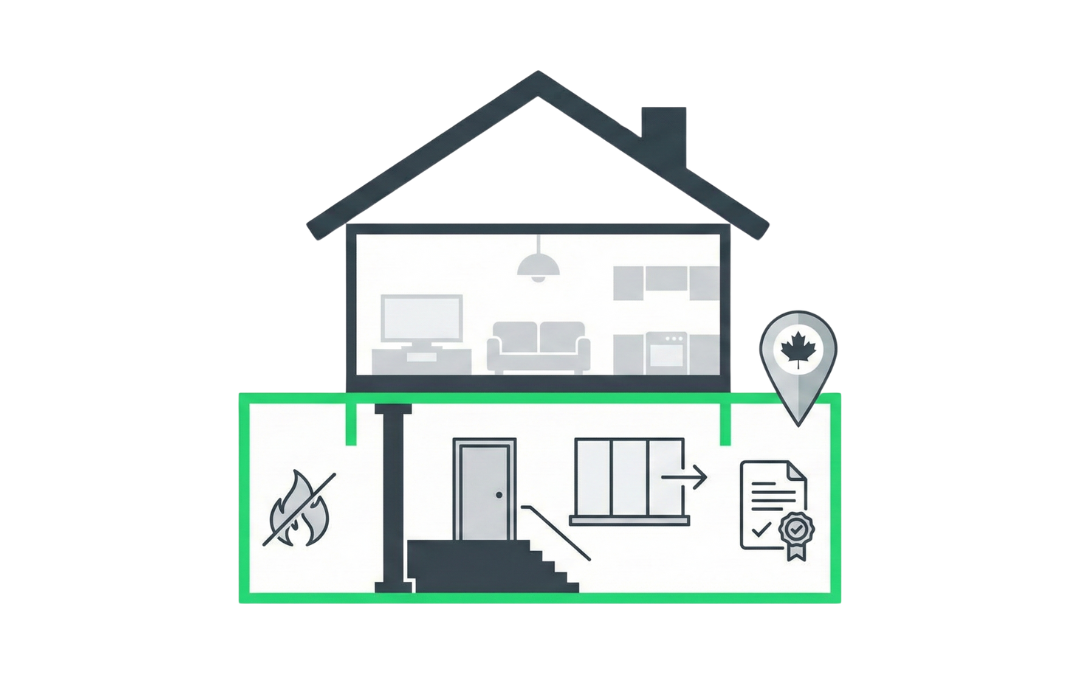
This is the most critical safety element. There must be a continuous fire separation between the basement unit and the upstairs unit.
- This typically involves specific types and thicknesses of drywall (e.g., Type X gypsum board) on ceilings and walls separating the units.
- Any doors connecting the basement to the upstairs (like a door at the top of the stairs) must be a rated fire door with a self-closing device.
2. Safe Egress (Getting Out Alive)
The basement unit must have a safe way out in an emergency.
- Primary Exit: Usually a separate, dedicated entrance door leading directly outside.
- Secondary Exit (Egress Window): Bedrooms generally require windows large enough for an adult to crawl out of during a fire. If the window is below grade, it requires a window well with specific dimensions to allow escape.
3. Ceiling Height
This is a common dealbreaker for older Brampton bungalows.
- Generally, you need a continuous ceiling height of at least 6’5” (1.95m) over the required floor area.
- Be careful with bulkheads (ductwork/beams). The space under these can sometimes be lower, but there are strict limits on how low and how much area they can cover.
4. HVAC and Air Quality
You cannot simply share the upstairs furnace ductwork without modification.
- You need fire dampers where ducts pass through the fire separation.
- Often, the easiest solution is a completely separate heating source for the basement (e.g., electric baseboards or a ductless split system) to avoid complex ductwork retrofitting.
- The unit requires its own ventilation system (HRV or ERV fans) in bathrooms and kitchens.
5. Electrical Safety
The Electrical Safety Authority (ESA) is separate from the City. You must have an ESA inspection to ensure the electrical panel can handle the added load of a second kitchen/laundry, and that all wiring is safe. You will likely need a 200-amp panel.
Phase 3: The Registration Process (Making it Official)
In Brampton, building it to code isn't enough. You must complete the Two-Unit Dwelling Registration process.
The 2025 Workflow Steps:
- Professional Drawings: Hire a qualified designer (BCIN holder) or architect to prepare site plans, floor plans, and elevations showing compliance with zoning and code.
- Building Permit Application: Submit drawings to the City of Brampton for review. Pay the permit fees.
- Construction and Inspections: Once the permit is issued, construction begins. You must call for City inspections at various stages (framing, insulation, final).
- ESA Inspection: Obtain the electrical safety certificate.
- Final Registration: Once all building and ESA inspections are passed, the City issues a Certificate of Occupancy and adds the unit to its public registry of legal two-unit dwellings.
Conclusion: The Cost of Cutting Corners
In 2025, the City of Brampton is actively enforcing against illegal units, often driven by neighbour complaints about parking or noise.
The consequences of operating an illegal unit far outweigh the cost of compliance. If caught, you face expensive tickets, orders to rip out kitchens and bathrooms, and, most critically, the denial of insurance coverage in the event of a fire or flood.
Legalizing a basement apartment is a significant construction project requiring time, money, and professional expertise. However, it is the only way to secure a sustainable, insurable, and profitable rental asset in Brampton’s competitive market.
Disclaimer: Laws, bylaws, and building codes are subject to change and interpretation. This blog post is for informational purposes only as of 2025 and does not constitute legal or professional engineering/architectural advice. Always consult with the City of Brampton building department and qualified professionals for your specific project.