
Asset vs. Share Sale in Ontario: Tax Implications for Business Sellers in 2026
Book Consultation Book Consultation
29
NovAsset vs. Share Sale in Ontario: Tax Implications for Business Sellers in 2026
Selling a business in Ontario is the most significant financial transaction most entrepreneurs will make. The gross price on the letter of intent is not what ends up in your bank account — the after-tax amount is. And in Canada, the structural decision made before any negotiation begins — whether you are selling assets or shares — can determine whether you pay a fraction of what a poorly structured sale would cost, or lose a substantial portion of the proceeds to the CRA.
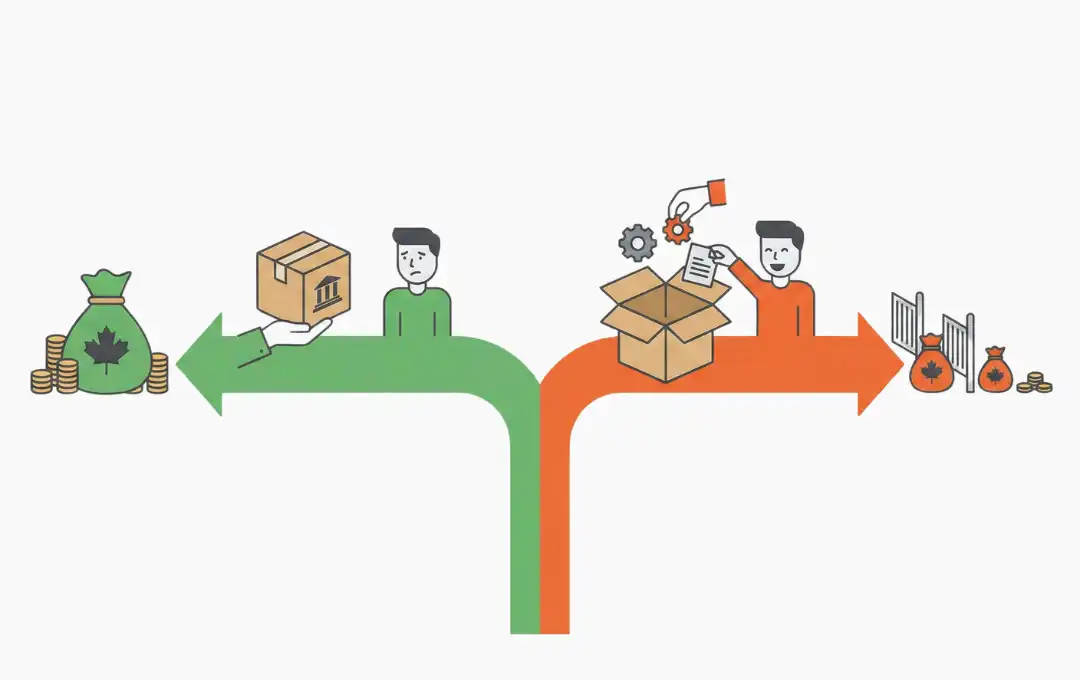
In an Ontario share sale, the seller sells their ownership interest in the corporation — everything the company owns and owes transfers with it. In an asset sale, the corporation sells specific assets to the buyer, and the cash proceeds stay inside the corporate entity. For an eligible seller, a share sale combined with the Lifetime Capital Gains Exemption (LCGE) can result in a dramatically lower tax bill than an asset sale, often by hundreds of thousands of dollars. This is the central tension in every business sale negotiation in Ontario.
This guide explains how each structure is taxed, what the LCGE requires to qualify, and how structure affects the negotiated price.
What Is the Difference Between an Asset Sale and a Share Sale in Ontario?
The difference is what the buyer actually acquires.
In a share sale, the buyer purchases the shares of the corporation from the seller. The corporation itself — with all its assets, contracts, employees, tax history, and liabilities — transfers intact to the new owner. The seller receives cash for their shares and exits the corporation entirely. The buyer owns the “box,” including everything inside it, known and unknown.
In an asset sale, the buyer purchases specific assets from the corporation — equipment, inventory, client lists, intellectual property, goodwill — and leaves the corporate entity itself with the seller. The corporation receives the cash, not the individual shareholder. The seller then faces a second tax event to extract those proceeds from the corporation as dividends or salary. The buyer takes a “clean slate” with no exposure to the corporation’s historical liabilities.
This structural distinction drives most of the tax consequences that follow.
How Is a Share Sale Taxed for Ontario Business Sellers?
When an individual sells shares of a corporation in Canada, the gain — the sale price minus the adjusted cost base of the shares — is a capital gain. Under the Income Tax Act (Canada), capital gains are included in income at the applicable inclusion rate, and the tax is paid personally by the selling shareholder.
The most valuable tax feature available in a share sale is the Lifetime Capital Gains Exemption (LCGE) for Qualified Small Business Corporation Shares (QSBC shares). The LCGE allows an eligible individual to shelter a significant portion of the capital gain from a qualifying share sale entirely from tax. The 2024 federal budget proposed increasing the LCGE limit to $1.25 million for QSBC shares — confirm the current limit with your accountant, as the legislative status of this increase was subject to parliamentary uncertainty as of early 2025.
The potential tax saving from the LCGE is substantial. Without it, capital gains on a share sale are taxed personally at the applicable marginal rate — in Ontario, the combined federal-provincial top marginal rate on capital gains has historically been in the range of 26% on the included portion. With a full LCGE claim, that gain is sheltered entirely. On a $1.25 million gain, the tax saving can exceed $300,000 for a high-income seller, depending on their total income in the year of sale.
Where more than one shareholder holds QSBC shares — a spouse, adult children, or a family trust — each eligible individual can access their own LCGE, multiplying the total tax-free proceeds available from a single sale.
What Are the Rules for Qualifying QSBC Shares for the LCGE?
The LCGE does not apply automatically to every share sale. The corporation’s shares must qualify as Qualified Small Business Corporation (QSBC) shares under the Income Tax Act, and the qualification tests require advance planning — typically two or more years before the sale.
The 24-month holding period test. The shares being sold must have been owned by the selling individual (or a related person) for at least 24 months immediately before the sale. Shares recently issued or recently acquired do not meet this test.
The 50% active business asset test (during the 24 months). Throughout the 24-month period before the sale, more than 50% of the fair market value of the corporation’s assets must have been used in an active business carried on primarily in Canada. Corporations that have accumulated significant passive investments — cash, publicly traded securities, or rental properties — risk failing this test. Purifying the corporation by removing excess passive assets before the 24-month window begins is a standard pre-sale planning step.
The 90% active business asset test (at the time of sale). At the moment of sale, 90% or more of the corporation’s assets must be used in an active business. This test is stricter than the 50% test and requires that the corporation be substantially free of passive assets at closing. A corporation that holds, for example, a rental property as a passive investment alongside its operating business may fail this test unless the passive asset is removed before closing.
Failing any one of these tests disqualifies the shares from LCGE treatment and converts the gain into fully taxable income at the regular capital gains rate. The two-year planning horizon is the minimum — some corporations require longer to purify. A well-structured shareholder agreement anticipates the QSBC tests by maintaining share structure continuity and limiting passive asset accumulation.
How Is an Asset Sale Taxed for Ontario Business Sellers?
An asset sale generates a more complex and generally less favorable tax result for the seller, primarily because the proceeds flow into the corporation rather than directly to the individual — creating a two-stage tax event.
Stage one: corporate-level tax on asset disposition. When the corporation sells its assets, it pays tax on the gain at the corporate level. Different assets are taxed differently:
Depreciable assets (equipment, machinery) that are sold for more than their undepreciated capital cost (UCC) trigger recapture — the difference between the sale price and the UCC is added back to the corporation’s income and taxed at the full corporate rate under the Capital Cost Allowance (CCA) rules in the Income Tax Act. Recapture is taxed as ordinary income, not capital gains.
Goodwill and non-depreciable capital property generate capital gains within the corporation, taxed at the applicable capital gains inclusion rate. Corporate capital gains are subject to the passive investment income rules, which can result in a higher effective corporate tax rate on investment income than on active business income.
Stage two: personal-level tax on distribution. After the corporation pays corporate tax on the asset sale proceeds, the remaining cash is trapped inside the corporation. Extracting it requires paying it out as a salary (fully taxable at personal rates) or a dividend (taxable at dividend rates, which vary depending on whether the dividend is eligible or non-eligible). This second layer of tax — on top of the corporate tax already paid — is the “double taxation” problem that makes asset sales structurally inferior for most sellers. For a full picture of how corporate taxation works, including the small business deduction and passive income rules, our guide to tax consequences of incorporating in Ontario covers the framework.
Why Do Buyers Prefer Asset Sales and Sellers Prefer Share Sales?
The two structures create directly opposing tax incentives, which is why structure is always a negotiation point in an Ontario business sale.
Buyers prefer asset sales for two reasons: they leave the corporation’s historical liabilities — past tax disputes, pending claims, undeclared employment issues — behind, acquiring only identified assets with known values; and they receive a “step-up” in the tax cost of the acquired assets to the purchase price, which allows them to claim higher Capital Cost Allowance (depreciation) deductions against future income, reducing their future taxes.
Sellers prefer share sales primarily for the LCGE. A seller who qualifies can shelter up to the full LCGE limit from tax entirely — a benefit unavailable in any asset sale structure.
The negotiation consequence: a buyer who agrees to a share sale is accepting higher risk and forgoing the step-up in asset cost base. A rational buyer will offer a lower gross purchase price for shares than for assets, knowing the seller’s after-tax proceeds are still higher. A seller forced into an asset sale — because the buyer refuses to accept historical liability — should negotiate a higher gross price to compensate for the double-tax exposure the structure creates.
Price allocation in an asset sale is a separate negotiation within the negotiation: the buyer wants as much of the price allocated to depreciable assets (to maximize CCA claims) and as little to goodwill as possible; the seller wants the reverse (goodwill generates capital gains, not recapture). The allocation affects both parties’ tax outcomes and should be addressed explicitly in the purchase agreement, with both parties taking independent tax advice.
If a dispute with the CRA arises after the sale — over the LCGE qualification, the recapture calculation, or the price allocation — our guide to when to call a tax lawyer for CRA disputes in Ontario covers the escalation process.
How a Brampton Business Lawyer Fits In
The structural decision between an asset sale and a share sale needs to be made — and planned for — well before a buyer is at the table. LCGE qualification alone requires a minimum two-year runway. Our business law team works with Ontario business owners on corporate restructuring for LCGE eligibility, share purchase agreement drafting, asset purchase negotiations, and the due diligence process that buyers require on share sales. The earlier in the process legal and tax counsel are involved, the more options remain available.
Frequently Asked Questions
What is the difference between an asset sale and a share sale in Ontario?
In a share sale, the buyer purchases the seller’s shares in the corporation — acquiring everything the corporation owns and owes. In an asset sale, the corporation sells specific assets to the buyer and retains the corporate entity. For sellers, the key tax difference is that share sale proceeds are received personally and may qualify for the Lifetime Capital Gains Exemption, while asset sale proceeds flow into the corporation and are subject to corporate tax before they can be extracted personally.
What is the Lifetime Capital Gains Exemption for Ontario business sellers?
The LCGE allows individual shareholders who sell Qualified Small Business Corporation shares to shelter a portion of the capital gain from income tax entirely. The 2024 federal budget proposed a limit of $1.25 million — confirm the current limit with your accountant, as its legislative status was uncertain as of early 2025. The LCGE is not available on asset sales and requires the corporation’s shares to meet strict qualification tests for at least 24 months before the sale.
How do I qualify for the LCGE on a share sale in Ontario?
The shares must meet three tests under the Income Tax Act: the seller must have held the shares for at least 24 months; throughout those 24 months, more than 50% of the corporation’s assets by fair market value must have been used in an active Canadian business; and at the time of sale, 90% or more of the corporation’s assets must be in an active business. Failing any test disqualifies the LCGE. Most corporations require 12 to 24 months of pre-sale planning to meet these conditions.
Why do buyers prefer asset sales in Ontario?
Buyers prefer asset sales because they acquire only identified assets without inheriting the corporation’s historical liabilities — past tax disputes, undisclosed claims, or employment issues. They also receive a step-up in the tax cost of the purchased assets to the purchase price, allowing higher Capital Cost Allowance deductions against future income. Share sales require buyers to accept historical risk, which they typically price into a lower gross offer.
What is double taxation in an Ontario asset sale?
In an asset sale, the corporation pays corporate tax on the asset disposition proceeds. To extract the after-tax cash personally, the shareholder must then receive it as a salary or dividend, which is taxed again at the personal level. The combined corporate and personal tax burden on an asset sale is typically materially higher than the personal capital gains tax on a qualifying share sale — often by hundreds of thousands of dollars on a significant business sale.
How does the capital gains inclusion rate affect Ontario business sales in 2026?
The capital gains inclusion rate — the proportion of a capital gain included in taxable income — determines how much of the gain from a share or asset sale is subject to tax. The 2024 federal budget proposed increasing the inclusion rate from one-half to two-thirds for gains above $250,000. Confirm the current inclusion rate with your accountant before finalizing any sale structure, as the legislative status of this change was subject to parliamentary uncertainty as of early 2025.
Final Takeaway
The structure of an Ontario business sale is not a paperwork detail — it is a decision worth hundreds of thousands of dollars in after-tax proceeds. LCGE qualification requires planning that begins years before a sale, not at the negotiating table. Book a free consultation with GS Arora Law to discuss how your corporate structure aligns with LCGE eligibility and what steps are available before you take your business to market.
Disclaimer: The information provided in this blog is for general informational purposes only and should not be considered legal, tax, financial, or professional advice. Tax laws, including capital gains inclusion rates and LCGE limits, are subject to change and their current status should be confirmed with a qualified accountant or tax lawyer. Regulations and procedures may change over time and vary by jurisdiction. For guidance tailored to your specific situation, please consult a qualified professional.
GS Arora, Lawyer & Notary Public. Brampton, Ontario.