
Brampton Eviction Guide: What to Do When a Tenant Stops Paying Rent in 2026
Book Consultation Book Consultation
05
FebBrampton Eviction Guide: What to Do When a Tenant Stops Paying Rent in 2026
A tenant who stops paying rent is a financial emergency for any Brampton landlord — and in a market where carrying costs remain high, the pressure to act quickly is real. The problem is that quick action, if it is the wrong action, can convert a winnable eviction case into a complaint against you.
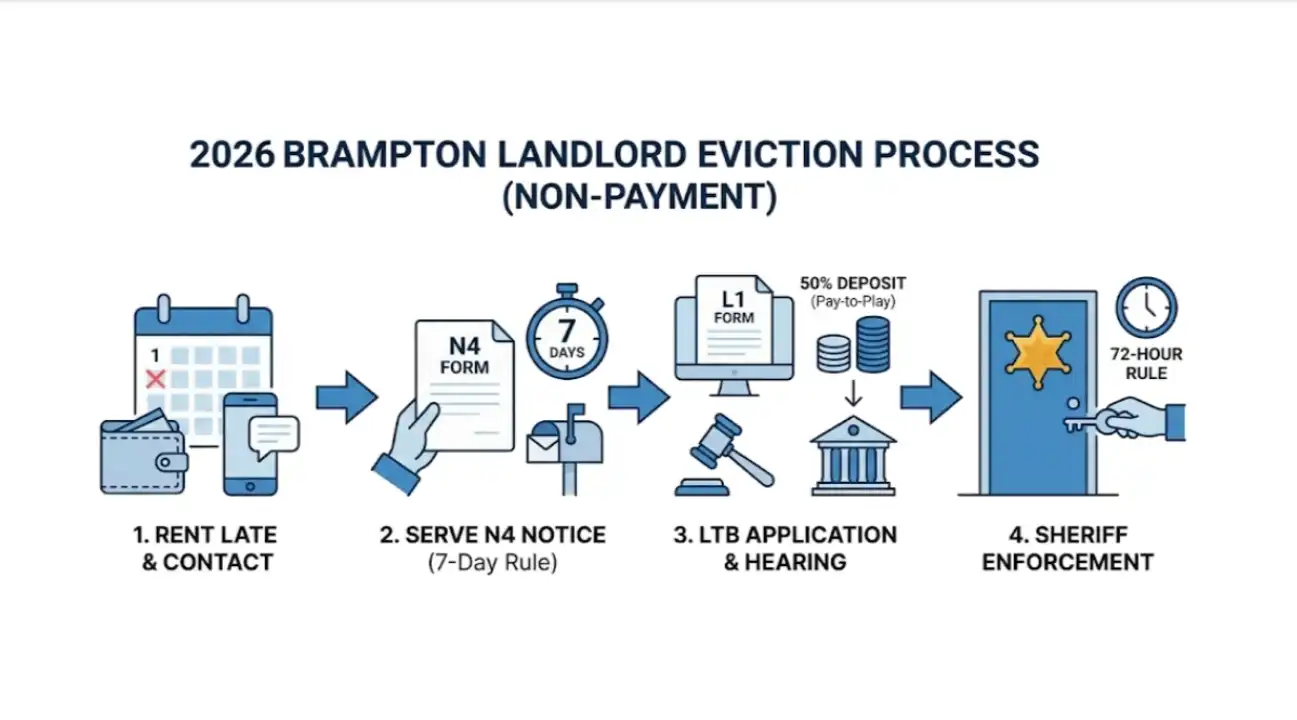
In Ontario, the only legal way to evict a tenant for non-payment of rent is through the Landlord and Tenant Board (LTB), using the prescribed forms under the Residential Tenancies Act. The process runs in sequence: N4 notice, L1 application, LTB hearing, eviction order, and Sheriff enforcement. There are no shortcuts, and taking any unilateral action outside this process is an offence under the Act.
This guide covers every step of that process in 2026 — from the day rent goes missing to post-eviction debt collection — and the actions that will destroy a legitimate case if taken in the wrong order.
What Can a Landlord Not Do When a Tenant Stops Paying Rent?
Before covering what to do, the actions that most commonly derail a landlord’s case need to be addressed directly.
Under the Residential Tenancies Act (RTA), only the Court Enforcement Office (the Sheriff) can physically remove a tenant from a residential unit. Regardless of how much rent is owing, a landlord cannot change the locks, disconnect heat, hydro, water, or internet services, remove or seize the tenant’s belongings, enter the unit without proper notice, or engage in any conduct toward the tenant that amounts to harassment.
These are not technicalities. A landlord who takes any of these actions commits an offence under the RTA. The Rental Housing Enforcement Unit (RHEU) can be contacted by the tenant and may investigate and lay charges. More immediately: at the LTB hearing, an adjudicator who learns about any of these actions can impose financial penalties on the landlord and, in the most serious cases, decline to grant the eviction order regardless of the legitimacy of the rent arrears. The illegal action poisons the file.
For a foundational overview of landlord obligations under the RTA — including what must be in a lease and what maintenance obligations attach — our guide to key lease clauses every Ontario landlord needs in 2026 covers the baseline requirements.
Does Your Brampton Rental Unit Need a Licence Before Filing at the LTB?
In 2026, Brampton landlords with one to four residential rental units are required to hold a valid Residential Rental Licence (RRL) from the City of Brampton before operating those units. This is a municipal licensing requirement separate from the provincial LTB process, but the two are increasingly connected in practice.
Adjudicators applying the “clean hands” principle will scrutinize a landlord’s compliance position at an eviction hearing. A landlord seeking to evict from an unlicensed unit may find the tenant’s representative raises the licensing issue, which can result in the address being flagged to the City of Brampton and triggering a by-law audit — with fines and Orders to Comply that could require significant remediation or unit closure.
Before filing anything at the LTB, confirm that your RRL is current and valid. Our guides to legalizing a Brampton basement apartment and Brampton’s 2026 rental licensing rules cover the licensing requirements in detail.
How Do You Evict a Tenant in Ontario for Non-Payment of Rent?
The process follows a fixed sequence under the RTA. Each step must be completed before the next can begin, and skipping or shortcutting any step can cause the application to be rejected or the hearing to be adjourned.
Step 1 — Document the missed payment and communicate in writing
The day rent is late, send a written message — text or email — noting that the payment has not been received and asking when it will be sent. This is not legally required, but it creates a contemporaneous record showing you attempted to resolve the issue before escalating. If the tenant proposes a payment plan, put any agreement in writing. A written payment plan that the tenant then breaches provides a clear, documented record for the LTB.
Step 2 — Serve the N4 Notice
The N4 — Notice to End your Tenancy Early for Non-Payment of Rent is the required first formal step. The N4 sets out the amount owing and gives the tenant a termination date — for a monthly tenancy, the termination date must be at least 14 days after the date the notice is served.
Service of the N4 must be done properly. Sliding it under the door is generally not valid service. The accepted methods under the RTA include handing it directly to the tenant, placing it in the mail slot, or, where both parties have agreed in writing, by email. Using an improper method of service will cause the application to be rejected when it reaches the LTB. The landlord must retain proof of service — the date, time, and method used.
During the 14-day period, the tenant can void the N4 by paying all rent owing plus any NSF charges specified in the lease. If full payment is made, the notice is void and cannot be used to proceed to an application. If the tenant pays some but not all of the arrears, the notice is not voided.
Step 3 — File the L1 Application at the LTB
If the termination date on the N4 passes without full payment, the landlord can file the L1 — Application to Evict a Tenant for Non-Payment of Rent and to Collect Rent the Tenant Owes through the LTB’s online portal. As of 2026, the filing fee is approximately $186.
The L1 application must be accompanied by the Certificate of Service proving the N4 was properly served. Without it, the application will be rejected. The application can also include any rent that has continued to go unpaid between the N4 date and the L1 filing — the landlord can update the arrears figure up to the date of the hearing.
Step 4 — The LTB Hearing
After the L1 is filed and served on the tenant, the LTB schedules a hearing. In 2026, the LTB’s ongoing efforts to reduce the non-payment backlog have reduced typical wait times for non-payment hearings — current estimates are in the range of three to five months from filing to hearing, though this varies by region and case complexity.
At the hearing, the landlord presents the evidence of non-payment. If the tenant raises maintenance issues as a defence (a Section 82 defence under the RTA), the adjudicator may exercise discretion on how to proceed. In some cases, adjudicators require a tenant raising maintenance claims to demonstrate some effort to pay or deposit arrears before the maintenance defence is fully heard. A landlord who has maintained good records — a ledger of payments and arrears, copies of all communications, documentation of any maintenance requests and responses — is in the strongest position at this hearing.
Step 5 — The Eviction Order
If the LTB grants the eviction, the order sets a date by which the tenant must vacate. Tenants have a window to apply for a review of the order — confirm the current review period with the LTB or a lawyer at the time of your hearing, as procedural timelines have been subject to amendment. The order will also typically include a requirement for the tenant to pay the outstanding arrears and the L1 filing fee.
Step 6 — Sheriff Enforcement
If the tenant does not vacate by the date on the eviction order, the landlord cannot remove them directly. The eviction order must be taken to the Peel Region Court Enforcement Office (Sheriff) to be enforced. The current enforcement fee is approximately $350 to $400. The Sheriff’s office will post a Notice to Vacate on the unit door, giving the tenant a final period (typically around seven days) to leave. On the enforcement date, the landlord — with a locksmith — meets the Sheriff at the property. The Sheriff ensures the tenant vacates and the landlord changes the locks. Only at that point does the landlord regain possession.
What Happens to the Tenant’s Belongings After Eviction in Ontario?
After the Sheriff enforces an eviction order, tenants frequently leave belongings behind. Under the RTA, the landlord must make those belongings available to the tenant for retrieval for 72 hours following Sheriff enforcement. During that window, the landlord must provide access to the unit between 8:00 AM and 8:00 PM to allow the tenant to collect their possessions — the landlord is present to supervise but does not provide the tenant with unsupervised access or a key.
Once the 72-hour window expires without the tenant retrieving their belongings, the landlord may sell, keep, or dispose of them. In practice, most landlords end up paying for disposal. Document the condition of the unit thoroughly — photos and video — immediately upon regaining possession, before anything is moved.
How Does a Brampton Landlord Collect Rent Arrears After an Eviction?
The LTB eviction order typically includes a requirement for the tenant to pay the arrears. However, the LTB cannot garnish wages or seize assets — only a court with civil enforcement jurisdiction can do that. To collect the money, the landlord must take the LTB order to Small Claims Court and have it converted into a civil court judgment. Once it is a Small Claims judgment, the landlord can apply to garnish the tenant’s wages (up to 20% of net wages under Ontario’s Wages Act) or to seize funds from a known bank account.
Collecting from a tenant who has left the province, changed employers, or has no attachable assets is genuinely difficult. If the tenant’s whereabouts are unknown, a skip tracer can locate a current address or employer — this is a service available through private investigation firms. The practical reality is that many small landlords write off a portion of arrears after eviction, which is why preventing arrears from accumulating beyond one month before escalating is the better financial strategy.
If the unit was damaged beyond normal wear and tear, damages cannot be added to the L1 order — that application covers rent arrears only. A separate L2 application must be filed for property damage, and L2 hearings are typically scheduled with lower priority than eviction applications.
How a Brampton Landlord Lawyer Can Help
The LTB process has specific procedural requirements at every step — incorrect service of the N4, a missing Certificate of Service, or a poorly documented arrears ledger can delay or derail an otherwise clear-cut case. Our real estate law team advises Brampton landlords on the RTA eviction process, LTB applications, and post-eviction debt enforcement, and can review your file before you file to prevent procedural errors.
Frequently Asked Questions
How long does it take to evict a tenant for non-payment in Ontario in 2026?
From the date of the N4 notice to physical enforcement by the Sheriff, the non-payment eviction process in Ontario currently takes approximately four to six months in most cases. This includes the 14-day N4 period, the time between L1 filing and the LTB hearing (currently three to five months in many regions), any post-hearing review window, and the Sheriff enforcement scheduling.
What is the N4 notice in Ontario and how do I serve it?
The N4 is the required first formal step in a non-payment eviction under the Residential Tenancies Act. It sets out the arrears owing and gives the tenant a termination date of at least 14 days (for monthly tenants). Valid service methods include hand delivery to the tenant, placing it in the mail slot, or service by email if both parties have previously agreed in writing to email service. Always retain proof of service — the method, date, and time used.
Can a tenant void an N4 notice in Ontario?
Yes. If the tenant pays all rent arrears (and any NSF fee specified in the lease) in full during the N4 notice period, the notice is voided and the landlord cannot proceed to file the L1. Partial payment does not void the notice. If the tenant voids a second N4 within six months, the landlord may be able to file an L1 without giving another notice — the RTA provides for this in repeat non-payment situations.
What is a Section 82 defence at an LTB non-payment hearing?
A Section 82 defence is a tenant’s right to raise maintenance and repair issues at a non-payment hearing, even without having filed their own LTB application. If the tenant claims the landlord failed to maintain the unit and seeks a rent abatement, the adjudicator can address it at the same hearing. Landlords should attend all hearings with complete records of any maintenance requests received and steps taken to address them.
What do I do with a tenant’s belongings after eviction in Ontario?
After the Sheriff enforces the eviction, the landlord must give the tenant 72 hours to retrieve their belongings, with access available between 8:00 AM and 8:00 PM. The landlord supervises access but does not provide unsupervised entry. After 72 hours, if the belongings have not been retrieved, the landlord may sell, keep, or dispose of them.
How do I collect unpaid rent after an LTB eviction order in Ontario?
The LTB eviction order includes a money component for arrears, but the LTB cannot enforce payment directly. To collect, the landlord must file the LTB order in Small Claims Court and have it converted to a civil judgment. With a Small Claims judgment, the landlord can apply to garnish wages (up to 20% of net pay) or seize funds from a known bank account.
Final Takeaway
The non-payment eviction process in Ontario protects both landlords and tenants through a structured, sequential set of rules. Landlords who follow the process precisely — and who avoid the unilateral actions that derail cases at the hearing stage — are in the strongest position at the LTB. Book a free consultation with GS Arora Law if you are a Brampton landlord dealing with a non-paying tenant and want your file reviewed before you file at the LTB.
Disclaimer: The information provided in this blog is for general informational purposes only and should not be considered legal, tax, financial, or professional advice. Regulations and procedures may change over time and vary by jurisdiction. For guidance tailored to your specific situation, please consult a qualified professional.
GS Arora, Lawyer & Notary Public. Brampton, Ontario.