
Tenant Stops Paying Rent in Brampton? The Complete 2026 LTB Process Explained
Book Consultation Book Consultation
02
JanTenant Stops Paying Rent in Brampton? The Complete 2026 LTB Process Explained
Introduction: A New Era for Ontario Landlords
If you are a landlord in Brampton facing a tenant who has stopped paying rent, the process has shifted significantly compared to just a year ago.
The provincial government’s “Fighting Delays, Building Faster Act” (Bill 60) is now in force, offering real relief to landlords who have long dealt with 8-month-plus delays at the Landlord and Tenant Board. The old 14-day waiting period on non-payment notices is gone.
But Brampton landlords face a double-edged sword. While the province has sped up the eviction process, the City of Brampton has simultaneously tightened compliance. As of January 1, 2026, the Residential Rental Licensing (RRL) program is mandatory across all wards. You can now act faster on non-payment than ever before — but only if your paperwork, and your licensing status, are flawless.
The Brampton Pre-Requisite: Are You Licensed?
Before filing a single eviction form, confirm your licensing status. As of January 1, 2026, every rental property with 1–4 units in Brampton — from Fletcher’s Meadow to Bramalea — must hold an active Residential Rental Licence.
Why This Matters for a Non-Payment Case
The Landlord and Tenant Board is a provincial body, but showing up to a hearing with an unlicensed unit can derail your case. Tenants are increasingly raising “landlord illegality” as a defence at LTB hearings. If you are operating an unlicensed unit — particularly an unregistered basement apartment — you risk drawing municipal By-law enforcement into the eviction process, triggering fines starting at $750 and escalating to $1,500 or more.
If your basement rental unit has never been through the legalization process, resolve that before you file for eviction, not after. See our guide on legalizing a basement apartment in Brampton in 2026 for the full requirements.
The New 2026 Legal Process Under Bill 60
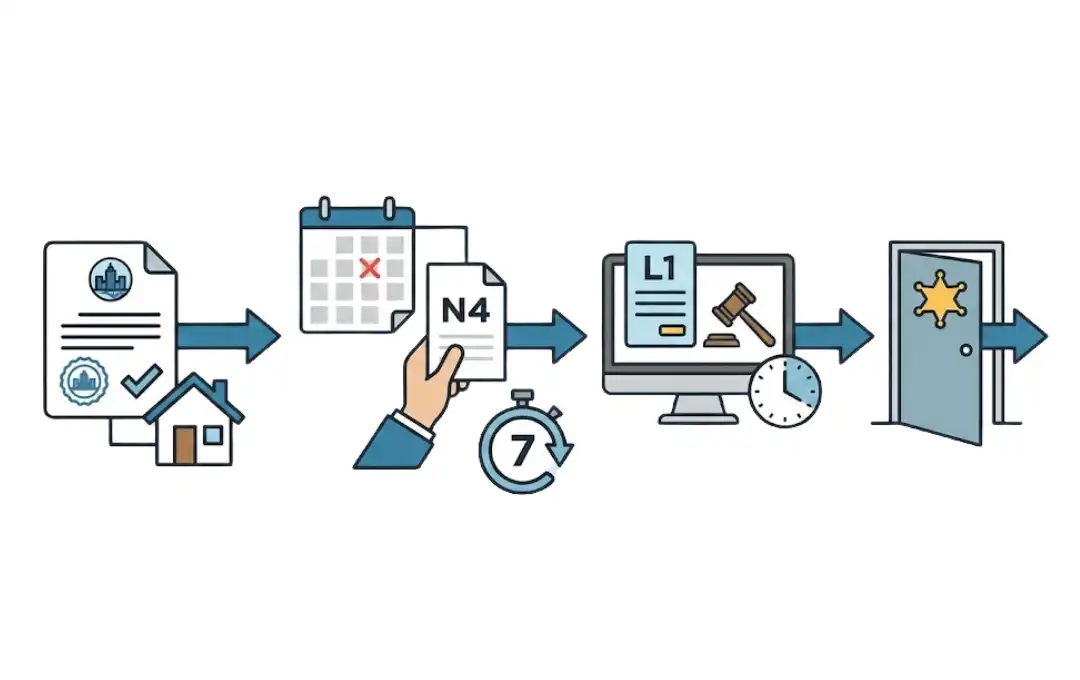
Here is the step-by-step non-payment eviction process for 2026, with the critical timeline changes landlords need to know.
Step 1: The “Soft” Approach (Day 2)
Direct communication remains your first line of defence. A text or email reminder, sent promptly, often resolves the issue without formal proceedings.
Many landlords now use rent collection apps that automatically timestamp these communications — this creates a documented record of good-faith efforts to collect, which strengthens your file if the matter proceeds to the LTB.
Step 2: Serve the N4 Notice — The New 7-Day Rule
This is the major 2026 change. Under the current legislation, the waiting period on an N4 Notice of Termination for non-payment has been cut in half. Landlords no longer wait 14 days — an N4 can now be issued with a 7-day termination date.
- Action: If rent is due on the 1st and unpaid, serve the N4 on the 2nd.
- The countdown: The tenant has 7 days to pay the full arrears to void the notice.
- The benefit: This removes a full week of dead time from the process before you are eligible to file for a hearing.
If your lease includes a written consent-to-service-by-email clause, you can serve this notice instantly rather than losing additional days to mail delivery. See our guide on the essential clauses every Ontario lease needs in 2026 for how to build this into your tenancy agreement from day one.
Step 3: Apply to the LTB — Form L1
If the 7-day period passes with rent still unpaid, file the L1 Application immediately.
- 2026 filing fee: Approximately $186 online
- Timeline: With the new procedural efficiencies, hearing dates are currently being scheduled in the 3–5 month range, down from the 8-plus months landlords faced in previous years
Step 4: The Hearing and the “Pay-to-Play” Rule
This is the most significant procedural win for landlords in the 2026 updates.
Previously, tenants could delay an eviction by raising maintenance complaints — “the landlord never fixed the stove” — at the hearing itself, often forcing an adjournment and buying additional months of occupancy.
The new rule: Tenants must now pay 50% of the claimed arrears into the LTB Trust before they are permitted to raise conduct or maintenance issues at a non-payment hearing. If the tenant cannot pay this deposit, the adjudicator will generally decline to hear maintenance complaints and will focus the hearing solely on the non-payment eviction. This closes off a common stalling tactic.
Step 5: The Faster Appeal Window
If you win the eviction order, the tenant previously had 30 days to file a Review Order request — often buying an additional free month of occupancy.
2026 update: The appeal window has been shortened to 15 days, significantly reducing the delay between a successful hearing and actual possession of the unit.
Rent Increases in 2026: What Landlords Need to Know
If your tenant is paying but you need to adjust the rent going forward, keep the current guideline in mind:
- The cap: 2.1% for 2026, down from 2.5% in 2025
- Notice requirement: 90 days’ written notice using Form N1
- Exemption: Buildings first occupied for residential purposes after November 15, 2018, remain exempt from the guideline cap
Summary Checklist for Brampton Landlords in 2026
- Get licensed. Confirm your Brampton Residential Rental Licence is active before you file anything with the LTB.
- Act fast. Serve the N4 on Day 2 of non-payment — don’t wait to see if the tenant catches up on their own.
- Count to 7, not 14. The waiting period has been cut in half — use it.
- Prepare for the hearing. Be ready to cite the 50% arrears rule immediately if the tenant attempts to raise maintenance issues to stall.
- Have your lease reviewed. A single drafting error on an N4, or a missing clause in your lease, can restart the entire process and cost you months.
Conclusion
The 2026 reforms genuinely favour landlords who follow the process correctly — faster notice periods, faster hearings, and a real barrier against stalling tactics at the hearing itself. But every one of these advantages depends on flawless paperwork and, for Brampton landlords specifically, an active rental licence. A single error on an N4 notice can restart the entire clock, erasing the very speed advantage these new rules were designed to give you.
If you are a Brampton landlord dealing with a non-paying tenant, or want your N4 and L1 documents reviewed before filing, contact GS Arora Law to speak with our real estate law team.
Disclaimer: The information provided in this blog is for general informational purposes only and should not be considered legal, tax, financial, or professional advice. Regulations and procedures may change over time and vary by jurisdiction. For guidance tailored to your specific situation, please consult a qualified professional.