
Understanding Federal and Provincial Income Tax in Canada: How to Maximize RRSP and FHSA Contributions in 2026
Book Consultation Book Consultation
13
OctUnderstanding Federal and Provincial Income Tax in Canada: How to Maximize RRSP and FHSA Contributions in 2026
Introduction
Every year, as tax season approaches, Canadians ask the same question: how exactly are we taxed on our total income, and how can we legitimately lower the amount owing? With multiple levels of government, different brackets, and several registered savings plans, the system can feel genuinely complicated.
If your income is around $80,000, you fall squarely into the middle-income range, where careful tax planning makes a real, measurable difference. This guide breaks down how income tax works in Canada, the difference between federal and provincial rates, and how contributing to your RRSP and First Home Savings Account (FHSA) can meaningfully reduce your 2026 tax bill.
How Income Tax Works in Canada
Canada uses a progressive tax system — the more you earn, the higher the rate on each additional dollar of income.
A common misconception is that moving into a higher tax bracket means your entire income gets taxed at that higher rate. This is not true. Only the income falling above each threshold is taxed at the higher rate for that portion — everything below continues to be taxed at the lower rates that apply to it.
For example, if you earn $80,000, part of your income is taxed at 14%, another portion at 20.5%, and so on up through the brackets your income actually reaches.
Federal Income Tax Brackets for 2026
The federal tax brackets for 2026 are:
- 14% on income up to $58,523
- 20.5% on the portion from $58,523 to $117,045
- 26% on the portion from $117,045 to $181,440
- 29% on the portion from $181,440 to $258,482
- 33% on income above $258,482
Note that the lowest federal rate dropped from 15% to 14% — a cut originally introduced mid-2025 that is now in effect for the entirety of 2026.
What This Means at $80,000 of Income
If you earn $80,000, your income is taxed in layers:
- The first $58,523 is taxed at 14%
- The remaining $21,477 (from $58,523 to $80,000) is taxed at 20.5%
Your average tax rate is therefore meaningfully lower than 20.5%, even though a portion of your income technically falls into the second bracket.
Provincial Income Tax
On top of federal tax, you also pay provincial or territorial tax based on where you resided on December 31 of the tax year.
Ontario’s 2026 Tax Brackets
- 5.05% on income up to $53,891
- 9.15% on the portion from $53,891 to $107,785
- 11.16% on the portion from $107,785 to $150,000
- 12.16% on the portion from $150,000 to $220,000
- 13.16% on income above $220,000
For someone in Ontario earning $80,000, your combined marginal rate (federal plus provincial) on the portion of income in the second bracket works out to roughly 29.65% (20.5% federal + 9.15% Ontario).
Federal vs. Provincial: Key Differences
- Federal brackets and rates are identical for every Canadian, regardless of province.
- Provincial brackets and rates vary considerably — Alberta’s top combined rate is meaningfully lower than Ontario’s or Quebec’s, for example.
- Your provincial tax owing is based on your province of residence on December 31 of the tax year, not where you lived for most of the year.
This is why location genuinely matters for tax planning. Moving from one province to another before year-end can measurably change your total tax bill for that year, since the CRA looks at where you resided on that single date.
RRSP Contributions: How They Reduce Tax
The Registered Retirement Savings Plan (RRSP) remains one of the most effective tax planning tools available to Canadians. Contributions are deducted directly from your taxable income in the year you claim them, and the funds grow tax-deferred until withdrawal in retirement — ideally at a lower marginal rate than you’re paying today.
Your 2026 Contribution Room
Your personal RRSP deduction limit is the lesser of 18% of your prior year’s earned income, or the annual dollar limit — $33,810 for 2026 (up from $32,490 in 2025) — plus any unused contribution room carried forward from previous years.
Example for 2026
Someone earning $80,000 who contributes $10,000 to their RRSP reduces their taxable income to $70,000. At a combined marginal rate of roughly 29.65% on the top portion of that contribution, this contribution generates meaningful tax savings in the year it’s claimed, while the full $10,000 continues growing tax-deferred inside the plan.
FHSA Contributions: The Opportunity for First-Time Buyers
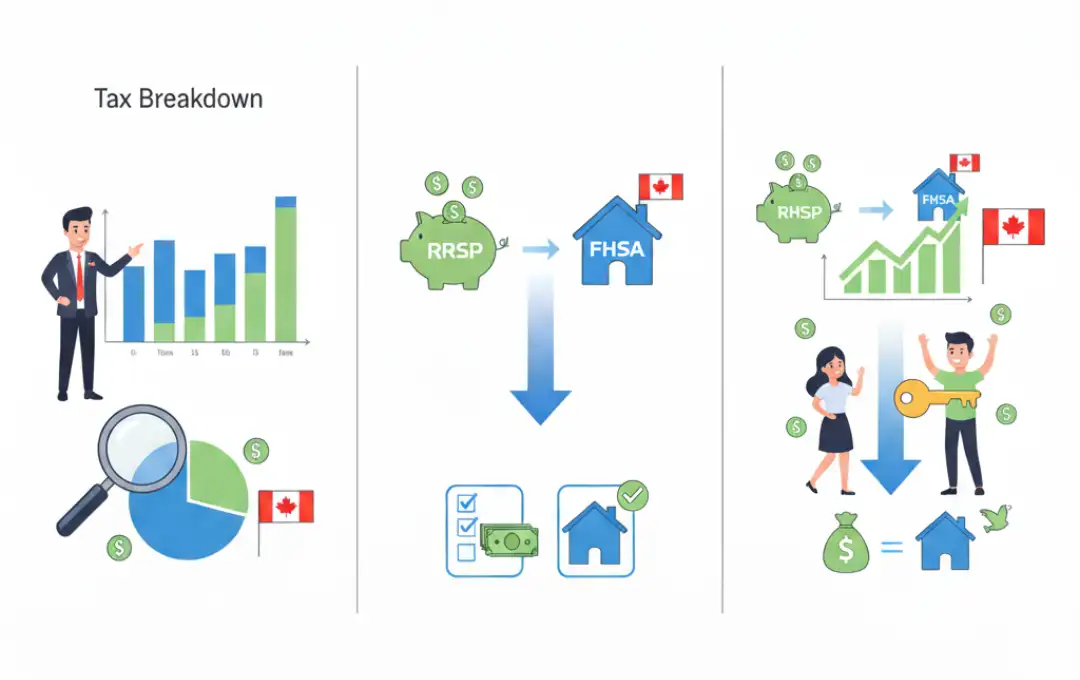
The First Home Savings Account (FHSA), introduced in 2023, combines the best features of an RRSP and a Tax-Free Savings Account (TFSA).
The 2026 FHSA Limits
- $8,000 annual contribution limit
- $40,000 lifetime maximum
- Unused annual room carries forward, but only up to one additional year’s worth at a time — you cannot stack multiple unused years indefinitely, and you can never exceed the $40,000 lifetime cap regardless of how the room accumulated
As of 2026, these limits remain fixed and have not been indexed to inflation, unlike the RRSP dollar limit or the TFSA annual limit.
For someone earning $80,000, contributing to an FHSA reduces taxable income immediately, exactly like an RRSP contribution does. But unlike RRSP withdrawals — which are fully taxable when taken out, even for a first home purchase under the Home Buyers’ Plan — funds withdrawn from an FHSA specifically for a qualifying first home purchase are never taxed, either going in as a deduction or coming out for the purchase.
Example for 2026
Someone earning $80,000 who contributes the full $8,000 annual FHSA limit reduces their taxable income to $72,000 for the year — generating an immediate deduction — while building a down payment that can later be withdrawn completely tax-free when they buy their first home.
Combining RRSP and FHSA
You don’t have to choose between the two. Strategic planning typically means using both together, particularly for someone actively saving toward a first home purchase while also building retirement savings.
Example Combining Both, at $80,000 Income
- FHSA contribution: $8,000, reducing taxable income to $72,000
- RRSP contribution: an additional $5,000, further reducing taxable income to $67,000
- Total deduction claimed: $13,000, while both amounts continue growing — one earmarked tax-free for a first home, the other tax-deferred for retirement
This combined approach maximizes your current-year tax deduction while building two entirely separate pools of savings, each optimized for a different future goal.
Other Ways to Maximize Deductions
Beyond RRSP and FHSA contributions, Canadians should also consider:
- Home office expenses, if you’re self-employed or meet the eligibility criteria for employees working from home
- Childcare expenses, subject to the current annual limits and eligibility rules — see our companion guide on claiming childcare expenses in Canada for the full requirements
- Medical expenses exceeding the lesser of 3% of net income or a set annual threshold
- Charitable donation credits, which increase in rate for donations above $200 in a year
- Union or professional dues, which are fully deductible where required for your employment
Each of these can reduce your taxable income or generate a credit that offsets tax otherwise owing.
Why Tax Planning Matters for Real Estate
For many Canadians, tax savings directly affect housing affordability. An FHSA and RRSP contribution strategy, executed well before you make an offer, can materially change how large a down payment you’re able to bring to closing — and a larger down payment can mean avoiding CMHC mortgage insurance premiums entirely if it gets you to the 20% threshold.
This is why real estate lawyers often work closely with accountants and financial advisors on a purchase. Understanding the tax rules helps clients structure their savings timeline and maximize the government incentives actually available to them, rather than discovering the FHSA or RRSP Home Buyers’ Plan only after an offer is already signed.
Practical Steps for 2026
- Confirm your exact RRSP contribution room through your CRA My Account or your most recent Notice of Assessment, rather than assuming the standard dollar limit applies to you.
- Open an FHSA now if you haven’t already, even with a small initial contribution, since unused annual room only carries forward one year at a time.
- Time significant contributions before year-end if you’re targeting a specific tax bracket outcome, since the deduction applies to the calendar year in which it’s made (with the RRSP allowing contributions up to 60 days into the following year to still count for the prior tax year).
- Coordinate your home-buying timeline with your FHSA and RRSP strategy, ideally well before you start house hunting, not after you’ve found a property.
How a Lawyer or Advisor Can Help
While accountants typically lead day-to-day tax planning, lawyers play an important role in aligning tax strategy with broader financial and legal goals. A tax-informed lawyer can:
- Help structure a home purchase to take full advantage of available first-time buyer incentives, coordinated with your FHSA and RRSP withdrawal timing
- Advise on the tax implications of family contributions toward a down payment, including any gift documentation needed
- Coordinate with your accountant where a purchase involves self-employed income, multiple properties, or other complexity beyond a standard employment-income purchase
In more complex cases — self-employed income, family-assisted down payments, or multi-property ownership — combined legal and tax advice helps ensure you capture every advantage actually available to your situation.
Final Takeaway
Canadian income tax is calculated by combining federal and provincial progressive rates, both updated for 2026 — including a genuinely lower federal rate on the first bracket. For someone earning $80,000, careful planning around these updated brackets can make a real difference in what’s ultimately owed.
The RRSP remains the cornerstone of long-term tax deferral, while the FHSA offers a unique advantage for first-time buyers by combining an immediate deduction with a fully tax-free withdrawal at the other end. Used together, Canadians can reduce their current taxable income, build retirement savings, and prepare for home ownership simultaneously.
Don’t let tax season catch you by surprise. With early planning, RRSP and FHSA contributions can save real money and help you reach home ownership sooner. For first-time buyers in Brampton and beyond, coordinating your tax and real estate planning together ensures you maximize every advantage available under the current 2026 rules.
If you’re planning a home purchase and want your tax and real estate strategy aligned, contact GS Arora Law to speak with our real estate law team.
Disclaimer: The information provided in this blog is for general informational purposes only and should not be considered legal, tax, financial, or professional advice. Regulations and procedures may change over time and vary by jurisdiction. For guidance tailored to your specific situation, please consult a qualified professional.