
Choosing Your Future: What Is the Best Business Structure in Ontario for 2026?
Book Consultation Book Consultation
28
OctChoosing Your Future: What Is the Best Business Structure in Ontario for 2026?
Introduction: Your First, Most Critical Business Decision
Starting a new business in 2026 is an exciting prospect. As an entrepreneur, you have a vision, a drive, and a plan to succeed. But before you make your first sale or sign your first client, you face a foundational decision that will shape every aspect of your new venture: choosing the right legal structure.
This isn’t just paperwork. The structure you choose — sole proprietorship, partnership, or corporation — fundamentally defines your business’s relationship with the law, the Canada Revenue Agency, and the public. It directly determines two things every business owner cares about deeply: personal liability (what you stand to lose) and taxes (what you get to keep).
For entrepreneurs in a competitive market like Brampton, making the right choice from day one can set the stage for sustainable growth and genuinely protect your personal assets. This guide breaks down the three most common business structures in Ontario to help you determine which one fits your 2026 launch.
Option 1: The Sole Proprietorship — The Simplest Start
What Is a Sole Proprietorship?
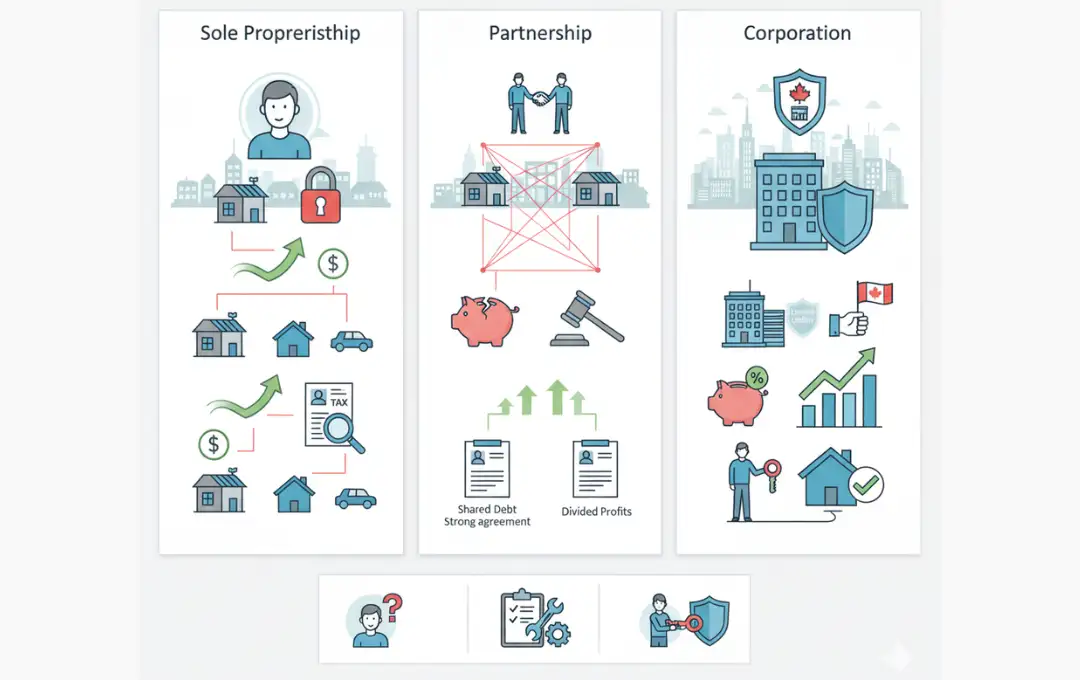
A sole proprietorship is the simplest and most common business structure in Ontario. In the eyes of the law, you and the business are one and the same — there is no legal distinction between your personal assets (your house, car, personal bank account) and your business assets.
To start, you simply register your business name — a Master Business Licence — with the Ontario government, unless you are operating strictly under your own exact legal name.
Liability: The Critical Risk
This is the single most important factor to weigh. Because you and the business are legally identical, you carry unlimited personal liability.
What this means: if your business incurs debt, you are personally responsible for repaying it. If your business is sued — a client alleges negligence, for example — your personal assets, including your home, can be at risk to satisfy any resulting judgment. This structure offers zero liability protection.
Taxes: Simple, But Not Always Better
Taxation is straightforward. All profit — or loss — your business earns “passes through” directly to you personally. You report this income on your own T1 tax return, specifically on Form T2125 (Statement of Business or Professional Activities).
The upside: it’s genuinely easy to manage — you don’t file a separate corporate tax return. The downside: your business income is taxed at your personal marginal rate. As your business becomes more profitable, you move quickly into higher personal tax brackets, potentially paying substantially more in tax than a corporation would on the same income.
Pros and Cons of a Sole Proprietorship
Pros: minimal setup cost and paperwork; complete control over all decisions; simple, single tax filing; easy and inexpensive to wind down if the venture doesn’t work out.
Cons: unlimited personal liability with no protection for personal assets; profits taxed at your full personal marginal rate; can appear less credible to some larger clients or lenders; harder to raise outside investment, since there are no shares to sell.
Option 2: The Partnership — Sharing the Journey
What Is a Partnership?
A partnership is similar to a sole proprietorship, but for two or more owners. It’s a relationship between individuals, corporations, or trusts carrying on a business together with a view to profit.
There are two main types recognized in Ontario:
- General Partnership: all partners actively participate in managing the business and share unlimited personal liability for its debts and obligations.
- Limited Partnership (LP): consists of at least one general partner with unlimited liability who manages the business, and one or more limited partners who contribute capital but have limited liability, provided they do not participate in day-to-day management. Limited partnerships must be registered with the province.
Liability: The Shared Risk
In a General Partnership, the liability risk is even more significant than in a sole proprietorship. All partners carry unlimited joint and several liability.
What this means: “joint and several” liability means each partner is responsible not only for their own actions but also for the actions and debts incurred by every other partner in the course of the business. If your partner signs a bad deal without your knowledge, you remain 100% personally liable for it regardless.
Taxes: Pass-Through, Divided
Like a sole proprietorship, a partnership is a pass-through entity for tax purposes. The partnership itself files an information return (T5013) with the CRA but does not pay tax directly. Income or loss is divided among the partners according to the partnership agreement, and each partner reports their individual share on their own personal tax return.
The Partnership Agreement: Your Most Important Document
If you are considering a partnership structure, a comprehensive, professionally drafted Partnership Agreement is non-negotiable. It should clearly outline:
- Capital contributions — how much each partner is contributing initially, and how future capital calls will be handled
- Profit and loss sharing ratios — how income and losses are divided, which does not have to mirror capital contributions
- Decision-making authority — which decisions require unanimous consent versus a simple majority of partners
- Dispute resolution mechanisms — a defined process for resolving disagreements before they escalate
- Exit and buyout provisions — what happens if a partner wants to leave, retires, becomes disabled, or dies, including how their share will be valued and purchased
Without a formal agreement, your partnership is governed entirely by Ontario’s default Partnerships Act, which may not reflect what the partners actually intended and rarely produces an outcome tailored to a specific business.
Pros and Cons of a Partnership
Pros: shared startup costs and workload; combined skills and resources between partners; relatively simple tax filing through pass-through treatment; flexible profit-sharing arrangements if properly documented.
Cons: unlimited joint and several liability in a general partnership; personally exposed to a partner’s mistakes or misconduct; potential for serious disputes without a clear governing agreement; more difficult to exit cleanly than a sole proprietorship.
Option 3: The Corporation — The Separate Legal Entity
What Is a Corporation?
A corporation, or “company,” is a legal entity entirely separate from its owners (the shareholders). It can own property, enter into contracts, and sue or be sued in its own name. It is managed by directors elected by the shareholders.
To create one, you file Articles of Incorporation either provincially, with the Ontario government, or federally.
Liability: The Corporate Veil
This is the primary reason most entrepreneurs choose to incorporate. The corporation is responsible for its own debts and liabilities, creating a “corporate veil” separating the business from its owners.
What this means: as a shareholder, your liability is generally limited to your actual investment in the company. If the corporation fails or is sued, your personal assets are generally protected from the claim. Important exception: directors can still be held personally liable for certain specific obligations, such as unpaid employee wages or unremitted HST — incorporation is not absolute personal protection in every circumstance.
Taxes: The Big Difference
A corporation files its own T2 tax return and pays its own taxes, creating several key advantages:
- Access to the small business tax rate: eligible Canadian-Controlled Private Corporations pay a combined federal and Ontario rate of 11.2% on the first $500,000 of active business income, effective July 1, 2026 — substantially lower than most personal marginal tax rates. See our full breakdown of tax consequences of incorporating in Ontario for the complete rate schedule.
- Tax deferral: profits retained in the corporation are only taxed at the corporate rate until withdrawn personally as salary or dividends, allowing you to reinvest a larger portion of pre-tax profit into growing the business.
- Income splitting opportunities: with proper structuring, dividends can sometimes be paid to family members who are legitimate shareholders, subject to the Tax on Split Income (TOSI) rules.
- Potential access to the Lifetime Capital Gains Exemption: on an eventual sale of qualifying shares, individual shareholders may be able to shelter a significant portion of the capital gain from tax entirely.
Pros and Cons of a Corporation
Pros: limited personal liability for shareholders; significantly lower tax rate on active business income up to $500,000; greater credibility with larger clients, lenders, and investors; easier to raise capital by issuing shares; potential access to the Lifetime Capital Gains Exemption on a future sale.
Cons: higher setup and ongoing administrative costs, including annual filings and a maintained minute book; more complex tax filing requiring professional accounting support; less flexibility to simply walk away without a formal wind-up process; corporate formalities (resolutions, minute books) must be genuinely maintained to preserve the liability protection.
So, What Is the “Best” Structure for Your Ontario Business in 2026?
The “best” structure is the one that genuinely matches your specific risk exposure, revenue level, and long-term goals — there is no single universally correct answer.
- Choose a sole proprietorship if you are testing a low-risk business idea, working alone, and don’t yet have meaningful revenue or exposure to liability — simplicity and low cost matter more at this stage than tax optimization.
- Choose a partnership if you are building the business with one or more co-founders, you trust them completely, and you’re willing to invest in a properly drafted partnership agreement to manage the shared liability risk.
- Choose a corporation if your business carries meaningful liability exposure (client contracts, employees, physical premises), you expect profitability that would benefit from the lower corporate tax rate, or you plan to eventually raise investment or sell the business.
Many businesses that start as a sole proprietorship or partnership to test an idea eventually incorporate once revenue and risk both increase — there is no requirement to get this decision perfectly right on day one, though switching structures later does involve its own legal and tax steps.
Conclusion: Don’t Build Your Future on a Shaky Foundation
Choosing your business structure is the legal and financial foundation of your company. A decision made to save a few hundred dollars today can end up costing your home tomorrow if the structure doesn’t match your actual risk exposure.
As a law firm serving the business community in Brampton, we’ve seen both sides — the real pain of a poorly chosen structure, and the genuine strength a well-formed corporation provides when things go wrong. The right structure protects your personal assets, simplifies your taxes, and sets your business up for sustainable, long-term success.
Before you register your business name, make your first major decision the right one. Contact GS Arora Law to speak with our business law team and ensure your foundation is built to last.
Disclaimer: The information provided in this blog is for general informational purposes only and should not be considered legal, tax, financial, or professional advice. Regulations and procedures may change over time and vary by jurisdiction. For guidance tailored to your specific situation, please consult a qualified professional.