
How Are Pensions, RRSPs, and Business Assets Divided in an Ontario Divorce?
Book Consultation Book Consultation
23
MarHow Are Pensions, RRSPs, and Business Assets Divided in an Ontario Divorce?
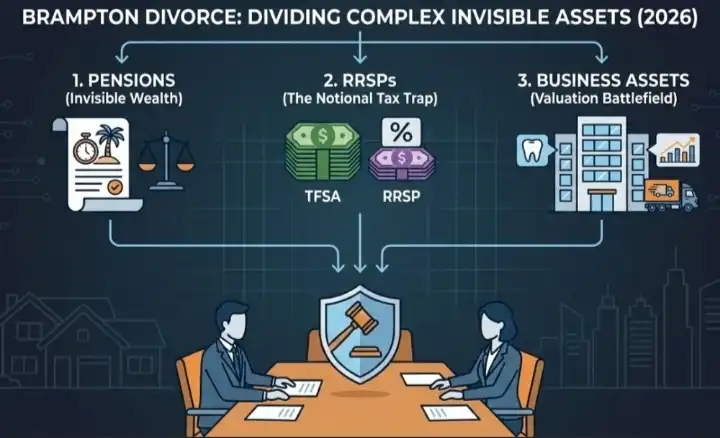
When a marriage ends in Brampton, the matrimonial home is usually the first asset discussed — it is visible, it has an address, and it can be appraised in a day. But for many couples in 2026, the home represents only a portion of what needs to be divided. The assets that produce the largest disputes — and the most expensive mistakes — are the ones that do not appear on a single statement: defined benefit pensions, tax-deferred savings accounts, and privately owned businesses.
Ontario divorces do not split assets 50/50. Married spouses go through the equalization of net family property under the Family Law Act: each spouse calculates their net worth at marriage and at separation, and the spouse whose net worth grew more during the marriage pays half the difference to the other. Pensions, RRSPs, and business interests all feed into that calculation — but each is valued differently, and the errors made in valuing them are often permanent.
This guide explains how each asset class is valued and divided in an Ontario divorce in 2026, the specific legal rules that govern each, and when the complexity of these assets requires a family lawyer with property experience.
How Does Equalization of Net Family Property Work in Ontario?
Equalization of net family property (NFP) is the mechanism under Part I of the Family Law Act that governs property division between married spouses in Ontario. Each spouse calculates their net family property — the value of all property owned at the date of separation, minus debts at separation, minus the value of property owned at the date of marriage — and the spouse with the larger NFP pays the other spouse half the difference. The goal is to equalize the financial gain each spouse made during the marriage, not to divide every individual asset.
The calculation has two critical exceptions that produce most of the disputes: excluded property (inheritances, gifts from third parties, and certain pre-marriage assets that were not the matrimonial home) can be deducted from a spouse’s NFP, reducing the equalization payment owing. And the matrimonial home — whatever was the family residence at separation — receives no date-of-marriage deduction, meaning a spouse who brought the home into the marriage cannot credit that pre-marriage value.
Pensions, RRSPs, and business interests are all included in the NFP calculation at their date-of-separation value, subject to the valuation rules specific to each.
How Is a Pension Divided in a Divorce in Ontario?
For many Brampton divorces — particularly those involving teachers, nurses, Peel Regional Police officers, municipal workers, or other public-sector employees — a defined benefit (DB) pension is the most valuable asset in the marriage, often exceeding the equity in the home.
A pension cannot be valued by looking at the annual member statement. Under the Family Law Act and the regulations administered by the Financial Services Regulatory Authority of Ontario (FSRA), the pension must be valued using the Family Law Value (FLV) — a specific calculation of how much the pension grew from the date of marriage to the date of separation, expressed in present-value dollars. The pension plan member submits prescribed forms to the plan administrator to request the FLV. In 2026, this process typically takes up to 60 days and must be completed before the equalization can be finalized — it is not optional and it cannot be estimated.
Once the FLV is determined, that amount is included in the pension member’s NFP. If equalization requires the non-member spouse to receive a share of the pension, there are two paths:
A lump-sum transfer of up to 50% of the FLV can be made directly from the pension plan into the non-member spouse’s Locked-In Retirement Account (LIRA). This provides a clean break — the non-member spouse has their own retirement account and the member spouse’s pension continues unaffected going forward.
If the plan member is already retired and receiving monthly payments, a division in pay arrangement can be set up so the plan administrator pays a portion of each monthly payment directly to the former spouse.
The survivor benefit election — whether the former spouse retains any right to a survivor benefit on the member’s death — is a permanent election that must be addressed in the separation agreement or court order. Overlooking it is one of the most expensive and irreversible mistakes in pension division.
What Is the RRSP Notional Tax Problem in an Ontario Divorce?
RRSPs are the most common tax-deferred asset in Canadian divorces and the most frequently misvalued in self-represented proceedings. The error is treating an RRSP balance as equivalent in value to an equal balance in a TFSA or non-registered account — it is not.
A TFSA holds after-tax money. A withdrawal of $100,000 from a TFSA is $100,000 in your hands. An RRSP holds pre-tax money. A withdrawal of $100,000 from an RRSP is taxable as income in the year of withdrawal; depending on the account holder’s marginal tax rate, the after-tax value of that $100,000 RRSP may be $65,000 to $80,000. If the equalization calculation treats both accounts as equal, the spouse who holds the RRSP overstates their NFP and overpays equalization.
A family lawyer with property experience will apply a notional tax discount to RRSPs and other tax-deferred assets when calculating NFP — reducing the RRSP’s stated balance by an estimated tax liability to reflect its real economic value. The appropriate discount rate depends on the account holder’s projected marginal rate at the time the funds are expected to be withdrawn, which is itself a fact-specific determination.
When RRSP funds are transferred to satisfy an equalization payment, the Canada Revenue Agency allows a direct, tax-deferred transfer using Form T2220 — funds move from one spouse’s RRSP to the other’s without triggering immediate tax, provided the transfer is made pursuant to a written separation agreement or court order. Cashing out the RRSP and paying equalization in cash triggers an immediate tax event that reduces the actual value transferred. This is a fixable problem — but only if identified before the agreement is signed.
How Are Business Assets Divided in an Ontario Divorce?
Brampton is home to a significant number of small and mid-sized businesses — logistics and trucking operations, medical and dental practices, construction companies, retail operations, and professional corporations. A spouse who owns any of these brings a business interest into the equalization calculation, and it must be valued at its date-of-separation fair market value.
A business cannot be valued based on its most recent tax return, its book value, or an owner’s estimate. The court requires a valuation by a Chartered Business Valuator (CBV), a professional designation regulated by the CBV Institute. The CBV will apply recognized valuation methodologies — typically a capitalized earnings approach or a discounted cash flow analysis — to determine what a willing buyer would pay for the business on the date of separation. Goodwill (both personal and commercial), accounts receivable, equipment, real property, and the effect of any shareholders’ agreements on transferability all factor in.
Where both spouses retain their own CBV and those valuations diverge — which they usually do — the litigation becomes a battle of experts, which is among the most expensive forms of family court litigation. The more cost-effective approach, where both parties can agree, is a joint retainer of a single CBV whose valuation both sides accept as the starting point. A well-drafted shareholder agreement for Ontario business owners often contains a pre-agreed valuation mechanism that can simplify this process considerably at separation.
Corporate structures — holding companies, operating companies, family trusts, inter-corporate loans — are commonly used in small business ownership and are not automatically transparent in financial disclosure. A family lawyer with property experience works with forensic accountants to trace the actual value of business assets through layered corporate structures, particularly where a spouse suspects wealth is being held in a form that is not immediately visible.
What Is the Double-Dipping Problem for Business Owners?
Double-dipping is one of the most heavily litigated issues in Ontario family law for business owners, and the Supreme Court of Canada addressed it directly in Boston v. Boston [2001] 2 SCR 413. The problem arises when the same stream of business income is used twice: once to value the business as an asset in the equalization calculation, and again as the income base for calculating ongoing spousal support.
If a business is valued at $2 million based on its projected future earnings, the non-owner spouse receives half of that value through equalization — they have already received, in a lump sum, the present value of future income the business will generate. If spousal support is then also calculated against the full income the business owner draws from that same business, the owner is effectively paying twice for the same future income stream.
The courts have developed nuanced rules to address this — a partial reduction in the income figure used for support calculations is sometimes applied, or the equalization payment is structured in a way that reduces the ongoing support obligation. The analysis is highly fact-specific and requires both legal and financial expertise to navigate correctly. Getting it wrong, in either direction, has permanent financial consequences. For a full picture of how spousal support is calculated alongside property division, our guide to spousal support entitlement and duration in Ontario covers the SSAG framework in detail.
The Matrimonial Home Trap in an Ontario Divorce
The matrimonial home rule under section 4(1)(b) of the Family Law Act catches many property-owning spouses off guard. The general rule in NFP calculation is that a spouse can deduct the value of property they owned at the date of marriage — so assets brought into the marriage are not shared. The matrimonial home is the major exception. If a spouse owned a home before the marriage, moved into it as the family home, and is still living in that home at the date of separation, the pre-marriage value of that home cannot be deducted from their NFP. The entire value at separation is included.
The practical consequence: a spouse who purchased a home for $400,000 before the marriage, watched it appreciate to $1,100,000 by the date of separation, and lived in it as the family home throughout cannot deduct the $400,000 they brought in. The full $1,100,000 enters their NFP. This rule applies even though an equivalent pre-marriage asset held in a different form — a stock portfolio, a RRSP — would be fully deductible. Understanding how the matrimonial home is treated in Ontario equalization before entering a marriage, or before deciding how to hold a property during the marriage, can significantly affect the financial outcome at separation.
When Do You Need a Family Lawyer with Property Experience in Brampton?
Simple divorces — short marriages, employed spouses with T4 income, no pension, renting a home — can sometimes be handled with minimal legal intervention. The moment any of the following are present, experienced property-focused legal counsel is required:
A defined benefit pension is involved. The FLV process, survivor benefit election, and LIRA transfer mechanics are permanent and non-reversible once a separation agreement is signed. A mistake here cannot be undone.
A spouse owns a business or professional corporation. The valuation, the double-dipping analysis, and the corporate structure disclosure all require expertise that a generalist approach will miss.
One spouse controlled the family finances. If investments, offshore accounts, cryptocurrency holdings, or corporate structures were not transparent during the marriage, a forensic accountant working alongside the family lawyer is required to ensure honest disclosure.
The matrimonial home was owned before the marriage. The section 4(1)(b) trap applies automatically and cannot be contracted around without a properly drafted marriage contract signed before or during the marriage.
Tax-deferred assets form a significant part of the net worth. Notional tax discounting and proper RRSP transfer mechanics require attention to the equalization calculation before the agreement is signed, not after.
Our family law team works with clients in Brampton and across the GTA on complex property division, including pension valuation coordination, business asset disclosure, and equalization calculations involving layered corporate structures.
Frequently Asked Questions
How is a pension divided in a divorce in Ontario?
A defined benefit pension is valued using the Family Law Value (FLV), a document prepared by the pension plan administrator under FSRA regulations that measures the pension’s growth from the date of marriage to the date of separation. The FLV is included in the member spouse’s net family property. If equalization requires a pension share, the non-member spouse can receive up to 50% of the FLV as a transfer to a Locked-In Retirement Account (LIRA), or through a monthly division in pay if the member is already retired.
What is notional tax on an RRSP in a divorce?
Notional tax is the estimated income tax liability embedded in a tax-deferred account like an RRSP. Because RRSP funds will be taxed as income on withdrawal, their face value overstates their real economic value. In an Ontario divorce, the RRSP’s stated balance should be reduced by a notional tax discount in the equalization calculation to reflect the true after-tax value — failure to do this inflates one spouse’s NFP and produces an inaccurate equalization payment.
Can RRSP funds be transferred in a divorce without paying tax?
Yes. Under the Income Tax Act, Form T2220 allows a direct transfer of RRSP funds between spouses’ accounts on a tax-deferred basis, provided the transfer is made pursuant to a written separation agreement or court order. Cashing out the RRSP to fund an equalization payment triggers immediate tax and reduces the real value transferred.
How are business assets valued in an Ontario divorce?
Business assets are valued by a Chartered Business Valuator (CBV) using recognized methodologies — typically capitalized earnings or discounted cash flow — to establish the fair market value of the business as of the date of separation. Both spouses retaining separate CBVs frequently results in competing expert valuations and expensive litigation; a joint CBV retainer is more efficient where both parties can agree to it.
What is double-dipping in an Ontario divorce for business owners?
Double-dipping refers to the improper use of the same business income stream to both value the business as an asset for equalization and calculate ongoing spousal support. The Supreme Court of Canada addressed this in Boston v. Boston [2001] — courts will adjust the calculation to avoid compensating the non-owner spouse twice from the same income source, though the specific adjustment is highly fact-dependent.
Does the matrimonial home rule affect a pre-marriage property in Ontario?
Yes. Under section 4(1)(b) of the Family Law Act, if a spouse owned a property before marriage and it was used as the matrimonial home throughout the marriage, the pre-marriage value of that property cannot be deducted from their net family property — unlike other pre-marriage assets. The full value at the date of separation is included in their NFP, which can significantly increase the equalization payment owed.
Final Takeaway
Pensions, RRSPs, and business interests are the assets where Ontario’s equalization rules are least forgiving of errors — and where the financial consequences of getting the calculation wrong are permanent. The time to get expert legal advice is before the separation agreement is signed, not after. Book a free consultation with GS Arora Law to have your Brampton divorce’s property picture reviewed by a family lawyer with complex asset experience.
Disclaimer: The information provided in this blog is for general informational purposes only and should not be considered legal, tax, financial, or professional advice. Regulations and procedures may change over time and vary by jurisdiction. For guidance tailored to your specific situation, please consult a qualified professional.
GS Arora, Lawyer & Notary Public. Brampton, Ontario.