
The Matrimonial Home in Ontario: Special Rules Every Spouse Should Know in 2026
Book Consultation Book Consultation
11
MayThe Matrimonial Home in Ontario: Special Rules Every Spouse Should Know in 2026
Ontario family law treats the matrimonial home differently from every other asset a couple owns. The distinctions matter most at separation, but they also matter while the marriage is intact — when one spouse wants to sell, refinance, or rent it out. The rules under the Family Law Act are not intuitive and they are not the same rules that apply to common-law couples. Understanding them is among the most practically valuable pieces of family-law literacy a married person in Ontario can have.
The matrimonial home in Ontario is any property in which a spouse has an interest and that was ordinarily occupied by both spouses as their family residence at the time of separation, as defined under section 18 of the Family Law Act. It does not need to be jointly owned, it does not need to be purchased during the marriage, and a couple can have more than one matrimonial home simultaneously.
This guide explains the definition, the consent rules, the equalization treatment, exclusive possession, court-ordered sale, and the issues that come up most often at separation in 2026.
What Counts as a Matrimonial Home Under the Family Law Act?
Section 18 of the Family Law Act defines the matrimonial home as a property in which a person has an interest and that is, at the time of separation, ordinarily occupied by the person and their spouse as their family residence. Three key points follow:
The home does not have to be jointly owned. A house registered solely in one spouse’s name is still a matrimonial home if the family lives there. The same rules apply — including the consent requirement for sale — regardless of whose name is on title.
A couple can have more than one matrimonial home. A cottage, vacation property, or secondary residence regularly used as a family home can each qualify simultaneously. All of them receive the full protections of the matrimonial home regime.
The test is “ordinarily occupied at the time of separation,” not at the time of purchase. A property purchased before the marriage becomes a matrimonial home the moment the married couple occupies it as their family home — with significant consequences for the equalization calculation, as discussed below.
The status is automatic. No registration, designation, or declaration is required for the matrimonial home rules to apply.
The Matrimonial Home Rules Apply Only to Married Spouses
This is the single most important distinction in the Ontario matrimonial home regime: the special rules in the Family Law Act apply only to legally married spouses. Common-law partners — including long-term partners with children and decades of shared life — are not “spouses” under Part I or Part II of the Family Law Act for matrimonial home purposes.
Common-law partners can still have property claims against a shared home through unjust enrichment and constructive trust, as recognized by the Supreme Court of Canada in Kerr v. Baranow [2011] 1 SCR 269. But those are trust-based claims that require proof — they are not the automatic possessory and equalization protections that flow to married spouses under the Act. Our guide to common-law vs. married property rights in Ontario covers that distinction in detail.
If you are in a common-law relationship and the home is registered in your partner’s name only, your rights on separation are materially different — and generally weaker — than those of a married spouse in the same situation.
Section 21: Neither Spouse Can Sell or Mortgage Without the Other’s Consent
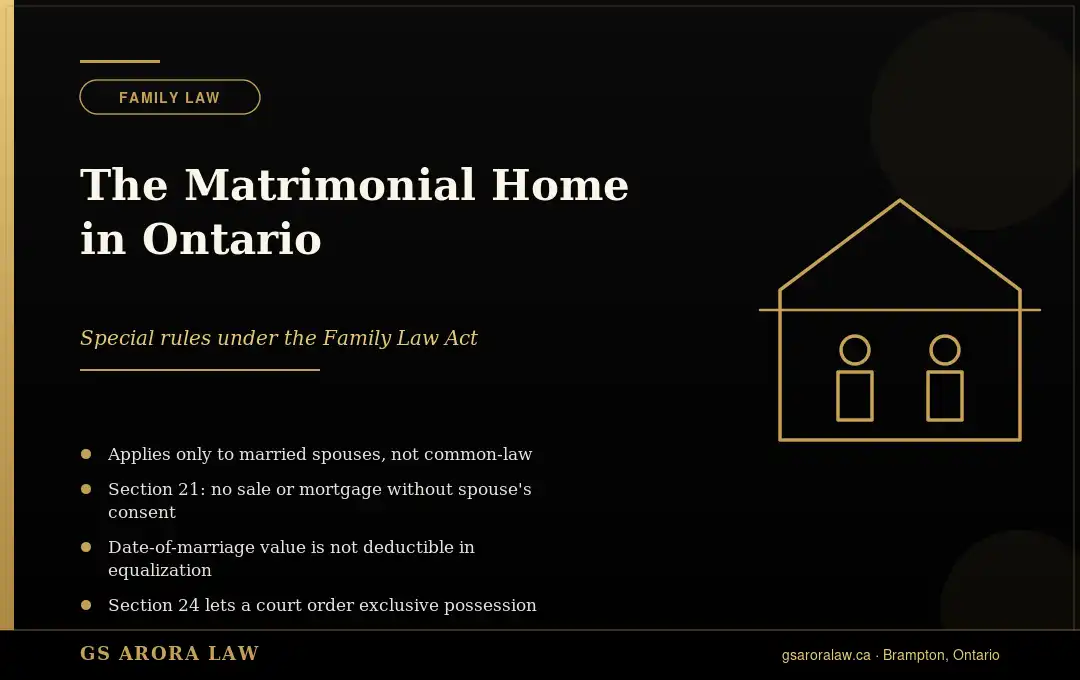
For married spouses, section 21 of the Family Law Act creates one of the most powerful protections in Ontario property law: no spouse may dispose of or encumber an interest in a matrimonial home unless the other spouse joins in the transaction or consents in writing, or unless a court has ordered otherwise. This rule applies even if only one spouse is registered on title.
In practice: a husband who solely owns the family home cannot sell it, refinance it, or place a new mortgage on it without his wife’s written consent. Banks, mortgage lenders, and real estate lawyers in Ontario treat this as a mandatory step on any residential transaction involving a property that could be a matrimonial home. The consent is a formal, witnessed document — not a verbal agreement or informal acknowledgment.
The consequence of proceeding without consent is severe. A disposition or encumbrance that violates section 21 can be set aside by the court on application by the non-consenting spouse. This is why the question “is this a matrimonial home?” is asked on every Ontario residential real estate transaction. If you are considering putting a property into one name, or transferring title between spouses, the consent rules are one of the first things to address — our guide to adding a spouse to title in Ontario covers the related title and LTT implications.
Equalization Treatment: The No-Deduction Rule
Ontario divides marital property through the equalization model under Part I of the Family Law Act. Each spouse calculates their “net family property” (NFP) — the increase in net worth from the date of marriage to the date of separation — and the spouse with the larger NFP pays half the difference to the other.
The matrimonial home receives special treatment in two specific ways that frequently surprise separating spouses:
The no-deduction rule. Property a spouse owned before the marriage is normally deducted from their NFP, crediting them for what they brought in. But if that pre-marriage asset is the matrimonial home that the parties still occupy at separation, the date-of-marriage value cannot be deducted. The entire value of the home at separation is included in that spouse’s NFP — the pre-marriage equity disappears from the calculation. A spouse who owned a paid-off $400,000 home before the marriage, lived in it with their spouse for ten years, and sees it worth $900,000 at separation cannot deduct the $400,000 they brought in.
Excluded property loses its protection. Inheritances, gifts from third parties, and certain damage awards received during the marriage are normally “excluded property” — kept out of NFP. But if the spouse uses excluded funds to acquire or improve a matrimonial home, those funds lose their excluded status to the extent they are reflected in the home’s value.
These rules apply regardless of how long the marriage lasted and regardless of the relative contributions of each spouse.
Exclusive Possession of the Matrimonial Home
Section 24 of the Family Law Act authorizes a court to grant one spouse exclusive possession of the matrimonial home for a defined period — meaning the other spouse must vacate and stay out, even if both names are on the title deed.
The court considers the best interests of any children in the home, each spouse’s financial position and access to other accommodation, any existing family violence (which carries significant weight and can result in urgent interim orders), and whether exclusive possession is necessary to preserve the stability of the children’s environment. In Brampton and across Ontario, exclusive possession motions are among the most commonly sought emergency remedies at the start of a contested separation.
Exclusive possession is a possessory order, not an ownership order. The non-possessing spouse retains their ownership interest; they simply cannot occupy the property during the order’s duration. The order does not affect title, does not waive equalization rights, and does not determine who ultimately keeps the home.
Can a Court Order the Sale of the Matrimonial Home?
Yes — and this is one of the most practically significant issues in contested Ontario family law files. When separated spouses cannot agree on what to do with the matrimonial home, either spouse can bring a court application for a sale. The court has jurisdiction to order a sale under several overlapping sources of authority:
Under section 9 of the Family Law Act, when making an order to give effect to the equalization of net family properties, the court can order the partition and sale of a property in which a spouse has an interest — including the matrimonial home.
Under the Partition Act (Ontario), a co-owner (including a spouse with a registered interest in the home) can apply to court for an order for partition or sale. The court has broad discretion but will generally order a sale where continued co-ownership is not workable.
In practice, court-ordered sale of the matrimonial home most often arises in contested separations where one spouse wants to sell and the other refuses, where the parties cannot agree on listing price or terms, or where one spouse is preventing a court-ordered buyout from being completed.
If you are in a situation where the matrimonial home is disputed and your spouse is blocking a resolution, the Partition Act and Family Law Act together give the court the tools to force a sale. Legal advice early in that process matters enormously for the outcome.
What Happens to the Home at Separation?
Separating spouses with a matrimonial home typically end up in one of three positions:
Sell and divide the proceeds. The cleanest outcome. The home is listed, sold, and the net proceeds (after mortgage payout, real estate commissions, and legal fees) are held in trust and applied against the equalization payment. Both parties get a clean break.
One spouse buys out the other. The keeping spouse refinances the home, pays out the departing spouse’s share of equity, and takes over sole ownership. The buyout amount is often intertwined with the equalization payment — meaning the total owed between the spouses across all assets nets against the home buyout. This requires a formal separation agreement or court order to document clearly.
Defer the sale. Some couples agree by separation agreement to keep the home — most commonly until the youngest child finishes school — and then sell. This requires careful drafting to address who pays the mortgage, who maintains the property, who bears the risk of value fluctuation, and what the sale terms will be when the deferral period ends.
Each option has tax, mortgage qualification, and equalization implications that need to be worked through together. The principal residence exemption, timing of the transfer, and any capital gains on deferred sales all matter — and they interact with the division of other assets. Our guide to dividing pensions, RRSPs, and business assets in a Brampton divorce covers the broader asset division picture that runs alongside the matrimonial home decision.
Domestic Contracts Can Change the Rules — Within Limits
A marriage contract under Part IV of the Family Law Act can alter how the matrimonial home is treated on equalization — for example, by agreeing that each spouse keeps what they own, or that the no-deduction rule is waived. However, section 52(2) of the Act draws one hard line: a marriage contract cannot limit or waive the right of a spouse to possession of the matrimonial home under Part II.
Spouses can contract about ownership, equalization, and financial entitlements on separation. They cannot contract away possessory rights to the matrimonial home itself. This means even the most carefully drafted prenuptial agreement in Ontario cannot fully remove a matrimonial home from the family law system — a fact that surprises many clients who believe a marriage contract gives them complete control over a pre-owned property.
How a Brampton Family Lawyer Fits In
The matrimonial home rules in Ontario are technical, counterintuitive, and carry large financial consequences at separation. A spouse who understands the no-deduction rule before they purchase property in one name, the consent requirement before they refinance, or the exclusive possession remedy before they leave the family home is far better positioned than one who learns these rules under the pressure of a separation. Our family law team advises married spouses in Brampton and across the GTA on matrimonial home rights at every stage — from marriage contracts and title planning to separation, court motions, and final resolution.
Frequently Asked Questions
What is a matrimonial home in Ontario?
Under section 18 of the Family Law Act, a matrimonial home is any property in which a spouse has an interest that was ordinarily occupied by both spouses as their family residence at the time of separation. It does not need to be jointly owned, it can include a cottage or vacation property, and the status is automatic — no registration is required.
What is exclusive possession of the matrimonial home in Ontario?
Exclusive possession is a court order under section 24 of the Family Law Act that requires one spouse to vacate the matrimonial home and allows the other to remain, even if both names are on title. It is a possessory order only — it does not transfer ownership or waive either spouse’s equalization rights. Courts weigh the children’s best interests and any history of family violence heavily in these motions.
Can a court order the sale of the matrimonial home in Ontario?
Yes. If separated spouses cannot agree on the disposition of the matrimonial home, a court can order a sale under section 9 of the Family Law Act (as part of an equalization order) or under the Partition Act (Ontario) if one or both spouses hold a registered interest in the property. Court-ordered sale is most commonly sought when one spouse refuses to list or accept reasonable terms for a buyout.
Does section 21 of the Family Law Act apply if only one spouse is on title?
Yes. Section 21 requires the written consent of both spouses for any sale, mortgage, or other disposition of a matrimonial home, regardless of whose name is on the title. A sole-owner spouse cannot sell or refinance the matrimonial home without the other spouse’s written consent or a court order.
Do the matrimonial home rules apply to common-law couples in Ontario?
No. The matrimonial home protections under Parts I and II of the Family Law Act apply only to legally married spouses. Common-law partners may have property claims through unjust enrichment or constructive trust, but they do not have the automatic consent, equalization, or exclusive possession rights that married spouses hold.
Can a marriage contract remove the matrimonial home from family law rules?
Partially. A marriage contract can alter the equalization treatment of the matrimonial home. However, section 52(2) of the Family Law Act expressly prohibits any marriage contract from waiving or limiting a spouse’s possessory rights to the matrimonial home under Part II. Even a well-drafted prenuptial agreement cannot fully isolate the matrimonial home from the family law system.
Final Takeaway
The matrimonial home is the most legally protected asset in an Ontario marriage — and the one that produces the most surprises at separation. Whether you are planning a marriage contract, considering a title change, or navigating a separation, understanding these rules before you need them is always less costly than learning them under pressure. Book a free consultation with GS Arora Law to review your matrimonial home situation with a Brampton family lawyer.
Disclaimer: The information provided in this blog is for general informational purposes only and should not be considered legal, tax, financial, or professional advice. Regulations and procedures may change over time and vary by jurisdiction. For guidance tailored to your specific situation, please consult a qualified professional.
GS Arora, Lawyer & Notary Public. Brampton, Ontario.