
12
FebFounders' Agreement Key Terms Every GTA Startup Needs in 2026
In the startup hubs of Brampton, Mississauga, and Toronto, optimism is the default currency. You and your co-founder have a shared vision and a handshake agreement to split everything 50/50. It feels like a partnership in its best form — and in the beginning, everyone is on their best behaviour.
But in 2026, where the GTA tech ecosystem has matured into a high-stakes arena of venture capital, rapid scaling, and competitive acquisitions, a handshake is a liability.
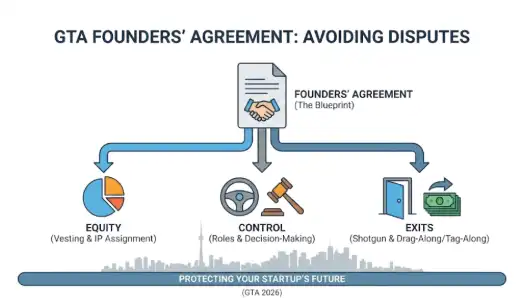
A Founders’ Agreement is a legally binding contract that governs how equity is earned, how decisions are made, how IP is owned, and how a co-founder can exit — before any of those situations become a crisis. Without one, 65% of startups fail not from product-market fit problems, but from co-founder conflict that a written agreement would have resolved.
This guide covers the 7 non-negotiable terms every GTA startup should include in their founders’ agreement before a single dollar of investment arrives.
1. Reverse Vesting — The Equity Handcuff Clause
The most common and costly mistake early-stage founders make is issuing shares outright on day one. If your co-founder receives 50% of the corporation immediately and walks away after three months to take a job elsewhere, they still own half your company. That cap table structure makes you functionally uninvestable to any serious Ontario or GTA-based venture capital firm.
How Reverse Vesting Works
The solution is reverse vesting — a mechanism where founders technically receive their shares upfront (which matters for tax purposes under Canadian law), but the corporation retains a contractual right to repurchase unvested shares at a nominal price (typically $0.0001 per share) if the founder departs before earning them.
The GTA standard schedule mirrors what has become the North American startup norm: a 4-year vesting period with a 1-year cliff. Under this structure, if a founder leaves before the 12-month mark, they walk away with nothing. After the cliff, 25% of their shares vest immediately. The remaining 75% vest monthly over the following 36 months.
This structure ensures that every founder’s equity reflects their actual contribution to the business. It also protects the remaining founders from carrying a permanent, non-contributing shareholder on the cap table — a problem that becomes acutely visible when you need to allocate equity to a replacement co-founder or early employee. Before issuing any shares, the corporation must first be properly structured — something our guide to choosing the right business structure in Ontario addresses in detail.
2. IP Assignment — Closing the Side Hustle Trap
In 2026, many GTA founders are building their startups while simultaneously employed elsewhere, completing graduate programs at universities like Waterloo or Toronto Metropolitan University, or running other ventures. This creates one of the most dangerous and frequently overlooked legal risks in early-stage company formation.
The Canadian Copyright Default
Under Canadian copyright law, the creator of intellectual property owns it — not the company they eventually build around it. If your co-founder writes the core application code on their personal laptop before the corporation is incorporated, they own that code. If the relationship deteriorates and they leave, they can legally withhold or seek compensation for IP that your entire business depends on.
What the Assignment Clause Must Cover
Your founders’ agreement must include explicit language stating that all past, present, and future intellectual property created in connection with the business is irrevocably assigned to the corporation upon its creation. This includes code, designs, trade secrets, business processes, and any derivative works.
Two additional provisions are critical. First, each founder must waive their moral rights to the assigned work — a specific right under the Copyright Act that otherwise allows creators to object to modifications of their work even after ownership transfer. Second, if any founder is a current student, the agreement must explicitly address and resolve any IP ownership claims that their university’s IP policy may assert over work created using institutional resources. This IP assignment obligation extends beyond co-founders to contractors and vendors as your team grows — a risk we cover in detail in our guide to protecting IP in Ontario contractor and software vendor agreements.
3. The Shotgun Clause — Breaking a 50/50 Deadlock
Many Brampton and GTA startups launch as 50/50 partnerships. Equal equity feels fair in the beginning. It becomes paralyzing the moment the two founders fundamentally disagree — on whether to accept an investor’s term sheet, hire a key executive, or pivot the product. With no mechanism to break the tie, the company freezes.
How the Shotgun Clause Resolves It
The shotgun clause is the standard deadlock-breaking mechanism for equal partnerships, and it is deliberately structured to produce fair outcomes. Founder A names a price per share and offers to buy Founder B’s shares at that price. Founder B then has a short, defined window — typically 48 to 72 hours — to make a binary choice: sell their shares to Founder A at the named price, or buy Founder A’s shares at that same price.
The elegance of the mechanism is that the party making the offer does not know in advance whether they will end up as buyer or seller. This compels realistic pricing. An artificially low offer risks the other founder buying you out cheaply. An artificially high offer is expensive to execute if the other founder forces you to buy them out at that price. The result is a fair market-driven transaction that ends the deadlock immediately and cleanly.
For startups with more complex shareholder structures — including outside investors or multiple classes of shares — the shotgun clause interacts directly with the broader governance provisions covered in our guide to shareholder agreements in Ontario.
4. Good Leaver vs. Bad Leaver — The Price of Departure
Not all founder exits are equal, and treating them identically is both legally inappropriate and practically damaging. A founder who leaves because of a terminal illness should not face the same financial consequences as one terminated for fraud or gross misconduct.
Defining the Categories
A Bad Leaver is a founder who is terminated for cause — defined circumstances that typically include fraud, criminal conviction, material breach of the founders’ agreement, or serious violations of fiduciary duty. The consequence for a Bad Leaver is that the corporation has the right to repurchase all shares, including vested shares, at nominal or book value. The departing founder exits with little or nothing beyond what the corporation chooses to pay.
A Good Leaver is a founder who departs through death, permanent disability, or termination without cause. The consequence here is materially different: Good Leavers typically retain their vested shares or receive fair market value for them upon repurchase.
The Drafting Battle
The definition of “Cause” is the most heavily negotiated provision in this section and for good reason. A vague or overbroad definition of cause allows one founder to manufacture a pretext for terminating another and repurchasing their equity at a fraction of its value. Your lawyer must define “Cause” narrowly, specifically, and with a high evidentiary threshold. The difference between a well-drafted and a poorly drafted Bad Leaver definition can be worth hundreds of thousands of dollars to a departing founder.
Our business law team advises GTA founders on structuring these provisions to protect all parties from opportunistic interpretation.
5. Drag-Along and Tag-Along Rights — Protecting Every Exit
Acquisition discussions reveal structural weaknesses in cap tables that seemed irrelevant at the seed stage. Two provisions — drag-along and tag-along rights — address the two most common problems that derail GTA startup exits.
Drag-Along Rights (Protecting the Majority)
When a buyer offers to acquire 100% of a company, they typically require exactly that — 100%. If a minority co-founder holding 8% of shares refuses to sell, the entire deal collapses. A drag-along right gives the majority shareholders the contractual authority to compel minority shareholders to sell their shares on the same terms and at the same price as the majority. The minority receives the same per-share value; they simply cannot block the transaction.
Tag-Along Rights (Protecting the Minority)
The inverse problem occurs when a majority founder sells their controlling stake to a private equity firm or strategic acquirer while minority founders remain behind with a shareholder they never agreed to partner with. A tag-along right gives minority shareholders the right to participate in the sale on identical terms — same price per share, same conditions — ensuring no founder can cash out while leaving others stranded in a company they no longer control.
Both rights must be defined in the founders’ agreement with clear triggering thresholds, notice periods, and price-adjustment mechanics to be reliably enforceable under Ontario corporate law.
6. Role Definition and Time Commitment — The Moonlighting Problem
In 2026’s gig economy environment, one of the most common and destructive sources of co-founder friction is asymmetric effort. One founder is working 70-hour weeks building the product while the other is treating the startup as a side project alongside consulting clients and board seats at other companies.
What the Agreement Must Specify
The founders’ agreement should define with precision: titles and decision-making authority (who is CEO, who is CTO, who controls what); time commitment expectations (is this a full-time role, or is part-time permissible during a defined period); and outside activity restrictions (are founders permitted to consult for other companies, accept advisory roles, or sit on other boards — and if so, under what conditions).
On decision-making, avoid the trap of requiring unanimous consent for routine operational matters. A workable governance structure operates in tiers: day-to-day decisions are made by the CEO alone; major decisions — hiring executives, taking on significant debt, entering material contracts — require board approval; and fundamental changes — selling the company, issuing new shares, amending the founders’ agreement itself — require shareholder approval. This structure preserves agility while protecting all founders from unilateral action on consequential matters.
7. Spousal Consent — The Family Law Exposure
This provision surprises many first-time founders, but it is essential for any GTA startup with married co-founders operating under Ontario law.
The Family Law Act Risk
Under Ontario’s Family Law Act, shares in a private corporation held by a spouse can form part of the “net family property” subject to equalization upon marriage breakdown. If your co-founder goes through a divorce, their spouse may be entitled to an equalization payment that effectively gives them an economic interest in your company. In extreme cases, without proper structuring, the spouse’s claim could result in them holding or having rights to a portion of your co-founder’s shares — creating a shareholder you never agreed to and cannot manage.
The Spousal Consent Solution
A spousal consent provision — signed by each founder’s spouse at the time the agreement is executed — requires the spouse to waive any claim to the shares themselves, agreeing instead to seek their equalization entitlement from the founder personally in cash, rather than from the shares directly. This keeps the corporate cap table clean and ensures that a co-founder’s marital breakdown does not disrupt the company’s governance or make you an involuntary business partner with someone’s ex-spouse.
Frequently Asked Questions
What is a founders’ agreement and is it legally required in Ontario?
A founders’ agreement is a contract between co-founders of a corporation that governs equity ownership, vesting schedules, IP assignment, decision-making authority, and exit mechanics. It is not legally required under Ontario law, but the absence of one is one of the leading causes of startup failure and co-founder litigation. Most institutional investors in the GTA will require one as a condition of investment.
What is reverse vesting and why do GTA investors require it?
Reverse vesting is a mechanism where founders receive their shares upfront but the company holds the right to repurchase unvested shares at nominal cost if a founder departs early. The standard GTA schedule is a 4-year vest with a 1-year cliff — meaning a founder who leaves before 12 months receives nothing, and thereafter earns shares monthly. Investors require it because a cap table with a departed, non-contributing founder holding significant equity makes the company structurally difficult to manage and uninvestable.
Who owns the IP if a founder writes code before the company is incorporated?
Under Canadian copyright law, the creator owns the IP by default. If a founder writes code, creates designs, or develops any business-critical intellectual property before the corporation exists, that IP belongs to them personally — not the company. A founders’ agreement with a properly drafted IP assignment clause, executed at the time of incorporation and backdated to cover prior work, transfers that ownership to the corporation and eliminates the risk of a departing founder holding your product hostage.
What is a shotgun clause and when does it apply?
A shotgun clause is a deadlock-breaking mechanism used in 50/50 partnerships. One founder names a price per share and offers to buy the other out at that price. The receiving founder must either sell at that price or buy the first founder out at the same price. Because the offering party does not know which role they will play, the mechanism compels fair pricing. It applies when the founders reach an irreconcilable disagreement on a matter that cannot be resolved through normal governance.
Can a spouse claim a co-founder’s startup shares in an Ontario divorce?
Potentially yes. Under Ontario’s Family Law Act, private corporation shares held by a spouse can form part of net family property subject to equalization. Without a spousal consent clause in the founders’ agreement — signed by each founder’s spouse — a divorce could create a situation where the ex-spouse has an economic claim tied to the shares, disrupting the cap table and governance of the company. Spousal consent provisions address this by directing any equalization claim to a personal cash settlement rather than the shares themselves.
When is the right time to sign a founders’ agreement?
Before anything else of value exists — ideally at or immediately before incorporation, when equity is worth nothing and every founder is aligned. Once a company has received investment, generated revenue, or received an acquisition inquiry, the negotiating dynamics between founders shift dramatically and the cost of reaching agreement on these terms increases substantially. Waiting until there is money on the table to draft a founders’ agreement is one of the most expensive mistakes a GTA startup can make.
Sign the Agreement Before the Money Arrives
The best time to execute a founders’ agreement is when the equity is worth nothing and everyone is still friends. Once a term sheet arrives or an acquirer makes contact, greed and leverage enter the equation and the cost of reaching agreement on these terms — in time, legal fees, and damaged relationships — increases by an order of magnitude.
The seven provisions in this guide are not optional additions for sophisticated startups. They are the baseline contractual infrastructure that separates a fundable, scalable GTA company from a time bomb waiting for the first serious disagreement to detonate.
Book a consultation with GS Arora Law to have your founders’ agreement drafted or reviewed by a business lawyer who works with Brampton and GTA startups at every stage.
Disclaimer: The information provided in this blog is for general informational purposes only and should not be considered legal, tax, financial, or professional advice. Regulations and procedures may change over time and vary by jurisdiction. For guidance tailored to your specific situation, please consult a qualified professional.