
How Ontario Corporations Should Structure Commercial Leases in Brampton to Reduce Risk in 2026
Book Consultation Book Consultation
13
FebHow Ontario Corporations Should Structure Commercial Leases in Brampton to Reduce Risk in 2026
As we move through 2026, the Brampton commercial real estate market presents a strategic paradox. While Peel Region’s industrial sector remains strong, the office and retail plaza sectors are still absorbing the disruption of the past several years. Vacancy rates in Class B and C office buildings remain elevated, and retail plazas face sustained pressure from shifting consumer behaviour.
For corporate tenants, this sluggishness is leverage.
In a slow commercial leasing market, Ontario corporations have a rare window to negotiate lease terms that go far beyond price per square foot — structuring agreements that function as risk management tools with capped financial exposure, flexible exit options, and broad usage rights. The lease you sign today in Brampton locks in your risk profile for the next decade.
This guide explains the six most critical lease provisions Ontario corporations should negotiate in 2026, and why reviewing any commercial lease with a business lawyer before signing is essential.
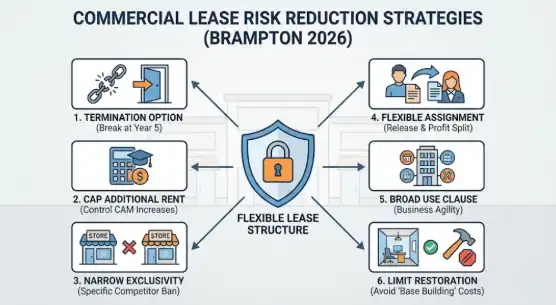
1. The Termination Option — Your Exit Clause
In a booming market, landlords dismiss termination clauses outright. In 2026, they are negotiating them.
Why It Matters
A standard 10-year commercial lease with no exit mechanism is a serious liability for any corporation whose business model, staffing levels, or space requirements may shift. A company that commits to 8,000 square feet of Brampton office space in 2026 may be half that size by 2029 — or fully remote.
How to Structure It
Instead of a flat 10-year term, negotiate a “5 + 5” arrangement or a 10-year term with a contractual break option at year 5 (the 60th month). The termination clause should specify a pre-negotiated exit penalty — typically 3 to 6 months’ rent plus any unamortized tenant inducement costs the landlord provided (free rent periods, leasehold improvement allowances).
The critical benefit: your maximum downside exposure on an early exit is capped and known from day one. You are not exposed to years of rent on an empty space you no longer need. Given the importance of well-structured commercial agreements across all aspects of business operations — not just real estate — the principles in our guide to key contract clauses for Brampton businesses apply equally here.
2. Cap Your Additional Rent — TMI and CAM Protections
Base rent gets all the attention in commercial lease negotiations. Additional rent — specifically TMI (Taxes, Maintenance, and Insurance) — is where budgets quietly collapse.
The Risk in Peel Region
Municipal property taxes in Peel Region have risen steadily to fund infrastructure investment. Because TMI is passed directly to tenants in most net leases, an uncontrolled TMI increase of 8–12% in a single year can blow a corporation’s occupancy budget even if the base rent stays flat.
How to Structure It
You cannot cap municipal property taxes — those are set by the municipality. But you can and should cap Controllable Common Area Maintenance (CAM) costs. Negotiate a year-over-year cap on controllable expenses (for example, CAM cannot increase by more than 5% annually, excluding items like snow removal and utilities that are genuinely market-driven).
The Gross-Up Protection: This is a clause many tenants overlook entirely. In a multi-tenant building where occupancy is 60%, landlords often “gross up” operating costs to a 95% occupancy basis — in effect, billing each existing tenant as though the building were nearly full, while the landlord’s vacant units contribute nothing. Negotiate language that limits any gross-up calculation to a realistic occupancy figure (80% is a common negotiated standard), ensuring your corporation is not subsidizing the landlord’s empty floors.
3. Exclusivity Clauses — Competition Act Compliance in 2026
For corporations leasing retail space in Brampton plazas — near Trinity Common Mall, Bramalea City Centre, or along major arterial corridors — an exclusivity clause is essential protection against a direct competitor opening within the same property.
The 2026 Legal Shift
Recent amendments to the federal Competition Act (stemming from Bill C-56) have introduced new scrutiny of broad exclusivity provisions in commercial leases. Clauses that “substantially lessen competition” in a market are now legally vulnerable — meaning an overly broad exclusivity clause may be unenforceable precisely when you need it most.
How to Structure It
Draft your exclusivity clause narrowly and specifically. Rather than banning “any food sales” in the plaza, ban “quick-service Mexican-style burrito restaurants operating under 2,000 square feet.” This protects your core business operation without making a sweeping competitive claim that could be challenged under the Competition Act. The narrower and more precisely defined your exclusivity, the more defensible it is and the more likely a landlord is to agree to it.
4. Assignment and Subletting — The Pivot Provision
Standard commercial lease language frequently allows landlords to “arbitrarily withhold consent” on assignment or subletting requests — or worse, to terminate the lease entirely when a tenant asks to sublet. For a corporation in a slow market that may need to downsize, sell its business, or exit a location, this is a critical exposure.
How to Structure It
Negotiate that landlord consent to assignment or subletting cannot be unreasonably withheld. This is a standard of reasonableness recognized in Ontario commercial lease law and provides you recourse if a landlord refuses consent without legitimate justification.
The Release Trigger: Without a specific release clause, if you assign your lease to a creditworthy new tenant and that tenant defaults three years later, you remain personally liable as an indemnifying party. Negotiate language that releases your corporation from ongoing indemnity obligations upon a successful assignment to a financially qualified assignee.
Profit-Sharing on Subletting: Many leases give landlords 100% of any “profit” generated when a tenant sublets at a higher rent than their base rate. In 2026, negotiate a 50/50 profit split after deducting your legitimate costs — broker commissions, legal fees, and any leasehold improvements made for the subtenant.
This provision becomes particularly important when a corporation is being sold or restructured — scenarios our guide to shareholder agreements in Ontario addresses in the context of share sales and business transfers, where the commercial lease is often a key asset being transferred to an incoming owner.
Our business law team reviews commercial lease assignments and subletting provisions as part of broader corporate transactions throughout Brampton and the GTA.
5. Permitted Use Clauses — Broaden Your Operational Flexibility
A narrow Permitted Use definition is one of the most quietly damaging provisions in a commercial lease. If your lease says “offices for accounting services only” and your firm begins offering financial planning or bookkeeping software support, you may technically be in breach of your lease.
How to Structure It
Negotiate the broadest Permitted Use definition the landlord will accept.
A restrictive clause reads: “Retail store for the sale of athletic footwear.”
A protective clause reads: “Retail store for the sale of athletic footwear, apparel, accessories, and related goods, and any other lawful retail use.”
The business case for this is straightforward: broader permitted use makes your space more adaptable if your core product or service line shifts during the lease term. It also substantially increases the value of your leasehold interest if you need to assign the lease or sell your business, since a wider range of potential assignees can legally operate from the space. The connection between your lease structure and your overall corporate structure matters — something we explore in our guide to choosing the right business structure in Ontario, where the corporation’s liability profile and operational flexibility are foundational decisions.
6. The Restoration Clause — Avoid a Six-Figure Exit Surprise
The single most expensive shock many corporate tenants face occurs not during the lease but at the end of it. Standard “Make Good” or “Restoration” clauses require tenants to return the premises to “base building condition” — meaning a stripped concrete shell, with all leasehold improvements demolished and removed.
The Cost Reality
In a 5,000 square foot Brampton office, full demolition and restoration to base building condition can cost $50,000 to $100,000 or more depending on the extent of improvements. This is a liability that crystallizes on your last day of occupancy — when your business is already bearing the cost of a new location.
How to Structure It
In a slow market where landlords actively want built-out, turnkey space to attract the next tenant quickly, you have genuine negotiating leverage here. Propose restoration language that excludes standard leasehold improvements — demising walls, flooring, standard lighting, and millwork — from the demolition obligation, limiting your make-good responsibility to specialized installations (server rooms, custom venting, branded features) that a general new tenant would not want.
This single clause negotiation, done correctly at the outset, can save a corporation tens of thousands of dollars at lease expiry.
Frequently Asked Questions
What is TMI in a Brampton commercial lease and how can it be capped?
TMI stands for Taxes, Maintenance, and Insurance — the “additional rent” charged on top of base rent in most Ontario net commercial leases. Property taxes cannot be capped as they are set by the municipality, but controllable Common Area Maintenance (CAM) costs can be capped through a negotiated year-over-year increase limit, typically 3–5% annually. A gross-up protection clause also prevents tenants from being billed as though the building were fully occupied when it is not.
Can a commercial lease in Ontario include a termination or break clause?
Yes, and in the current 2026 Brampton market, landlords are more receptive to break options than they have been in years. A standard break clause allows the tenant to exit at a specified date — typically the midpoint of the term — in exchange for a pre-negotiated penalty, usually 3 to 6 months’ rent plus unamortized inducement costs. This clause must be drafted precisely, including the notice period and penalty formula, or it may not be enforceable.
What happens if I want to sublet my Brampton commercial space?
Your right to sublet is governed entirely by your lease. Most standard landlord leases restrict subletting and give the landlord broad discretion to refuse consent or recapture the space. Before signing, negotiate language requiring that consent cannot be unreasonably withheld, that you are released from liability upon assignment to a qualified assignee, and that any sublet profit is shared rather than fully surrendered to the landlord.
Are exclusivity clauses in Brampton plaza leases still enforceable in 2026?
Broad exclusivity clauses are under increased scrutiny following amendments to the federal Competition Act. Clauses that substantially lessen competition in a market can now be challenged. The solution is to draft exclusivity provisions narrowly — protecting your specific business category and format rather than an entire product sector — which both reduces legal risk and makes the clause more likely to survive a challenge.
Do I need a lawyer to review a commercial lease in Ontario?
Yes. An Offer to Lease or a commercial lease agreement is a legally binding document that can create obligations running 5 to 20 years and expose a corporation to millions of dollars in rent liability. Key provisions — restoration obligations, gross-up calculations, exclusivity language, and assignment rights — are easy to miss without legal review and can be extraordinarily expensive to remedy after signing.
What is a “gross-up” clause and why does it matter?
A gross-up clause allows landlords to calculate each tenant’s proportionate share of building operating costs as though the building were operating at a specified occupancy level (often 95%), regardless of actual occupancy. In a building that is only 60% occupied, this means existing tenants effectively subsidize the costs attributable to vacant units. Negotiating a realistic gross-up cap — typically 80% — protects your corporation from absorbing costs that the vacant portion of the building should bear.
The Lease You Sign Today Shapes Your Risk for the Next Decade
The current commercial leasing environment in Brampton will not last. As absorption rates improve and vacancy tightens — likely by 2028 to 2029 — the leverage currently available to corporate tenants will shift decisively back to landlords.
The protections described in this guide — break options, TMI caps, gross-up protections, broad use clauses, and restoration limitations — are significantly easier to negotiate today than they will be in a tighter market. A commercial lease without these provisions is not just an overhead commitment; it is an uncapped financial exposure that can outlast the business conditions that made the space make sense in the first place.
Book a consultation with GS Arora Law before signing your next Offer to Lease or lease renewal in Brampton or across the GTA.
Disclaimer: The information provided in this blog is for general informational purposes only and should not be considered legal, tax, financial, or professional advice. Regulations and procedures may change over time and vary by jurisdiction. For guidance tailored to your specific situation, please consult a qualified professional.