
HST Fraud and the Hidden Cost of Dishonesty: How Some Small Businesses Get Caught Cutting Corners
Book Consultation Book Consultation
22
OctHST Fraud and the Hidden Cost of Dishonesty: How Some Small Businesses Get Caught Cutting Corners
Introduction
In the world of small business — especially in the restaurant and retail sector — competition is fierce and margins are thin. Many owners struggle to keep up with rising costs, payroll, rent, and taxes. While most business owners operate honestly and “by the books,” a persistent number quietly cross the line — under-reporting sales or failing to remit the Harmonized Sales Tax (HST) they collect from their own customers.
For honest entrepreneurs, this can be genuinely frustrating to watch. You collect and remit every dollar of HST as required, while others appear to get away with keeping part of it. The natural questions are: how are they getting away with this, and more importantly, what are the real risks and consequences if they’re caught?
This guide breaks down how HST actually works, why some businesses choose to cheat, how the CRA detects non-compliance in 2026, and why integrity ultimately remains the smarter financial strategy — especially with proper guidance from an accountant or a tax lawyer in Brampton.
Understanding How HST Actually Works
When a business sells goods or services subject to HST, it collects that tax from customers on behalf of the government — it never belongs to the business itself. The business doesn’t simply hand over everything collected, though. It first subtracts its Input Tax Credits (ITCs) — the HST the business itself paid on eligible expenses — and remits only the net difference.
Example: a restaurant collects $13,000 in HST from customers over a reporting period. During that same period, it paid $4,000 in HST on its own eligible expenses — food supplies, rent, equipment. It claims that $4,000 as an ITC and remits the remaining $9,000 to the CRA.
That’s how the system is designed to work. See our detailed guide on HST registration, filing, and ITCs for GTA businesses for the full mechanics of this calculation.
The problem arises when a business collects the full amount from customers but remits only part of it — or none at all. This is not a bookkeeping shortcut. It is tax fraud under the Excise Tax Act.
How Businesses Manipulate HST
There are several methods dishonest operators use to hide HST they legally owe:
- Cash sales left off the books entirely — a transaction paid in cash is simply never entered into the point-of-sale system, so no HST is ever recorded as collected on it in the first place.
- “Two sets of books” — maintaining an internal, accurate record of true sales alongside a separate, understated version filed with the CRA.
- Point-of-sale (“zapper”) software manipulation — using software specifically designed to selectively delete or alter transaction records after the fact, making the deletion difficult to detect through a casual review.
- Misclassifying taxable sales as exempt or zero-rated — deliberately coding taxable goods or services under an exempt category to avoid collecting HST on them at all.
- Delayed or partial remittance — collecting the full HST amount from customers but remitting only a portion to the CRA, treating the shortfall as informal, interest-free “borrowing.”
In every one of these scenarios, the business retains money that legally belongs to the government from the moment it was collected from a customer.
Why Some Businesses Take the Risk
Running a restaurant or small business is genuinely difficult. Profit margins are often under 10%, and a single slow quarter can put an owner underwater. Some rationalize non-remittance as temporarily “borrowing” from the CRA, quietly promising themselves they’ll catch up later. Others convince themselves that everyone in their industry does the same thing, or that the CRA simply can’t catch every small offender.
Reputable franchise brands typically have strict internal oversight — corporate head offices control point-of-sale data centrally and monitor cash flow patterns across locations. For independent businesses without that structural oversight, there is simply more room to manipulate the numbers — and therefore more temptation to do so.
Still, this is never a victimless shortcut.
The Ripple Effect of HST Fraud
When some businesses don’t remit their fair share, the shortfall doesn’t simply disappear — it shifts onto everyone else:
- Honest competitors are undercut on price, since a business retaining HST it should have remitted can effectively operate on a lower true cost base, allowing it to underprice competitors who are fully compliant.
- The tax burden shifts to compliant taxpayers, since government revenue targets don’t change — unremitted tax from noncompliant businesses is effectively made up elsewhere, including through enforcement costs funded by everyone.
- Legitimate businesses face harder scrutiny, since widespread non-compliance in a sector — restaurants, for example — leads the CRA to apply more aggressive industry-wide audit benchmarks that catch honest operators in the same net.
In short, HST fraud punishes the honest and rewards the reckless — but typically only until the CRA catches up.
How the CRA Detects Non-Compliance in 2026
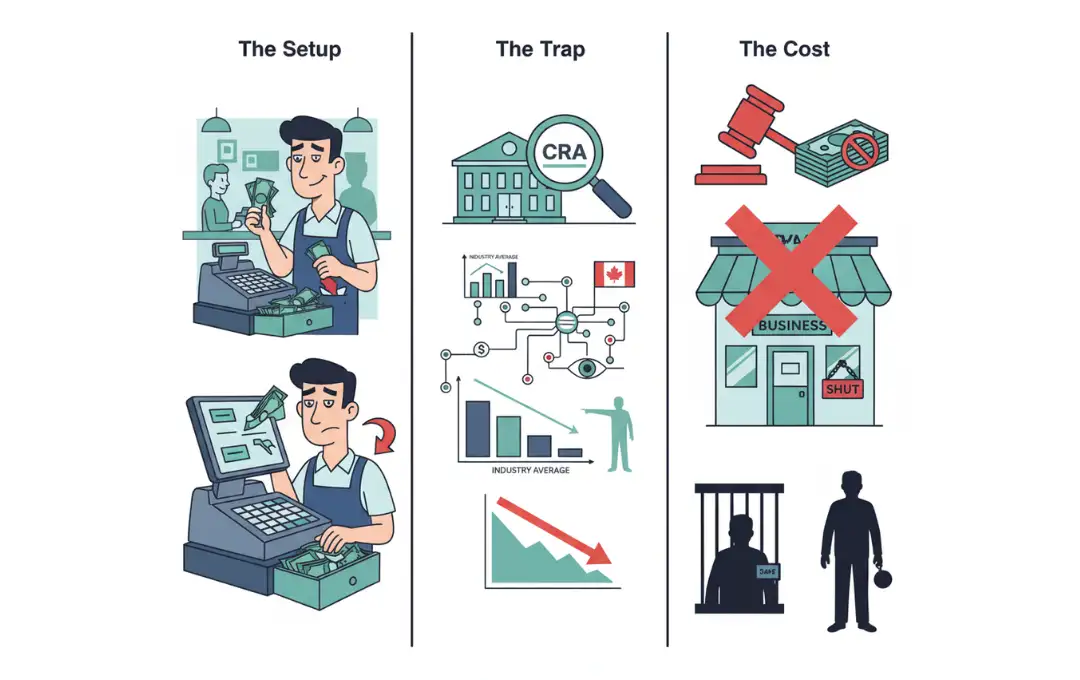
Many business owners assume the CRA lacks the capacity to catch small operators, but that assumption is increasingly outdated. The agency now uses data analytics, industry-specific benchmarks, and AI-driven pattern comparison to detect irregularities that would have gone unnoticed a decade ago.
What Commonly Triggers an Audit
- Reported sales significantly below industry benchmarks for a business’s size, location, and sector — the CRA maintains detailed profitability and revenue benchmarks by industry code
- A consistent mismatch between reported income and visible lifestyle indicators — luxury vehicles, real estate purchases, or major renovations inconsistent with reported business income
- Disproportionately high ITC claims relative to reported sales, which can suggest sales are being under-reported while expenses are claimed in full
- Tips from former employees, competitors, or business partners, which remain a genuine and common source of CRA audit referrals
- Inconsistencies between point-of-sale system data and reported HST filings, increasingly detected through direct data-matching where the CRA has access to POS export data during an audit
Once flagged, the CRA can go back multiple years, formally demand records, and impose penalties far exceeding the original unremitted amount.
Penalties for Not Remitting HST
Failing to remit HST is a serious offence under the Excise Tax Act, not a minor administrative lapse. Penalties can include:
- A penalty of up to 50% of the amount of tax sought to be evaded, in cases the CRA characterizes as involving genuine intent to evade
- Interest charges accruing on the unpaid amount from the date it was originally due, compounding daily
- Gross negligence penalties, applied where the CRA determines the failure to remit was more than a simple error
- Criminal prosecution under the Excise Tax Act in serious cases, which can result in significant fines and, in the most serious cases, imprisonment
In addition to these direct penalties, the CRA can freeze bank accounts, garnish receivables directly from customers, or place a lien on personal or business property to secure collection. Directors of a corporation can also face personal liability for unremitted HST, since it is legally treated as funds held in trust for the Crown — corporate liability protection does not shield directors from this specific obligation. The cost of getting caught substantially outweighs any temporary cash flow benefit.
The Role of Accountants and Advisors
Unfortunately, some business owners are misled by accountants or bookkeepers who tolerate or even encourage aggressive reporting practices, sometimes framing partial remittance as “standard industry practice” or assuring clients that the CRA “never really checks small restaurants.”
Professional accountants and bookkeepers have a legal and ethical obligation to report accurately — and critically, the business owner remains ultimately responsible for what is filed under their own name. “My accountant told me it was fine” is not a valid legal defence against a CRA reassessment or penalty.
If you ever feel pressured to falsify numbers or ignore a remittance obligation, seek a second opinion immediately — ideally from a corporate tax lawyer who can provide confidential, legally privileged advice separate from your existing accounting relationship.
Staying Compliant: Best Practices for Small Businesses
- Use a modern point-of-sale system that records every transaction electronically and cannot be selectively edited after the fact without leaving a clear audit trail.
- Reconcile bank deposits against daily sales reports as a routine practice, not just at year-end, so any discrepancy is caught early rather than compounding over months.
- Maintain a single, accurate set of books — never a separate internal version that differs from what’s filed with the CRA.
- Have your accountant or bookkeeper explain every HST filing before it’s submitted, rather than simply signing off on a number you don’t fully understand.
- Consider the CRA’s Voluntary Disclosures Program if you discover a past filing error — coming forward proactively before the CRA identifies the issue independently can result in significantly reduced penalties compared to being caught through an audit.
The Honest Way to Stay Profitable
For business owners feeling genuinely squeezed by thin margins, there are legal and strategic ways to improve cash flow without crossing into fraud:
- Maximize your legitimate Input Tax Credits on every eligible business expense, rather than leaving money on the table through poor record-keeping
- Restructure your corporate tax position properly, taking full advantage of the small business tax rate and available deductions rather than risking HST non-compliance for a similar cash benefit
- Negotiate payment terms with the CRA through a formal payment arrangement if you’re genuinely behind, rather than allowing the situation to compound silently through continued non-remittance
A tax lawyer in Ontario can help structure your business for genuine long-term efficiency while keeping you fully compliant with CRA regulations. Integrity in business isn’t simply the right thing to do — it remains a sound financial strategy over the long run.
Conclusion
HST non-remittance might seem like a victimless shortcut in the moment, but it is a form of tax fraud that undermines fair competition and public trust alike. While some businesses may evade detection for a time, the CRA’s tools for identifying inconsistencies continue to grow more sophisticated every year.
Honest business owners who properly collect and remit their HST are not actually at a disadvantage — they are protected. They can maintain clean, defensible records, sleep without worrying about a knock at the door, and remain eligible for financing, government grants, and franchise opportunities that a business with an unresolved compliance history may never access.
If you are unsure about your HST remittances, or suspect there may be errors in your past filings, don’t wait for the CRA to come to you first. Contact GS Arora Law to speak with our business law team about reviewing your compliance and correcting any past issues before they become a CRA-initiated problem.
Disclaimer: The information provided in this blog is for general informational purposes only and should not be considered legal, tax, financial, or professional advice. Regulations and procedures may change over time and vary by jurisdiction. For guidance tailored to your specific situation, please consult a qualified professional.