
How Can Ontario Startups Structure R&D Activities to Maximize Tax Credits and Grants in 2026?
Book Consultation Book Consultation
10
DecHow Can Ontario Startups Structure R&D Activities to Maximize Tax Credits and Grants in 2026?
Introduction: Don’t Leave Innovation Capital on the Table
For Ontario startups, cash flow is oxygen. Venture capital and revenue are the obvious lifelines, but there is a third pillar of funding that many founders underutilize: non-dilutive government incentives.
In 2026, the R&D funding landscape in Canada is more generous than it has been in years — driven by federal enhancements to the Scientific Research and Experimental Development (SR&ED) program introduced in 2025, and the continued aggressive rollout of provincial IP funding through Intellectual Property Ontario (IPON). But this money only reaches founders who are structured correctly before they start spending.
Many Brampton and GTA founders treat R&D credits as an afterthought — something for the accountant to “figure out” at tax time. This is a costly mistake. By the time you file, the structural decisions that determine how much you get back have already been made — often a year earlier.
This guide explains how to proactively structure your team, your contracts, and your documentation in 2026 to maximize your return on innovation.
1. The 2026 SR&ED Landscape: A Bigger Pot for Startups
SR&ED remains the cornerstone of Canadian innovation funding. It provides a refundable investment tax credit — real cash back — for eligible R&D work.
What Changed and Remains in Effect for 2026
Increased refundable limit: The expenditure limit for the enhanced refundable credit (the 35% federal rate) has phased up to $6 million for qualifying Canadian-Controlled Private Corporations (CCPCs) — up from the previous $3 million ceiling.
Capital expenditures restored: In a significant reversal, capital expenditures — such as equipment purchased specifically for R&D testing — are once again eligible for SR&ED claims. If you are buying hardware to test a hypothesis, that cost may now be claimable.
The Ontario boost: In addition to the federal 35% credit, Ontario startups can layer on:
- Ontario Innovation Tax Credit (OITC): an 8% refundable credit
- Ontario Research and Development Tax Credit (ORDTC): a 3.5% non-refundable credit
For a CCPC in Ontario, combining all three programs can result in getting back roughly 40 to 60 cents on every dollar spent on eligible R&D wages.
2. Structural Strategy #1: Employees vs. Contractors — The SR&ED Trap
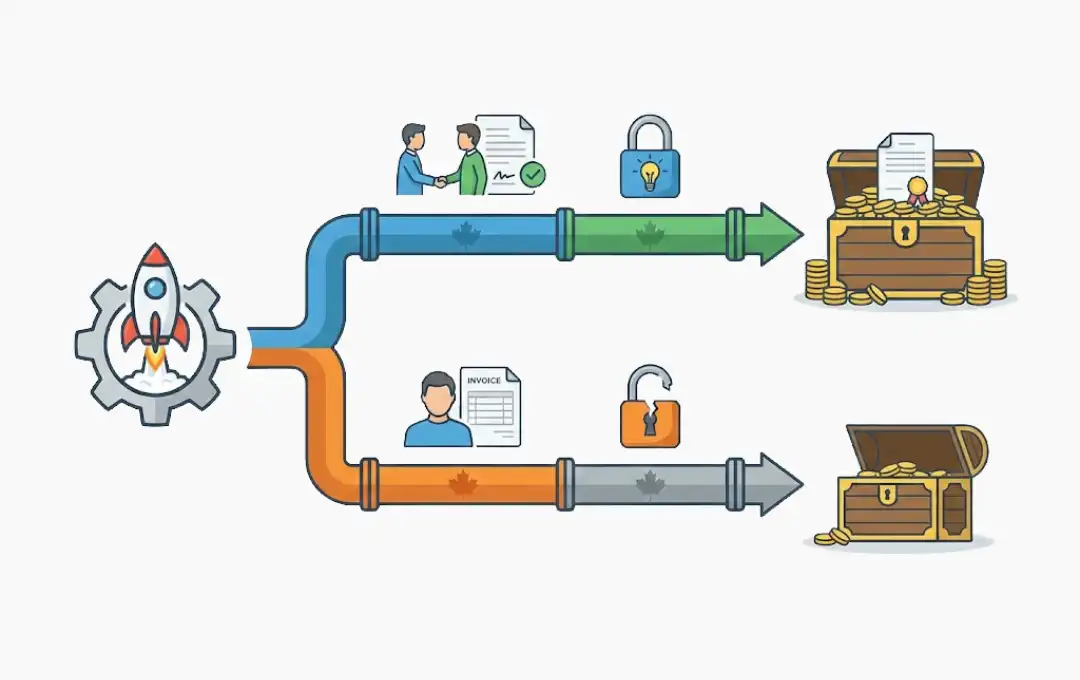
One of the most common mistakes early-stage startups make is hiring everyone as a contractor to save on payroll taxes. This decision often backfires significantly when calculating SR&ED.
The T4 Advantage
SR&ED credits are calculated primarily on wages. If you hire a Canadian employee on a T4, you can claim 100% of their eligible R&D salary, plus a Proxy Amount — an overhead allowance calculated at approximately 55% of that salary.
The Contractor Haircut
If you hire a Canadian contractor instead, you can generally claim only 80% of the fee paid — and you cannot claim any Proxy Amount on contractor fees at all.
The Foreign Contractor Ban
Payments to non-Canadian contractors — developers based in the US or overseas, for example — are generally 0% eligible for SR&ED, regardless of the work performed.
2026 tip: If you have a key developer currently classified as “contract-only,” run the actual math. Converting them to a T4 employee increases your CPP and EI costs, but the resulting increase in your SR&ED refund often outweighs that cost significantly — sometimes by a wide margin.
For guidance on properly classifying workers and the CRA risks of misclassification, see our companion guide on the $50,000 mistake: CRA contractor vs. employee rules.
3. Structural Strategy #2: IP Ownership and Grant Eligibility
Ontario remains heavily focused on intellectual property retention in 2026. Programs like IPON (Intellectual Property Ontario) and ElevateIP offer significant grants — up to $100,000 in some streams — to help startups patent and commercialize their technology.
These grants carry one strict, non-negotiable requirement: you must own the IP.
The Contractor Risk
If your independent contractor agreements do not contain a specific IP assignment clause, the contractor owns the IP by default under Canadian law — not your company. This can instantly disqualify you from IP grants, and it can also jeopardize your SR&ED claim, since the CRA wants to see that your corporation bears the actual risk and ownership of the R&D being claimed.
The Structure Fix
Ensure every single contributor — co-founder, employee, and contractor alike — has signed a robust IP Assignment Agreement in favour of the corporation before they write a single line of code. Retrofitting this after the fact is far harder, and sometimes impossible, once a contributor has left the company. See our guide on protecting trademarks, trade secrets, and IP in contracts with contractors and vendors for the specific clauses to include.
4. Structural Strategy #3: Project Tracking — The “Why,” Not Just the “What”
The CRA’s AI-driven audit tools are becoming increasingly effective at identifying “routine engineering” work disguised as eligible R&D.
The Mistake
Tracking hours by feature: “Built login page — 10 hours.” This kind of documentation gives the CRA nothing to distinguish routine development from genuine technological uncertainty.
The Fix
Track hours by technical obstacle instead.
- Weak: “Fixed database lag.”
- Strong: “Investigated novel query caching architecture because standard SQL indexing failed to handle concurrent write-loads of 10,000 transactions per second.”
Structure your workflow tool — Jira, Trello, or similar — to tag tickets as “SR&ED Candidate” whenever a developer encounters a problem that standard references like Stack Overflow or documentation could not resolve. This creates the contemporaneous documentation the CRA specifically looks for during an SR&ED review.
5. Stacking Strategy: Combining IRAP and SR&ED
The Industrial Research Assistance Program (IRAP) is a grant, not a tax credit — it pays for eligible R&D wages proactively, on a monthly basis, rather than as a year-end refund.
Can You Claim Both?
Yes — with one important catch. IRAP funding counts as government assistance, which reduces your eligible cost base when calculating your SR&ED claim at year-end.
The Strategy
Use IRAP funding for cash flow throughout the year to keep operations running. Use SR&ED at year-end to top up the difference between what IRAP covered and your full eligible R&D spend.
Important: IRAP is competitive and requires approval before you begin the work it is meant to fund. You cannot apply retroactively for work already completed.
Conclusion: Build the “R&D Factory”
In 2026, a successful Ontario startup doesn’t just build a product — it builds a documentation and structuring engine that turns innovation into non-dilutive capital. Prioritizing T4 hires where the math supports it, securing strict IP ownership from every contributor, and documenting technological uncertainty in real time together transform your tax return from a compliance burden into a genuine source of funding.
Don’t wait until your fiscal year-end to think about R&D structuring. The decisions you make today — how you hire, how you contract, and how you document — determine the refund you receive next year.
If you are structuring contracts, IP assignments, or corporate documentation to maximize your SR&ED and grant eligibility, contact GS Arora Law to speak with our business law team.
Disclaimer: The information provided in this blog is for general informational purposes only and should not be considered legal, tax, financial, or professional advice. Regulations and procedures may change over time and vary by jurisdiction. For guidance tailored to your specific situation, please consult a qualified professional.