
Professional Corporations in Ontario 2026: A Guide for Doctors, Dentists & Lawyers
Book Consultation Book Consultation
11
JunProfessional Corporations in Ontario 2026: A Guide for Doctors, Dentists & Lawyers
Introduction
For licensed professionals in Ontario — doctors, dentists, lawyers, accountants, optometrists, veterinarians, architects, engineers, and others — incorporation is permitted, but the structure is meaningfully different from an ordinary Ontario business corporation. The corporation must satisfy not just the Business Corporations Act (Ontario) but also the governing professional statute and the specific rules of that profession’s regulator on naming, ownership, and conduct. Getting the structure right unlocks real tax planning. Getting it wrong creates regulatory exposure on top of ordinary corporate exposure.
A professional corporation in Ontario is a corporation incorporated under the OBCA and authorized by the professional’s regulator to provide a specific professional service, such as medicine, dentistry, or law. Its shares generally must be owned by members of that same profession, and incorporation itself provides no shield against personal liability for professional negligence.
This guide explains how a professional corporation actually works in Ontario in 2026 — who can incorporate, what the share-ownership rules are, what changes about liability, and where the real tax advantages come from.
What Is a Professional Corporation in Ontario?
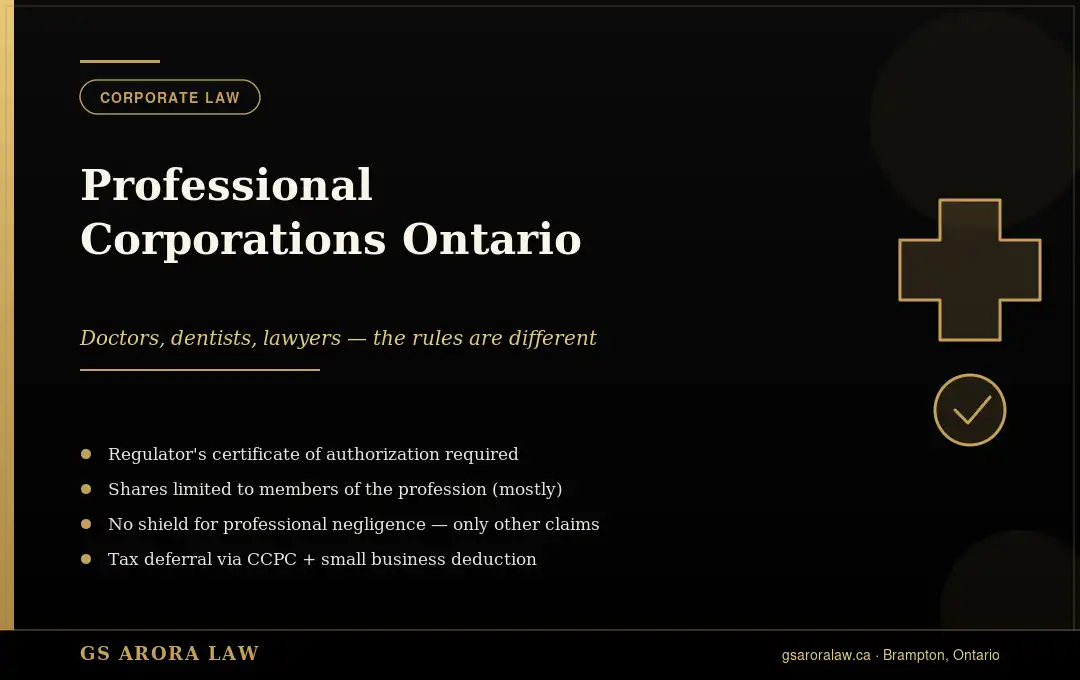
A professional corporation is an Ontario business corporation incorporated under the OBCA and authorized by the relevant regulator to provide professional services. The regulator issues a certificate of authorization confirming the corporation meets its requirements — and without that certificate, the corporation cannot lawfully provide the professional service, even though it has technically been incorporated.
The relevant regulators include the Law Society of Ontario for lawyers and paralegals, the College of Physicians and Surgeons of Ontario for physicians, the Royal College of Dental Surgeons of Ontario for dentists, and Chartered Professional Accountants of Ontario for CPAs. Optometrists, veterinarians, engineers, and architects are governed respectively by the College of Optometrists of Ontario, the College of Veterinarians of Ontario, Professional Engineers Ontario, and the Ontario Association of Architects, each with its own by-laws. Each regulator’s rules differ in the details, so the framework below describes the common shape — the specifics for any individual profession must be confirmed against that regulator’s current by-laws.
Who Can Own Shares in an Ontario Professional Corporation?
This is the rule that surprises new clients most: a professional corporation generally cannot have outside shareholders. The voting shares of an Ontario professional corporation must be owned by members of the same profession, and in most cases only that one profession’s members can hold voting shares.
Several professions allow family members to hold non-voting shares for income-splitting purposes, but the rules differ meaningfully between regulators. In medicine and dentistry, non-voting shares may be held by family-member shareholders — a spouse, parents, or children — under the regulator’s rules. In law, the Law Society’s by-laws restrict ownership to LSO licensees, and non-voting family shares are not permitted in the same way. Accountants and engineers are generally restricted to members of the profession as well.
Where the non-voting-family-share option is available, it forms the structural backbone of income-splitting planning for professional families — though the tax effectiveness of these plans has been significantly reduced by the federal Tax on Split Income (TOSI) rules in effect since 2018. Income splitting still works in some circumstances, but the easy versions are gone. Where multiple family members hold shares, even non-voting ones, a shareholder agreement becomes important to set out how those shares are valued and what happens if the professional’s circumstances change.
Naming Rules for a Professional Corporation
Professional corporations have specific naming requirements set by the regulator. As a general framework, the name must include the professional’s surname (and often initials or full name), the professional designation — “Medicine,” “Dentistry,” “Law,” “Optometry,” and so on — and the words “Professional Corporation,” rather than “Inc.” or “Ltd.”
Typical examples include “Smith Law Professional Corporation,” “Dr. J. Patel Medicine Professional Corporation,” “Lee Dentistry Professional Corporation,” and “Chen Accounting Professional Corporation.” Numbered professional corporations are generally not permitted, because the corporate name itself has to identify both the professional and the profession — unlike an ordinary Ontario business, where our guide to numbered vs. named corporations in Ontario explains that a numbered option is often available.
A practising professional can operate the practice under a different trade name — for example, “Mississauga Family Dental” — but the rules on trade-name use vary by regulator and have to be checked individually. The legal corporate name still appears on the certificate of authorization, on bills, and on all professional communications.
Liability: Why a Professional Corporation Doesn’t Shield Negligence Claims
The biggest misconception about professional corporations is that they protect the professional from negligence claims. They don’t. The professional remains personally liable for their own professional negligence regardless of the corporate structure, and most regulators reinforce this by requiring mandatory professional liability insurance — LawPRO for lawyers, the CMPA for physicians, and comparable schemes for other regulated professions.
What the corporate structure does protect against is non-professional liability: premises liability, contract disputes with suppliers, employment claims, and equipment leases. A landlord suing the practice for unpaid rent, a supplier suing over an unpaid invoice, or a former employee suing for wrongful dismissal are generally limited to pursuing the corporation’s assets rather than the professional’s personal assets, provided the corporation has been properly maintained as a separate legal entity. For most professionals, the personal-liability-for-negligence point is the headline takeaway — but the corporate shield remains real and valuable for everything else.
Where the Tax Advantage Actually Comes From
The main tax advantage of a professional corporation is tax deferral through the Canadian-controlled private corporation (CCPC) rules and the small business deduction. Active business income up to the small business limit is taxed at a low corporate rate, and the residual after-tax income can remain in the corporation and be invested, only taxed personally once it is distributed as dividends. For a professional consistently earning more than they spend in a given year, this deferral is meaningful: the portion not needed for personal expenses compounds at the corporate rate rather than the personal top marginal rate, and over a long career the difference compounds into a substantial sum.
Other benefits available through the structure include income splitting with family members through non-voting share dividends where the regulator and TOSI rules permit it, an Individual Pension Plan (IPP) — a defined-benefit pension option available to incorporated professionals that often provides more retirement room than an RRSP — and access to Health and Welfare Trusts or Private Health Services Plans for medical and dental benefits. On a future sale of the corporation’s shares, the Lifetime Capital Gains Exemption may also be available, subject to the qualifying small business corporation rules and TOSI. Investment income earned within the corporation is taxed at a high rate, though a refundable portion flows back to the corporation once dividends are eventually paid out.
These tax benefits are real, but they require active, ongoing planning with an accountant. A professional corporation set up without an accountant actively managing it is, in practice, a corporation paying full tax twice with none of the deferral advantage. Our Business & Tax Law team regularly coordinates the legal structuring side of this planning alongside a professional’s existing accountant, so the corporate documents actually support the tax strategy rather than working against it.
The Setup Process for a Professional Corporation in Ontario
A typical incorporation of a professional corporation in Ontario follows a consistent sequence. It begins with confirming eligibility with the regulator, including current good standing and no outstanding regulatory issues, followed by deciding the share structure — voting shares to the professional, and non-voting shares to family members if the regulator permits it and the planning makes sense. The corporate name is then cleared through a NUANS search, drafted to meet the regulator’s specific naming rules, before articles of incorporation are filed under the OBCA with the special-purpose restrictions required, since the corporation can only carry on the practice of the profession and activities ancillary to it.
Once incorporated, an organizational meeting is held to appoint directors and officers, issue shares, and adopt by-laws, after which the corporation applies for its certificate of authorization from the regulator, supported by corporate documents, insurance confirmation, and shareholder declarations. The final steps are opening a corporate bank account, registering for HST, payroll, and any other required CRA accounts, and notifying the regulator and tax authorities of the change. The process generally takes a few weeks once the regulator has the completed application in hand. The certificate of authorization is the critical step in this sequence — until it is issued, the corporation exists as a paper entity but cannot lawfully bill patients or clients.
When a Professional Corporation Is — and Isn’t — Worth It
Incorporation is most valuable for a professional consistently earning above what they spend personally. For a new associate at the start of their career, or a professional whose net practice income is fully drawn for living expenses, the ongoing cost of maintaining the corporation — accounting, filings, and general complexity — often exceeds the deferral benefit in the early years.
A professional with a stable practice, an accountant doing real planning, and earnings that meaningfully exceed personal spending will almost always benefit from incorporating. The exact break-even point depends on the profession and on personal spending patterns, and a CPA is the right person to model that trade-off before filing anything. For professionals still deciding between a professional corporation and other structures for a secondary business interest, choosing the right business structure in Ontario is a useful starting point.
Frequently Asked Questions
What is a professional corporation in Ontario?
It is a corporation incorporated under the Business Corporations Act (Ontario) and authorized by a professional regulator — such as the Law Society of Ontario or the College of Physicians and Surgeons of Ontario — to provide a specific professional service. It cannot lawfully bill clients or patients until the regulator issues a certificate of authorization.
Does a professional corporation protect me from malpractice or negligence claims?
No. This is the most common misconception about professional corporations. The professional remains personally liable for their own professional negligence regardless of incorporation, which is why regulators require mandatory professional liability insurance such as LawPRO or the CMPA.
Can my spouse or children own shares in my professional corporation?
It depends on the profession. Medicine and dentistry generally permit non-voting family shares for income-splitting purposes, subject to the regulator’s rules and federal TOSI restrictions, while law restricts ownership to Law Society licensees and does not allow non-voting family shares in the same way.
Who should consider incorporating a professional corporation in Ontario?
Professionals with a stable practice who consistently earn more than they spend personally are the best candidates, since the tax deferral benefit compounds over time. A new associate whose income is fully needed for living expenses often won’t see enough deferral benefit to justify the added accounting and filing costs in the early years.
Can a professional corporation have a numbered name, like an ordinary business?
No. Unlike an ordinary Ontario business corporation, a professional corporation’s legal name must include the professional’s surname and their designation, along with the words “Professional Corporation” — numbered names are generally not permitted for this structure.
Final Takeaway
Setting up a professional corporation in Ontario means coordinating with the regulator, the accountant, and often a financial planner — not simply filing articles of incorporation. Each profession has its own quirks in ownership rules, naming requirements, and tax planning opportunities, and getting the structure wrong can create regulatory exposure on top of ordinary corporate risk.
If you are a doctor, dentist, lawyer, or other regulated professional in Brampton or the GTA considering incorporation, book a free consultation with GS Arora Law and let us coordinate the legal structure with your accountant before any filings are made.
Disclaimer: The information provided in this blog is for general informational purposes only and should not be considered legal, tax, financial, or professional advice. Regulations and procedures may change over time and vary by jurisdiction. For guidance tailored to your specific situation, please consult a qualified professional.