Religious and Cultural Marriage and Divorce in Ontario: What Brampton Residents Need to Know in 2026
Book Consultation Book Consultation
25
MarReligious and Cultural Marriage and Divorce in Ontario: What Brampton Residents Need to Know in 2026
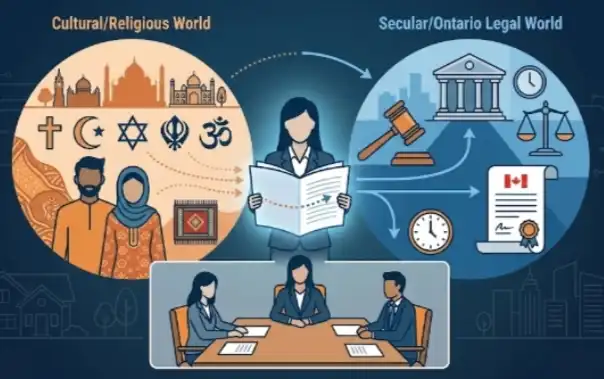
Brampton is one of the most culturally diverse cities in Canada. Many residents marry, raise families, and — when relationships end — navigate separation under the weight of both civil law and deeply held religious or cultural expectations. The problem is that Ontario’s legal system and many religious or cultural frameworks do not run in parallel. They intersect, and sometimes they collide.
In Ontario, civil law is supreme. A religious ceremony does not automatically create a legal marriage, and a religious divorce does not dissolve a legal marriage. Ontario courts apply the Family Law Act and the federal Divorce Act uniformly to all residents — religious tribunals, cultural agreements, and foreign legal codes have no automatic binding authority in an Ontario courtroom.
This guide explains how Ontario family law treats religious marriages and divorces in 2026, how cultural financial agreements like the mahr are analyzed, and why the distinction between civil and religious status matters enormously for property rights, support, and the ability to remarry.
Does Ontario Recognize Religious Marriages as Legally Valid?
Under Ontario’s Marriage Act, for a marriage to be legally recognized, the couple must obtain a marriage license, the ceremony must be performed by an officiant registered with the Province of Ontario, and the marriage must be officially registered with the Office of the Registrar General.
In practice, many religious ceremonies — a Sikh Anand Karaj, an Islamic Nikah, a Christian wedding — are performed by officiants who are also licensed by the Province. In those cases, the religious ceremony and the civil marriage happen in the same moment. One ceremony creates both the spiritual and the legal bond, and the marriage is fully recognized under Ontario law.
The problem arises when a religious ceremony is performed by an officiant who is not provincially licensed, or when a couple foregoes the license altogether — sometimes believing that the religious rite alone constitutes a valid marriage. In those situations, Ontario law may treat the parties not as married spouses but as cohabiting common-law partners. The practical consequence is significant: common-law partners do not have the automatic property equalization rights that married spouses hold under the Family Law Act. Our guide to common-law vs. married property rights in Ontario covers exactly how different those rights are at separation.
A family lawyer’s first task on any file involving a religious ceremony is to confirm whether the marriage was also legally registered — because the answer determines which entire body of law applies to the separation.
Is a Religious Divorce Recognized in Ontario?
No. Under the federal Divorce Act, the dissolution of a legally recognized marriage in Canada requires a civil divorce order signed by a judge. A religious divorce — whether a Talaq, a Get, or a dissolution granted by a religious elder — does not legally end a marriage in Ontario, regardless of how it was conducted or by whom it was granted.
A civil divorce order does one thing: it terminates the legal marriage contract. Without it, both parties remain legally married in Ontario, even if they have separated, completed a religious dissolution, and moved on with their lives. The civil divorce is required before either spouse can legally remarry in Canada.
The reverse problem is equally serious. An Ontario judge can grant a civil divorce — declaring both parties legally single — but cannot compel either spouse to perform a religious act. A husband who refuses to grant a Get (the Jewish religious divorce document required for a wife to remarry in the Jewish tradition) cannot be ordered by a court to provide one. A husband who will not pronounce a Talaq cannot be judicially compelled. The civil and religious systems operate independently, and the court must respect the separation of church and state.
What a family lawyer can do is use the tools Parliament has provided. Section 21.1 of the Divorce Act addresses “barriers to religious remarriage” — a court may strike out a spouse’s claims regarding division of property or other relief if that spouse is refusing, without reasonable cause, to remove a barrier to the other spouse’s religious remarriage. This is a meaningful lever, but it requires skilled and timely application. Your lawyer needs to identify the issue early in the file, not after the financial issues are already settled.
For married spouses navigating the civil side, spousal support entitlement and duration in Ontario covers the financial rights that flow from a legally recognized marriage — rights that a purely religious divorce does not extinguish.
The “In Limbo” Problem: Civil Divorce Without Religious Dissolution
The most common scenario our family law team encounters in Brampton is a client who is civilly divorced — legally free to remarry under Ontario law — but who remains “married” in the eyes of their religious community because the corresponding religious dissolution never occurred or was refused.
For a Jewish woman whose husband will not provide a Get, she is legally single but an Agunah — a “chained woman” — who cannot religiously remarry within her community. For a Muslim woman whose husband has not pronounced the Talaq and who has not obtained a Khul’ dissolution, the same gap exists. The social, familial, and practical consequences of remaining in this limbo are real and serious, particularly in Brampton’s closely connected faith communities.
Understanding this dynamic — and knowing when to apply the section 21.1 barrier lever versus when to negotiate through other channels — is precisely where culturally aware legal representation makes the difference. A lawyer who does not understand the significance of the Get in Jewish family law, or the distinction between Talaq and Khul’ in Islamic family law, cannot advocate effectively in this space.
Are Cultural Financial Agreements — Mahr, Dowry — Enforceable in Ontario?
Yes — but they are analyzed as contracts, not as religious obligations. Ontario courts do not enforce a mahr because Islamic law requires it. They enforce it because it meets the standard requirements of a valid contract under Ontario law.
For a cultural financial agreement to be enforceable in Ontario, the courts look at whether the agreement was entered into freely, without duress or undue pressure; whether both parties had sufficient disclosure of the financial implications; and whether the terms are not unconscionable or contrary to public policy. An agreement that purports to waive child support, for example, would not be enforced regardless of its cultural or religious basis — child support under the Child Support Guidelines cannot be contracted away.
Ontario courts have upheld mahr agreements in numerous cases where those conditions are met. The harder question is not enforceability — it is interpretation. If the mahr specifies a payment of $50,000 and the equalization calculation under the Family Law Act produces an amount of $100,000, the question of whether the mahr is part of that equalization payment or in addition to it is a factual and legal question that requires someone who understands both the intent behind the mahr and the mechanics of Ontario equalization. A generic approach to this analysis frequently produces the wrong answer. The matrimonial home is often the largest asset in that equalization calculation — understanding the matrimonial home rules every Ontario spouse should know is essential context for any family property dispute.
What Does “Culturally Aware” Family Law Actually Mean in Brampton?
Searching “family lawyer Brampton” returns hundreds of results. The meaningful differentiator in a culturally diverse community is not language — translation is straightforward. It is the ability to understand the framework within which a client is actually making decisions.
In many Brampton communities, a separation is not experienced as a private legal matter between two individuals. It is a family and community event, with pressure from parents, in-laws, elders, and community leaders — often pressure to settle quickly and quietly, to avoid shame, to protect a family’s standing. A client who is experiencing that pressure needs a lawyer who recognizes it for what it is, does not dismiss it, and helps the client make rational legal decisions that protect their statutory rights rather than surrendering them to manage social optics.
Culturally aware representation also shapes the dispute resolution process. Litigation in an Ontario courtroom is public and adversarial. Many clients in Brampton’s faith communities strongly prefer mediation, arbitration, or collaborative law processes — formats that allow for more private, structured, and culturally sensitive resolution. A family lawyer with genuine cultural competency knows how to structure those processes in a way that produces a legally binding result while respecting the manner in which the client’s community expects disputes to be handled.
How a Brampton Family Lawyer Can Help
The intersection of religious law, cultural expectation, and Ontario’s secular family law system is one of the most technically demanding areas of family practice. The clients who navigate it best are those who get accurate legal advice early — before signing anything, before agreeing to anything with the other family, and before taking action that is binding in one system but not the other. Our family law team works with clients in Brampton and across the GTA who are navigating exactly this intersection — culturally specific agreements, religious marriage validity questions, and the civil protections that apply regardless of how the marriage was conducted.
Frequently Asked Questions
Is a Nikah (Islamic marriage) legally valid in Ontario?
A Nikah is legally valid in Ontario only if it was performed by an officiant registered with the Province of Ontario and the couple obtained a marriage license beforehand. A Nikah performed by an unregistered officiant, or without a license, may not be recognized as a legal marriage under the Marriage Act — meaning the parties may be treated as common-law rather than married spouses, with substantially different property rights at separation.
Does a religious divorce (Talaq, Get, or other) end a legal marriage in Ontario?
No. A religious divorce does not dissolve a legal marriage in Ontario. The federal Divorce Act requires a civil divorce order signed by an Ontario judge to legally end a recognized marriage. A religious dissolution alone — however formally conducted — has no legal effect on the civil marriage status.
Can an Ontario court force a spouse to grant a religious divorce?
No. Ontario courts cannot order a spouse to perform a religious act, including granting a Get or pronouncing a Talaq. However, under section 21.1 of the Divorce Act, a court may strike out a spouse’s property and support claims if that spouse is unreasonably refusing to remove a barrier to the other spouse’s religious remarriage. This is a significant practical lever that a skilled family lawyer can use.
Is a mahr enforceable in Ontario?
Yes, in most cases. Ontario courts treat the mahr as a contract and will enforce it if it was entered into freely, with reasonable disclosure, and does not violate public policy. The more complex question is how the mahr interacts with the equalization of net family property under the Family Law Act — whether the mahr payment is credited against or in addition to the equalization amount requires careful legal analysis.
What property rights does a common-law partner have if the religious marriage was not legally registered?
If a religious ceremony did not create a legal marriage under the Marriage Act, the parties are common-law partners for property purposes. Common-law partners in Ontario do not have automatic equalization rights under the Family Law Act. They may have claims through unjust enrichment or constructive trust, but those require proof and are harder to establish than the automatic rights of a married spouse.
What is a culturally aware family lawyer, and why does it matter in Brampton?
A culturally aware family lawyer understands the specific religious and cultural context in which their client is making decisions — including family and community pressure, the significance of specific religious documents and agreements, and how to structure a dispute resolution process that produces a legally binding result while respecting the client’s community. In a city as diverse as Brampton, this competency directly affects the quality and accuracy of legal advice.
Final Takeaway
Ontario law is secular and uniform. It does not adjust its property division rules, support obligations, or divorce process based on religious affiliation. But it does provide tools — under both the Family Law Act and the Divorce Act — that a skilled family lawyer can use to protect a client navigating both worlds. If you are facing a separation or divorce in Brampton that involves a religious marriage, a cultural financial agreement, or a religious dissolution question, book a free consultation with GS Arora Law before you agree to anything.
Disclaimer: The information provided in this blog is for general informational purposes only and should not be considered legal, tax, financial, or professional advice. Regulations and procedures may change over time and vary by jurisdiction. For guidance tailored to your specific situation, please consult a qualified professional.
GS Arora, Lawyer & Notary Public. Brampton, Ontario.