
The Hidden Closing Cost: How Land Transfer Tax Works in Ontario — And How Brampton Buyers Can Save in 2026
Book Consultation Book Consultation
21
JanThe Hidden Closing Cost: How Land Transfer Tax Works in Ontario — And How Brampton Buyers Can Save in 2026
Introduction
You have saved for the down payment. You have budgeted for the mortgage. You have even set money aside for movers. But as you approach closing day on a home purchase in Ontario, there is one significant cost that catches many Brampton buyers off guard: Land Transfer Tax (LTT).
Unlike the annual property tax you pay to the City of Brampton, LTT is a one-time provincial tax paid the moment you take legal ownership. In 2026, with home prices in Brampton hovering near $1 million, this tax alone can equal the cost of a new car — and it must be paid in cash on closing day. It cannot be added to your mortgage.
The good news: buying in Brampton carries a real, quantifiable tax advantage over Toronto, and if you qualify as a first-time buyer, the province will cover part of the bill. This guide breaks down exactly how LTT is calculated, what Brampton buyers save compared to Toronto, and the legal strategies available to reduce what you owe.
How Is Land Transfer Tax Calculated in 2026?
Many buyers assume LTT is a flat percentage, similar to HST. It is not. LTT is a marginal tax — you pay a different rate on each portion of the purchase price, the same way income tax works.
As of 2026, the Ontario provincial rate tiers are:
- First $55,000: 0.5%
- $55,000 to $250,000: 1.0%
- $250,000 to $400,000: 1.5%
- $400,000 to $2,000,000: 2.0%
- Over $2,000,000 (for property with one or two single-family residences): 2.5%
Worked Example: A $1,000,000 Brampton Home
If you buy a detached home in Brampton for $1,000,000, you do not pay 2.0% on the entire amount. The tax is calculated in layers:
- 0.5% on the first $55,000 = $275
- 1.0% on the next $195,000 = $1,950
- 1.5% on the next $150,000 = $2,250
- 2.0% on the remaining $600,000 = $12,000
Total provincial LTT: $16,475, payable by bank draft on closing day, before any rebate is applied.
For the full breakdown of how these tiers apply at every price point, see our complete guide to land transfer tax in Ontario.
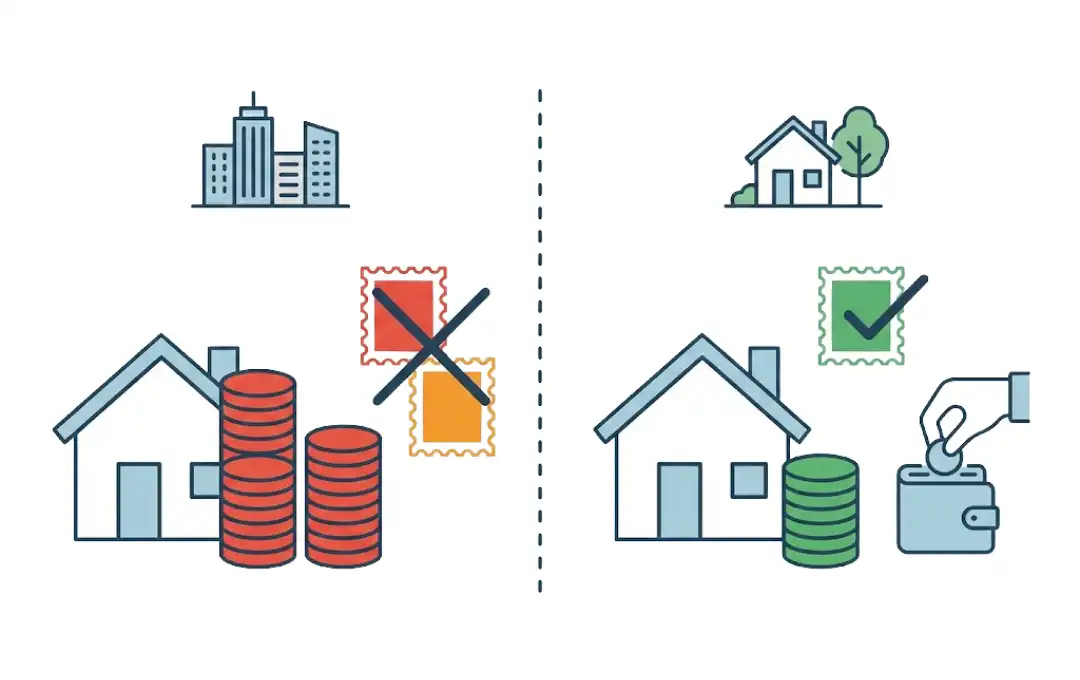
The Brampton Advantage: Avoiding Toronto’s Double Tax
The single most effective way to reduce your land transfer tax bill is choosing where you buy. Toronto is the only municipality in Ontario with the authority to charge its own Municipal Land Transfer Tax (MLTT) — on top of the provincial tax every Ontario buyer already pays.
Compare the same $1,000,000 home in each city:
- In Toronto (Etobicoke): $16,475 (Provincial) + $16,475 (Municipal) = $32,950 total
- In Brampton: $16,475 (Provincial only) = $16,475 total
By purchasing on the Brampton side of Steeles Avenue instead of Toronto, a buyer saves $16,475 on closing costs alone — money that can go toward renovations, furniture, or simply staying liquid in your first year of ownership.
The First-Time Home Buyer Rebate
If you qualify as a first-time buyer, Ontario provides a rebate that directly offsets your LTT bill.
- 2026 maximum rebate: $4,000
- How it’s applied: This is not a cheque issued after closing — your lawyer deducts it directly from the tax owed at registration, so it lowers the cash you need on closing day itself.
The Math With the Rebate
Using the $1,000,000 Brampton example above:
- Total LTT owed: $16,475
- Less first-time buyer rebate: −$4,000
- You pay: $12,475
Who Qualifies for the Full Rebate
- You must be a Canadian citizen or permanent resident
- You must never have owned a home anywhere in the world — inheriting a home counts as prior ownership
- If you are married, your spouse must not have owned a home while married to you; if they owned a home before the marriage and sold it prior to meeting you, you may still qualify for your share
See our guide to closing costs for first-time home buyers in Ontario for how this rebate fits into your total cash-due-on-closing calculation.
Legal Strategies to Reduce What You Owe
Beyond the rebate and choosing your municipality, LTT itself is mandatory — but how you structure your purchase can prevent you from overpaying.
Strategy A: The Spousal Split
If you are a first-time buyer but your spouse is not, how you take title matters significantly.
If you purchase as joint tenants at 50/50, you can only claim 50% of the rebate — capped at $2,000 instead of the full $4,000. The rebate is reduced proportionally by the non-first-time buyer’s ownership share.
In some cases, it may make sense for the first-time buyer to hold a larger percentage of title — even up to 99–100%, where the lender permits it — to maximize the rebate. This carries real family law and mortgage implications and should never be decided without a lawyer’s input first. See our guide on adding a spouse to title in Ontario before making this decision.
Strategy B: Purchase Price vs. Chattels
LTT is calculated on the “value of the consideration” for the land and home — not on movable items, known legally as chattels.
If the seller is including high-value furniture, appliances, or fixtures as part of the deal, ensure those items are itemized separately in the Agreement of Purchase and Sale, with a stated value. LTT is generally not owed on the value of chattels — only on the real estate itself.
Strategy C: The Fixer-Upper Approach
LTT is calculated on the purchase price at the time of closing — not the future value of the home after renovations.
Buying a dated $800,000 home (LTT: roughly $12,475 before rebate) and investing $200,000 into renovations results in a $1,000,000 asset — but you pay tax on the $800,000 purchase price, not the $1,000,000 finished value. Compared to buying a turnkey $1,000,000 home outright, this approach saves roughly $4,000 in land transfer tax.
A Warning for 2026: The Non-Resident Speculation Tax
While most local buyers focus on the provincial LTT rate, foreign buyers face a far steeper cost. The Non-Resident Speculation Tax (NRST) remains in full effect for 2026 at 25%, applied province-wide to residential property with six or fewer single-family residences.
If you are purchasing with a partner who is not a Canadian citizen or permanent resident, exercise caution. Even where that partner holds a small minority interest, NRST can apply to the entire property’s value — not just their share. On a $1,000,000 home, that is an additional $250,000 in tax exposure.
Certain exemptions exist — for example, where the non-resident partner is a Permanent Resident nominee or a Protected Person. Always confirm your specific eligibility with a lawyer before signing an offer, not after.
Conclusion
Land transfer tax is an unavoidable cost of buying property in Ontario — but for Brampton buyers, it is significantly lower than for buyers purchasing the equivalent home in Toronto. For a standard $1,000,000 purchase in 2026, budget roughly 1.2% to 1.6% of the purchase price for this tax after applicable rebates, and have that amount available as a bank draft well before closing day. Failing to have this cash ready is one of the most common — and most avoidable — reasons closings are delayed.
If you are buying in Brampton or anywhere in the GTA and want a clear picture of your total closing costs before you make an offer, contact GS Arora Law for a consultation with our real estate law team.
Disclaimer: The information provided in this blog is for general informational purposes only and should not be considered legal, tax, financial, or professional advice. Regulations and procedures may change over time and vary by jurisdiction. For guidance tailored to your specific situation, please consult a qualified professional.