
Closing Costs in Ontario for First-Time Home Buyers: A 2026 Guide
Book Consultation Book Consultation
09
MayClosing Costs in Ontario for First-Time Home Buyers: A 2026 Guide
The down payment is the number every first-time buyer in Ontario has memorised. The closing costs are the ones that catch them off guard at the lawyer’s office two weeks before key day. They are not hidden — they are simply spread across several government charges, an insurance product, a mortgage condition, and the legal file itself. Understanding each part is what turns a stressful Friday into a smooth one.
How much are closing costs in Ontario? For a first-time buyer purchasing a resale home in Brampton or the GTA in 2026, total closing costs typically range from 1.5% to 4% of the purchase price, on top of the down payment. On a $700,000 home, that means roughly $10,500 to $28,000 in additional cash required on closing day — the exact figure depends on your eligibility for the first-time buyer Land Transfer Tax rebate, whether you carry default insurance, and the adjustments owed to the seller.
This guide walks through every closing cost category in Ontario in 2026, which ones first-time buyers can reduce or eliminate, and what to read carefully on the lawyer’s statement before you sign.
What Are Closing Costs in Ontario?
Closing costs are the one-time amounts a buyer must deliver — on top of the down payment — on the day a property in Ontario legally changes hands. They are paid through your real estate lawyer’s trust account, not directly to the seller. None of them form part of the purchase price; all of them require real cash available before the closing date.
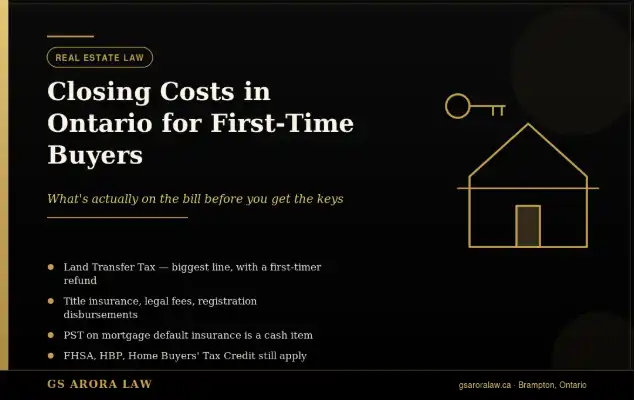
For a first-time buyer in Ontario, the major categories are Land Transfer Tax (provincial, and municipal if buying in the City of Toronto), legal fees and disbursements, title insurance, property tax and utility adjustments owed to the seller, home inspection fee (paid earlier before the firm offer), mortgage-related charges including default insurance if the down payment is under 20%, and HST if purchasing a new build. Each category has its own rules — and for first-time buyers, its own potential rebate or relief.
How Much Is Land Transfer Tax in Ontario for Buyers?
Ontario charges Land Transfer Tax on every property transfer under the Land Transfer Tax Act, calculated against the purchase price on a tiered marginal scale. For a $700,000 purchase, provincial LTT is approximately $12,200 before any rebate. For a $900,000 purchase it is approximately $16,500. The Government of Ontario publishes the current tier schedule on ontario.ca, and your lawyer calculates your exact figure against it.
The relief that matters most for first-time buyers is the Ontario Land Transfer Tax refund for first-time homebuyers. To qualify, you must be at least 18, a Canadian citizen or permanent resident, intend to occupy the home as your principal residence within nine months of registration, and have never owned a home anywhere in the world. If your spouse (married or under the Family Law Act) previously owned a home during the marriage, the full rebate is not available — a partial rebate based on your ownership share may apply instead. Your lawyer claims the rebate electronically through Teraview at the time of registration; there is no separate application for eligible buyers closing in the normal way.
If you are buying in the City of Toronto, a separate Municipal Land Transfer Tax applies — currently roughly equal to the provincial LTT — with its own first-time buyer rebate. Buyers in Brampton, Mississauga, Vaughan, and the rest of the GTA outside Toronto do not pay MLTT. For a full breakdown of how LTT tiers, rebates, and the Non-Resident Speculation Tax interact, our guide to how Land Transfer Tax is calculated in Ontario covers each scenario.
Legal Fees and Disbursements
Your lawyer’s closing account has two components. Legal fees cover the work performed — reviewing the agreement of purchase and sale, searching title, preparing and reviewing mortgage documentation, preparing closing documents, registering the transfer and mortgage through Teraview, and reporting to the lender after closing. Disbursements are third-party costs the lawyer pays on your behalf and recovers from you: LTT, Teraview registration charges, title search fees through ServiceOntario, title insurance premium, courier charges, and software fees.
In Ontario in 2026, total legal fees and disbursements on a standard residential purchase typically range from $1,500 to $3,000, depending on the complexity of the transaction and the region. Condominiums often run toward the higher end because of the additional status certificate review. Ask your lawyer for a written estimate broken down between fees and disbursements at the start of the file — before you are days from closing — so there is no ambiguity in the final trust ledger statement.
Title Insurance
Title insurance is a one-time premium that protects you (and your mortgage lender) against title defects discovered after closing — including fraud, certain survey issues, encroachments, municipal work orders registered after the title search, and gaps in the chain of title. In Ontario, virtually every residential purchase closes with title insurance from an approved insurer such as Stewart Title or FCT (First Canadian Title). The premium is a disbursement paid once at closing; the policy covers you for as long as you own the home.
The premium on a $700,000 residential purchase runs approximately $250 to $350 for the owner’s policy. Title insurance replaced the older practice of commissioning a survey and having the lawyer issue a title opinion — for most buyers it is less expensive and covers a wider range of post-closing risks. Our article on title insurance in Ontario — what it covers and what it doesn’t explains the policy exclusions in detail.
Property Tax and Utility Adjustments
On closing, the buyer reimburses the seller for costs prepaid past the closing date, and receives credits for amounts owing by the seller. Property taxes are the most common adjustment: if the seller paid the full year’s installment and the closing is mid-year, you owe them for the portion of the year you will own the home. Condo maintenance fees, oil in a tank, and utility deposits work the same way.
Your lawyer prepares the Statement of Adjustments and walks you through each line. Adjustments are rarely large individually — often $500 to $2,500 combined — but they are mandatory cash items and appear on your closing day funds requirement. Read the Statement of Adjustments carefully; arithmetic errors on this document are among the most common correctable mistakes on a real estate file.
Mortgage Default Insurance and the PST Catch
If your down payment is less than 20% of the purchase price, federal mortgage rules require mortgage default insurance — issued by CMHC, Sagen, or Canada Guaranty. The insurance premium is calculated as a percentage of the mortgage amount (ranging from 2.8% to 4.0% in 2026 depending on the down payment percentage) and is typically added to the mortgage and amortized over the loan term rather than paid in cash on closing.
What does hit closing day is the Ontario provincial sales tax (PST) on the default insurance premium, which must be paid in cash and cannot be added to the mortgage. On a $665,000 insured mortgage (a $700,000 purchase with 5% down), the default insurance premium is approximately $26,600 — and the PST on that, at Ontario’s 8% rate, is approximately $2,130 in cash required on closing day. This is the line item that surprises first-time buyers most often. For a full picture of how the recent federal mortgage rule changes affect insured purchase limits and amortization options, see our guide to the new mortgage rules for Ontario first-time buyers.
HST: Resale vs. New Build
The question asked most often at closing consultations is whether HST applies to the purchase. On a resale home in Ontario — any previously occupied residential property — there is no HST on the purchase price. On a new-build home or pre-construction condo, HST at 13% applies to the purchase price. Builders typically net the Ontario and federal New Housing Rebates against the price in their contracts, but the rebate eligibility conditions and the math in the builder’s agreement should be reviewed by your lawyer before you sign, because builder contracts vary and some shift rebate risk to the buyer.
If you are buying a new build and plan to rent it rather than occupy it as your principal residence, the rebate structure is entirely different — and the HST exposure substantially larger. This is one of the most expensive mistakes in Ontario real estate closings and one of the clearest reasons to have your lawyer review the agreement of purchase and sale before you firm up.
What Are Closing Costs When Selling a House in Ontario?
Sellers in Ontario have their own set of closing costs that are separate from the buyer’s. The largest is typically the real estate commission, currently negotiable but historically 3.5% to 5% of the purchase price plus HST — a $700,000 sale at 4% commission plus HST means approximately $31,640 paid out of the proceeds on closing. Other seller-side closing costs include legal fees and disbursements (typically $1,000 to $1,800 for a straightforward sale), any mortgage discharge fees or prepayment penalties if the seller’s mortgage is being broken early, and any adjustments credited to the buyer on the Statement of Adjustments.
Sellers do not pay Land Transfer Tax, but they may face capital gains tax if the property is not their principal residence — a question to address with an accountant before listing, not on closing day.
Federal Programs Still Available to First-Time Buyers in 2026
The federal First-Time Home Buyer Incentive (the shared-equity program) ended in March 2024 and is no longer available. Programs that remain active in 2026:
The Home Buyers’ Plan allows a first-time buyer to withdraw up to $60,000 (increased in 2024) from an RRSP without immediate tax consequences, repayable over 15 years beginning the second year after withdrawal.
The First Home Savings Account (FHSA) combines RRSP-style annual deductibility with TFSA-style tax-free withdrawal when used for a qualifying first home purchase. Annual contribution room is $8,000, with a lifetime maximum of $40,000.
The First-Time Home Buyers’ Tax Credit is a 15% non-refundable federal tax credit on $10,000, claimed on the tax return for the year of purchase — worth up to $1,500 at tax time.
Your real estate lawyer does not administer these programs, but they materially affect your cash position for closing and should be coordinated with your accountant or financial advisor before the closing date.
The Closing Costs Mistake to Avoid
The most common mistake first-time buyers make is treating closing costs as a single lump sum and relying on a generic estimate. The actual total varies enough that a dollar-based guess without knowing your purchase price, down payment percentage, first-time buyer eligibility, and property type can be off by thousands. The better approach: walk through the categories above with your lawyer at the start of the file, get a written estimate for each line item, and confirm the final numbers at least a week before closing. Most files contain one line that surprises someone — the PST on default insurance, a property tax adjustment in a reassessment year, an HST question on a new build — and all of those surprises are manageable when caught early. They are stressful when discovered on closing morning.
How a Brampton Real Estate Lawyer Fits In
On a residential closing in Ontario, your lawyer’s role is to give you clear title to the home, calculate every government charge and adjustment on your Statement of Adjustments, register the transfer and mortgage electronically through Teraview, and disburse funds so keys can change hands on schedule. None of this should feel opaque. If your lawyer is not walking you through the Statement of Adjustments line by line before closing, ask for that walkthrough — it is part of the service. Our real estate law team works with first-time buyers in Brampton and across the GTA to confirm every closing cost before the file reaches key day, with no surprises.
Frequently Asked Questions
How much are closing costs in Ontario for a first-time buyer?
For a first-time buyer purchasing a resale home in Ontario in 2026, total closing costs typically range from 1.5% to 4% of the purchase price, in addition to the down payment. On a $700,000 purchase, that is approximately $10,500 to $28,000. The range is wide because it depends heavily on Land Transfer Tax rebate eligibility, whether default insurance applies, and the property tax adjustment owed to the seller.
Is there a closing costs calculator for Ontario?
Ontario does not have one official calculator, but your real estate lawyer should provide a written estimate broken down by category — Land Transfer Tax, legal fees and disbursements, title insurance, and adjustments — at the start of your file. The Government of Ontario’s ontario.ca site provides the current LTT rate schedule, which is the largest variable in the calculation.
What closing costs does a first-time buyer not have to pay in Ontario?
First-time buyers who meet the eligibility requirements under the Land Transfer Tax Act can receive a rebate that offsets the provincial LTT on the first portion of the purchase price. Toronto first-time buyers can also receive the Municipal Land Transfer Tax rebate. These are the largest cost reductions available; there is no exemption from legal fees, title insurance, or property tax adjustments.
Do you pay HST on closing costs in Ontario?
On a resale home, there is no HST on the purchase price. HST does apply on legal fees and on real estate commissions. On a new build, HST applies to the full purchase price, with federal and provincial new housing rebates that may be credited against it depending on eligibility.
What are closing costs when selling a house in Ontario?
Sellers’ main closing costs are real estate commission (typically 3.5% to 5% of the sale price plus HST), legal fees and disbursements ($1,000 to $1,800 for a standard sale), and any mortgage discharge fees or prepayment penalties. Sellers do not pay Land Transfer Tax. Capital gains tax may apply if the property is not the seller’s principal residence.
When are closing costs paid in Ontario?
Closing costs are paid on the closing date, through your real estate lawyer’s trust account. The one exception is the home inspection fee, which is typically paid directly to the inspector before the firm offer is made. Your lawyer will provide a total funds required figure — down payment plus all closing costs — well before key day, so you can arrange the certified funds or wire transfer in time.
Final Takeaway
Closing costs in Ontario are predictable once you know the categories — and every one of them can be estimated in writing before your offer firms up. If you are buying in Brampton or the GTA for the first time in 2026 and want your closing costs confirmed before you make an offer, book a free consultation with GS Arora Law and bring your draft agreement of purchase and sale.
Disclaimer: The information provided in this blog is for general informational purposes only and should not be considered legal, tax, financial, or professional advice. Regulations and procedures may change over time and vary by jurisdiction. For guidance tailored to your specific situation, please consult a qualified professional.
GS Arora, Lawyer & Notary Public. Brampton, Ontario.