
02
JunTitle Insurance in Ontario: What It Covers and What It Doesn't
Introduction
Almost every residential closing in Ontario now involves a title insurance policy. Most buyers sign the paperwork without ever reading it, and most assume — incorrectly — that it covers everything that could go wrong with the property. It doesn’t. Title insurance is a powerful, inexpensive, one-time-premium product, but it is a specific kind of coverage with specific exclusions, and understanding what it does and does not cover is part of buying a home with your eyes open.
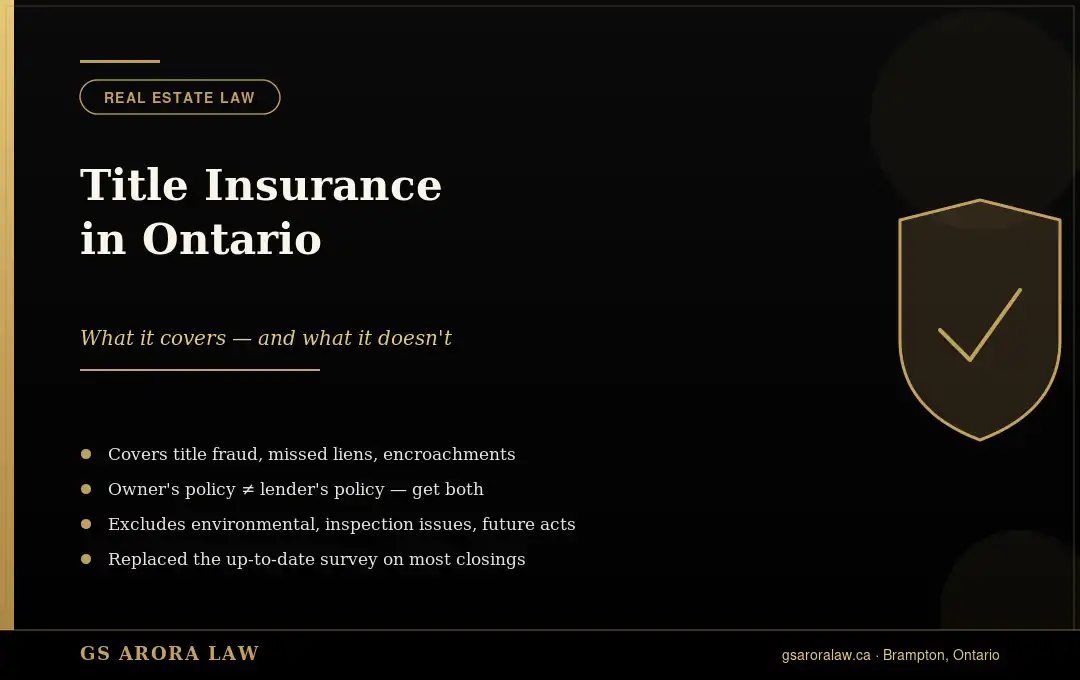
Title insurance in Ontario is an indemnity policy that protects a homeowner or lender against loss from defects in title — such as fraud, forgery, undischarged liens, encroachments, or existing zoning violations — in exchange for a single premium paid at closing. It does not cover future physical defects, environmental contamination, or issues the homeowner creates themselves after the policy is issued.
This guide explains what title insurance is in Ontario in 2026, what it actually protects you against, what it doesn’t, the difference between an owner’s policy and a lender’s policy, and why title insurance has effectively replaced the old “up-to-date” survey requirement on most Ontario closings.
What Is Title Insurance in Ontario?
Title insurance is an indemnity contract issued by a title insurer — in Ontario, most policies are issued by Stewart Title, FCT (First Canadian Title), Chicago Title, or TitlePlus, the Lawyers’ Professional Indemnity Company product. The policy is paid through a single premium at closing and protects the insured against loss arising from defects in title, certain off-title issues, and a defined list of additional risks.
Unlike most insurance products, title insurance is backward-looking as much as forward-looking. The premium reflects the insurer’s assessment of risks that already exist on the day the policy is issued — the chance that the seller didn’t actually own what they sold, that there’s an undischarged charge no one found, or that a previous transfer wasn’t properly executed. Once the policy is issued, the insurer takes on those risks, including the cost of defending the insured if a claim is later made.
What Does Title Insurance Cover in Ontario?
A typical Ontario residential owner’s policy covers loss arising from a defined list of risks. This includes situations where someone else has an ownership interest in the property — for example, where the seller was not the only owner, or a prior transfer in the chain of title was forged or invalid — as well as fraud or forgery in the chain of title generally, including the modern problem of title fraud, where a fraudster impersonates the registered owner and either mortgages or sells the property without the owner’s knowledge. Given how often title fraud comes up in claims today, our guide to protecting against title fraud and identity theft in Ontario covers the preventive steps buyers can take alongside their policy.
Coverage also extends to undischarged mortgages, liens, executions, or other registered charges that should have been cleared at closing but weren’t; unpaid realty taxes and water or utility arrears that became liens against the property before closing; and work orders, deficiency notices, or open building permits registered against the property before closing. Encroachments are covered as well — a fence built on the neighbour’s land, a deck extending over the lot line, or a shared driveway dispute — along with zoning violations that existed at the time the policy was issued, where the existing structure does not comply with the applicable by-law. This last category is often a deal-saver where a prior renovation was completed without permits. The policy further covers a lack of legal access to the property, meaning no registered easement giving the property a way out, and survey issues, where the property doesn’t match what the registered legal description says it is.
A good Ontario owner’s policy also includes coverage for some post-policy frauds — most notably, ongoing protection against someone fraudulently transferring or mortgaging the home after closing. For homeowners in Ontario, that post-policy title-fraud coverage has become one of the most valuable parts of the product as title-fraud cases continue to be reported across the province.
Owner’s Policy vs. Lender’s Policy
A lender’s title insurance policy protects the mortgage lender, not the homeowner. It covers loss to the lender if the mortgage turns out not to be a valid first charge — for example, if there’s a prior undischarged mortgage, if the borrower didn’t actually own the property, if a fraud unwinds the transaction, or if a competing interest takes priority over the lender’s charge.
Most Ontario lenders require a lender’s policy on every transaction. The lender’s policy is considerably cheaper than the owner’s policy because it only protects the lender’s outstanding loan balance, not the equity in the home. A buyer who takes only the lender’s policy is paying for coverage that protects the bank, not themselves — the marginal cost to add an owner’s policy at the same closing is small relative to the meaningfully broader protection it provides.
What Title Insurance Does Not Cover
The exclusions matter as much as the coverage, and this is where most buyer misunderstandings come from. A standard Ontario owner’s policy generally does not cover issues created after the policy date by the insured’s own actions — for example, if the homeowner builds an unpermitted addition after closing, that new work falls outside the policy. It also excludes voluntary acts of the insured, such as granting an easement, signing away rights, or agreeing to a new boundary line, along with known defects that were disclosed to the insurer before closing and specifically excluded from coverage in the policy itself.
Environmental contamination — soil contamination, underground storage tanks, asbestos, or mould — falls outside title insurance entirely, since these are environmental-insurance products rather than title products. Native land claims are generally excluded as well, and matters a proper home inspection would reveal about the physical condition of the property are not covered, since title insurance is never a substitute for a home inspection. Zoning compliance is also limited to existing violations at the time the policy was issued — the policy does not cover zoning issues that arise later because the buyer wants to convert the home to a different use. Off-title municipal issues that arise after closing, such as a road-widening announced after the fact, fall outside the policy as well. Reading the actual policy — its schedules, exceptions, and endorsements — is the lawyer’s job at closing, and it should be reviewed with the buyer before keys are exchanged.
Title Insurance and the Disappearing Survey
Until the early 2000s, almost every Ontario residential closing required an up-to-date survey — a registered plan showing the buildings, fences, and boundaries of the property. Surveys are expensive and slow. As title insurance became standard, lenders and lawyers began accepting title insurance in lieu of a current survey, and the practice has stuck ever since. Today, very few Ontario residential closings involve a fresh survey, since the title insurer accepts the risk of any boundary or encroachment issue instead.
This is not always a great trade. A survey reveals problems before closing, while a title insurance claim is only paid after the problem appears. For most buyers, the time and cost saving wins out, but for some — particularly buyers of rural properties, properties with outbuildings near lot lines, or properties with shared driveways — paying for a survey on top of title insurance is still the prudent move. A proper title search before closing remains an important complement to the policy, since it can catch some issues before they ever need to become a claim.
How Does Title Insurance Work in Ontario? Filing a Claim
When a covered issue surfaces — a missed lien, a boundary dispute, a fraudulent prior transfer — the homeowner contacts the title insurer’s claims department and provides the policy along with supporting facts. The insurer investigates the claim and decides whether to defend, settle, or pay the loss, and is legally entitled to choose between those options. In most cases, the insurer resolves the claim by clearing the title issue at its own cost — paying off a missed mortgage, defending a lawsuit brought by the alleged true owner, or paying out the loss in money where the underlying issue can’t be fixed.
The insured does not have to pay legal fees to chase the issue themselves; the insurer covers that cost. That single feature is often the most valuable part of the policy in practice, since litigation costs alone can otherwise exceed what most homeowners expect to spend defending their title.
Should You Take It?
For almost every Ontario residential buyer, the answer is yes. The premium is a one-time cost, the coverage lasts as long as the buyer owns the home, post-policy title-fraud protection is now a real-world need, and the lender will require its own policy regardless. The owner’s policy is the part the buyer is paying for personally, and on a normal residential closing, the marginal cost is modest relative to what is actually being covered.
The harder question is which policy to choose. The four major Ontario title insurers offer broadly similar coverage but differ in their endorsements, exclusions, claims process, and the specific wording of certain risks. Our Real Estate Law team reviews these differences on every file and recommends the policy that actually fits what your transaction needs, rather than defaulting to whichever insurer is fastest to process.
Frequently Asked Questions
What is title insurance in Ontario?
Title insurance is a one-time-premium indemnity policy that protects a homeowner or lender against financial loss from defects in title, such as fraud, forgery, undischarged liens, encroachments, or existing zoning violations discovered after closing.
What does title insurance cover in Ontario?
An owner’s policy typically covers ownership disputes, fraud or forgery in the chain of title, undischarged mortgages and liens, unpaid tax or utility arrears that became liens before closing, encroachments, existing zoning violations, lack of legal access, and survey discrepancies. It also often includes post-policy protection against future title fraud.
Is title insurance mandatory in Ontario?
A lender’s policy is effectively mandatory, since most Ontario mortgage lenders require one on every transaction to protect their loan. An owner’s policy is not legally required, but it is strongly recommended, since without it a buyer has no personal protection against the same risks the lender’s policy is covering only for the bank.
Does title insurance cover unpermitted work in Ontario?
It depends on timing. A policy generally covers existing zoning violations or open permits that were already in place when the policy was issued — for example, a prior owner’s unpermitted renovation. It does not cover unpermitted work the current homeowner does themselves after the policy takes effect.
Where do you buy title insurance in Ontario?
Title insurance is purchased through your real estate lawyer as part of closing. The lawyer orders the policy from one of the major Ontario title insurers, reviews the exceptions and endorsements, and confirms the coverage fits the specific transaction before the deal closes.
Who sells title insurance in Ontario?
The major Ontario title insurers are Stewart Title, FCT (First Canadian Title), Chicago Title, and TitlePlus, the Lawyers’ Professional Indemnity Company product. All four are typically available through a real estate lawyer at closing, and coverage details vary between them.
Final Takeaway
Title insurance has become a near-universal part of Ontario real estate closings, and for good reason — it’s inexpensive relative to the risks it covers and it has effectively replaced the old survey requirement on most transactions. But it is not blanket protection. Knowing what falls inside the policy and what falls outside it, before you close, is the difference between real peace of mind and an unpleasant surprise later.
If you are buying, refinancing, or selling a property in Brampton or the GTA, book a free consultation with GS Arora Law and let us walk you through the title-insurance options that fit your transaction.
Disclaimer: The information provided in this blog is for general informational purposes only and should not be considered legal, tax, financial, or professional advice. Regulations and procedures may change over time and vary by jurisdiction. For guidance tailored to your specific situation, please consult a qualified professional.