
17
MayHow Is Child Support Calculated in Ontario? A 2026 Guide
Introduction
Child support in Ontario is one of the few areas of family law where the right answer is, most of the time, mechanical. The Federal Child Support Guidelines set out tables based on the paying parent’s income, the number of children, and the province where they live. Plug in the numbers and out comes the table amount. The disputes are rarely about the tables themselves — they’re about the income figure that goes into them, the special expenses that come on top, the way shared parenting changes everything, and the situations where the tables don’t apply at all.
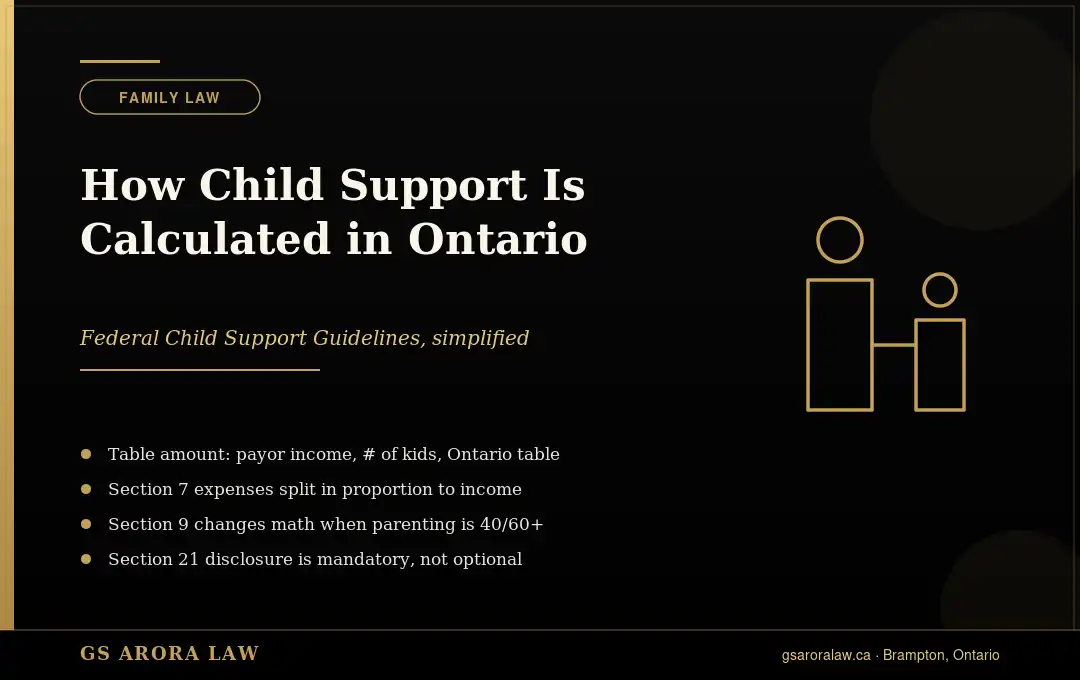
Child support in Ontario is calculated using the Federal Child Support Guidelines table amount, based on the paying parent’s annual income, the number of children, and Ontario’s specific table. Special expenses under section 7, shared parenting under section 9, and imputed income for self-employed payors can all adjust that base table amount up or down.
This guide walks through how child support actually gets calculated in Ontario in 2026, what is mandatory and what is discretionary, and what trips parents up most often.
The Two Statutes That Matter
Child support in Ontario can come from one of two places, depending on the parents’ situation. The federal Divorce Act governs child support claims between divorcing or divorced parents, and the Federal Child Support Guidelines are made under that Act. The Ontario Family Law Act governs child support claims between unmarried parents and between separated, but not divorcing, married parents. Ontario has adopted the Federal Child Support Guidelines under O. Reg 391/97, so the table amounts themselves are identical regardless of which statute technically applies. The choice of statute affects court jurisdiction and a handful of procedural details, but the substantive math never changes.
The Table Amount: The Starting Point for Almost Every Case
The Federal Child Support Guidelines include tables for every province and territory, and the Ontario table is what applies to Ontario-resident payors. To find the table amount, you need three pieces of information: the payor’s annual income, the number of children, and the province, which for this purpose is Ontario.
Take those three numbers, look them up on the federal child support tables — a free online lookup tool — and the result is the monthly child support amount. For most “table cases,” where one parent has the children primarily and the other parent pays support, the table amount is presumptively payable without further adjustment. The Government of Canada also publishes a Child Support Online Lookup tool that performs this calculation directly; it’s the same starting-point tool family lawyers use before layering on any of the adjustments described below.
The Income Number Is Where Most of the Fight Happens
The simplest cases involve a salaried employee with a single T4. The income used for child support purposes is essentially the employment income reported on line 15000 of the tax return, sometimes adjusted for specific items under section 16 and Schedule III of the Guidelines. There is very little to argue about in these cases.
The harder cases involve self-employed payors, business owners, or payors with significant non-employment income. In these situations, personal use of corporate assets — vehicles, travel, club memberships paid through the business — is added back into income for support purposes. Retained earnings in a corporation can also be attributed to the payor under section 18 of the Guidelines, where the corporation is closely held and those retained earnings genuinely represent the payor’s available means. Imputed income can be assigned under section 19 where the payor is intentionally underemployed, carries unreasonable expenses, or fails to provide the disclosure the Guidelines require, and capital gains, dividends, partnership income, and foreign income are all included with appropriate adjustments. Where a self-employed payor’s business interests are also being divided as part of a broader separation, our guide to how pensions, RRSPs, and business assets are divided in a Brampton divorce covers how those valuations interact with the income analysis here.
Section 21 of the Guidelines requires the payor to provide three years of tax returns, three years of T4s, T4As, and financial statements, and information about any corporation in which they hold an interest. This disclosure is mandatory, not optional, and a payor who refuses to disclose can be ordered to pay an imputed income amount well above their actual income as a consequence. For a self-employed payor with a corporation, getting the income number right typically requires the family lawyer to work directly with an accountant, and sometimes to retain a forensic accountant where the disclosure provided is incomplete.
Section 7: Special and Extraordinary Expenses
The table amount covers the everyday costs of raising a child — food, housing, clothing, transportation, and basic activities. It does not cover everything. Section 7 of the Guidelines lists “special and extraordinary expenses” that can be added on top of the table amount and shared between the parents in proportion to their incomes. These include childcare costs incurred because of a parent’s employment, illness, or education; the premium portion of medical and dental insurance attributable to the child; health-related expenses exceeding insurance reimbursement, such as orthodontics, prescription drugs, glasses, or therapy, above a defined threshold; extraordinary primary or secondary school expenses, including private school where appropriate; post-secondary education expenses; and extraordinary expenses for extracurricular activities, such as competitive sports, music lessons, or summer camps, where the cost is significantly more than what most families would typically spend.
The two-step test for section 7 expenses is reasonableness in light of the parents’ means and the family’s pre-separation pattern of spending, plus necessity having regard to the child’s best interests. Not every cost the receiving parent wants to share automatically qualifies for inclusion. Once a section 7 expense is confirmed, it’s calculated net of any tax credits or deductions and then divided in proportion to the parents’ respective incomes, not split equally. Where spousal support is also part of the same separation, it’s worth understanding how spousal support is calculated in Ontario alongside child support, since the two calculations affect each other’s underlying income figures.
Shared Parenting Changes Everything
Where each parent has the children at least forty percent of the time, section 9 of the Guidelines applies, and the calculation stops being a simple table lookup. Section 9 directs the court to consider three factors: the amount the Guidelines would direct each parent to pay if they were the receiving parent, usually expressed as the “set-off” of the two table amounts; the increased costs associated with shared parenting arrangements; and the conditions, means, needs, and other circumstances of each parent and child.
In practice, courts often start with the set-off of the two table amounts as a baseline and then adjust upward or downward for the second and third factors. Section 9 cases are not formulaic — the case law is extensive, and the result can vary significantly depending on the specific facts. Contino v. Leonelli-Contino, decided by the Supreme Court of Canada in 2005, remains the leading case on how section 9 is applied. Where a shared parenting arrangement is complicated further by one parent wanting to move, our guide to parent relocation with children in Brampton covers how that separate issue interacts with an existing support arrangement.
Split Custody, Undue Hardship, and High Incomes
A few additional situations follow their own distinct rules. Split custody, where one or more children live primarily with each parent, is dealt with under section 8: the table amounts are calculated separately for each parent, and the difference is paid by the higher-table parent. Undue hardship under section 10 lets a payor, or in some cases a recipient, argue for a different amount than the table where applying the table would cause genuine undue hardship and the household’s standard of living is not higher than the other household’s — this is a high bar to meet and is rarely successful in practice. High-income payors above a Guidelines threshold are subject to section 4, under which the table amount is presumptive only up to the threshold, with the court retaining discretion above it. Most high-income cases still settle at the table amount, but the discretion genuinely exists for the court to depart from it.
Ongoing Obligations: Review and Disclosure
A child support order is not “set and forget.” The payor’s obligation to disclose updated income annually under section 25 of the Guidelines applies where the payee requests it, and continues automatically by court order in many cases. When income changes meaningfully, the support amount usually needs to change too, either by agreement using a recalculation service or by a formal motion to vary.
Failing to update support when income rises is one of the most common ways arrears build up over time, while failing to update when income falls means a payor ends up paying more than they actually should. Both problems are fixable, but both require the disclosure to actually happen rather than being assumed. Our Family Law team regularly helps parents structure support arrangements that anticipate future income changes upfront, rather than waiting for a variation dispute to force the issue later.
Frequently Asked Questions
How is child support calculated in Ontario?
Child support is calculated using the Federal Child Support Guidelines table amount, based on the paying parent’s annual income, the number of children, and Ontario’s specific table. This table amount can then be adjusted for special expenses, shared parenting, or imputed income depending on the family’s circumstances.
How do you calculate child support in Ontario if you’re self-employed?
Self-employed income for child support purposes often includes add-backs for personal use of corporate assets, retained earnings attributed under section 18 of the Guidelines, and imputed income under section 19 if the payor is underemployed or fails to disclose properly. This typically requires working with an accountant to arrive at an accurate figure.
Is there a child support calculator for Ontario?
Yes. The Government of Canada publishes a free Child Support Online Lookup tool that calculates the basic table amount using the payor’s income, the number of children, and the province. It provides the starting-point table amount but does not account for special expenses, shared parenting adjustments, or imputed income.
What expenses can be added on top of the table amount in Ontario?
Section 7 of the Guidelines allows for special and extraordinary expenses such as childcare costs, health and dental premiums, uninsured medical expenses, private school costs, post-secondary education, and extraordinary extracurricular activities, all shared between the parents in proportion to their incomes.
Does shared custody change how child support is calculated in Ontario?
Yes. Where each parent has the children at least 40% of the time, section 9 of the Guidelines applies instead of a simple table lookup, and the court considers the set-off of both parents’ table amounts, the increased costs of shared parenting, and each household’s overall circumstances.
Final Takeaway
The mechanics of child support in Ontario are not, in most cases, where a family lawyer adds the most value — the table lookup itself is straightforward. Where a lawyer earns their keep is on the income figure for self-employed payors, the section 7 expense analysis, the section 9 shared-parenting calculation, and structuring an agreement that anticipates future income changes before they become a dispute.
If you are dealing with child support in Brampton or the GTA, book a free consultation with GS Arora Law.
Disclaimer: The information provided in this blog is for general informational purposes only and should not be considered legal, tax, financial, or professional advice. Regulations and procedures may change over time and vary by jurisdiction. For guidance tailored to your specific situation, please consult a qualified professional.