
Can You Relocate with Your Children After Separation in Ontario?
Book Consultation Book Consultation
21
MarCan You Relocate with Your Children After Separation in Ontario?
Following a separation or divorce, the desire for a fresh start is powerful and natural. For many parents in Brampton, this might mean accepting a job offer in Calgary, moving to Ottawa to be near family, or simply relocating to a city with a lower cost of living on a single income.
If you have no children, you pack your bags and go. If you share children with an ex-partner, your freedom of movement is legally bound to their parental rights and your children’s best interests under Ontario and federal law.
Under the Divorce Act and Ontario’s Children’s Law Reform Act, no parent — including the primary caregiver — has a unilateral right to relocate a child. Failing to follow the mandatory legal process in 2026 can result in a judge ordering the immediate return of your children to Brampton.
This guide explains the strict rules for moving with a child in Ontario, how courts decide relocation disputes, and why speaking with a Brampton divorce lawyer before you sign a lease or accept a job offer is the most important step you can take.
Part 1: Ontario’s Strict 60-Day Written Notice Rule
Prior to the 2021 amendments to the federal Divorce Act — which set the framework we operate under today — the rules around notifying an ex-spouse of a planned move were often unclear. In 2026, the law is precise and non-negotiable.
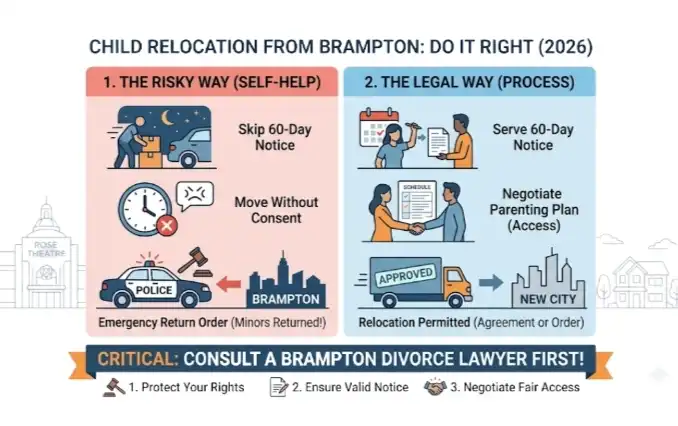
If your planned move will have a significant impact on a child’s relationship with the other parent — for example, relocating from Brampton to Windsor, Calgary, or Halifax — you must provide formal written notice at least 60 days before the expected move date.
The notice cannot be a text message or informal email. It must include:
- The new address and specific date of the intended move
- A detailed proposal for how parenting time will be restructured to preserve the child’s relationship with the other parent
Once served, the other parent has 30 days to formally object by filing with the court. If 30 days pass without a formal objection and no court order prohibits the move, you are generally permitted to relocate. If they object, the matter proceeds to a judge — which is where the burden of proof rules become critical.
Understanding how separation itself affects your legal obligations is foundational here. If you are navigating these questions alongside spousal support obligations after separation, the timelines and financial pressures often intersect in ways that make early legal advice essential.
Part 2: Who Bears the Burden of Proof?
When the other parent objects to the move, a Brampton judge must decide. The legal advantage at the outset — the “burden of proof” — is determined by your current parenting arrangement.
Scenario A: The “Vast Majority” Rule
If the child spends the vast majority of time with you (for example, 85% with you, every other weekend with the other parent), the court presumes the move is likely appropriate. The objecting parent must prove the relocation is not in the child’s best interests.
Scenario B: Substantially Equal Parenting Time
If you and your ex share time roughly equally — a 50/50 week-on/week-off arrangement, or a 60/40 split — the court presumes the move will be highly disruptive. The relocating parent bears the burden of proving the move overwhelmingly serves the child’s best interests. This is the hardest standard to meet.
Scenario C: The Middle Ground
If the arrangement falls between these poles, both parents share the burden of demonstrating what is best for the child. For parents in common-law relationships navigating these questions, the rights framework has important distinctions — our guide to what rights common-law couples actually have on separation in Brampton explains how the Children’s Law Reform Act applies to unmarried parents in the same way.
Part 3: The Best Interests Test — What the Judge Actually Weighs
A Brampton judge deciding a relocation case has no interest in what is fair to either parent. The analysis is singular: what is best for the child?
The court conducts a rigorous multi-factor analysis under the Divorce Act and Children’s Law Reform Act. No single factor is determinative; the judge weighs all of them together.
The Reason for the Move: A relocation for a significant career opportunity that materially improves the family’s financial position, or to access caregiving support from extended family, is treated as a good-faith reason. Moving to reduce the other parent’s access to the child — even if dressed up in other language — is treated as bad faith and is almost certain to result in denial.
Impact on the Child’s Existing Ties: The judge will examine the child’s roots in Brampton specifically — their school, friendships, sports teams, medical providers, and extended family network. The longer and more established those ties, the harder it is to justify severing them.
The Parenting Proposal: The quality of your proposed access plan carries enormous weight. If you are proposing to move to Vancouver, are you offering to fund the child’s flights back to Ontario for summer and March Break? Are you committing to daily video calls? A realistic, generous parenting proposal can shift a judge’s view substantially. This is also where child support calculations in Ontario become relevant — travel costs and extended-visit arrangements often need to be addressed alongside the existing support order.
History of Compliance: A parent with a documented history of following court orders and facilitating the child’s relationship with the other parent starts from a stronger position. A history of parental alienation or order violations is severely damaging to a relocation application.
Part 4: The Disaster of Moving Without Permission
One of the most catastrophic mistakes a separating parent can make is what lawyers call “self-help” — loading the children into a car without the other parent’s consent or a court order and driving to another city.
Do not do this.
In 2026, Ontario courts treat unauthorized relocation as a form of child abduction under the Criminal Code of Canada. The consequences unfold quickly:
- The left-behind parent can bring an urgent ex parte motion — a court appearance without you present — within days
- A judge will almost certainly issue an emergency order demanding the children’s immediate return to Brampton
- Police may be dispatched to enforce the return order
- At the eventual custody trial, the judge will have on record that you were willing to unilaterally eliminate the other parent’s relationship with the child — a fact that can result in you losing primary care entirely
The short-term “solution” of simply leaving becomes permanent, severe legal damage that no lawyer can fully undo.
Part 5: Why a Brampton Divorce Lawyer Must Be Your First Call
The relocation rules under Ontario and federal law are rigid precisely because the stakes — a child’s relationship with both parents — are irreversible. Here is what a local family lawyer does that you cannot do alone:
Strategic Timing: If you currently have a 50/50 parenting schedule, attempting relocation is legally very difficult. A lawyer will assess whether you need to first seek a modification to the parenting arrangement — establishing a new factual status quo — before serving a relocation notice. Timing this incorrectly forecloses your options.
Airtight Notice Drafting: A notice of relocation that omits mandatory information — such as the detailed access proposal — is legally invalid. The 60-day clock has not started. If you move on day 61 believing it has, you are still in self-help territory. A lawyer ensures the notice is procedurally complete from day one.
Negotiating a Mobility Agreement: Litigating a relocation case in Peel Region courts can take a year or more and cost $30,000 to $80,000 in legal fees, depending on complexity. A skilled local family lawyer will often negotiate a mobility agreement directly with opposing counsel — offering creative arrangements like full summer holidays with the left-behind parent and covered travel costs — that achieve your goal without a trial.
Peel Region Court Knowledge: Your case is heard in the Brampton courthouse under Peel Region jurisdiction. A local lawyer knows the mandatory mediation steps, the scheduling realities, and the approach local judges have taken in comparable mobility cases. That knowledge affects strategy from the first day.
Our family law team advises parents across Brampton, Mississauga, and Caledon on relocation notices, mobility agreements, and custody variation applications.
Frequently Asked Questions
Do I need court permission to move with my child in Ontario?
Not always — but you must follow the mandatory process. You are required to serve formal written notice at least 60 days before the move. If the other parent does not object within 30 days and no court order prohibits the move, you can generally proceed. If they object, a judge decides. Skipping the notice process entirely is treated as unauthorized removal of the child.
What happens if I move with my children without telling my ex?
A court will almost certainly issue an emergency order requiring the children’s immediate return to their previous location. Beyond the immediate order, a judge will consider your conduct as evidence that you are unwilling to support the child’s relationship with the other parent — which directly harms your position in any subsequent custody determination.
Does being the primary caregiver give me the right to relocate?
No. Being the parent the children live with most of the time gives you a legal advantage in a relocation dispute — the other parent bears the burden of proving the move is not in the child’s best interests — but it does not give you a unilateral right to move. You must still follow the 60-day notice process, and a judge can still deny the relocation.
How does the court decide if a relocation is in a child’s best interests?
The court considers the reason for the move, the quality of your proposed parenting plan, the child’s existing ties to their current community (school, friendships, family), the child’s own views if they are old enough, and each parent’s history of supporting the other’s relationship with the child. No single factor is decisive — the judge weighs all of them together.
What is the Rule of 65 in relocation cases?
The Rule of 65 is specific to spousal support, not relocation. In relocation law, the key thresholds are the “vast majority” rule (child lives primarily with one parent, giving that parent the stronger legal position) and the “substantially equal” rule (roughly 50/50 parenting time, where the relocating parent bears the harder burden of proof).
Can I relocate within Ontario without serving formal notice?
It depends on whether the move will have a “significant impact” on the child’s relationship with the other parent. Moving from one neighbourhood of Brampton to another is unlikely to trigger the formal notice requirement. Moving from Brampton to Thunder Bay almost certainly does. If you are unsure whether your planned move crosses that threshold, consult a family lawyer before making any arrangements.
Plan First. Pack Later.
Relocating with a child after separation is not impossible — but it is one of the most legally demanding challenges in Ontario family law. Courts operate from the principle that children benefit most from maximum contact with both parents, and overcoming that presumption requires a strong, well-documented case presented in the right procedural sequence.
Your first call should not be to a moving company or a real estate agent. It should be to a lawyer who knows Peel Region family court.
Book a consultation with GS Arora Law before you take any steps — signing a notice, accepting a job offer, or making moving arrangements — to ensure your plan is legally sound from the start.
Disclaimer: The information provided in this blog is for general informational purposes only and should not be considered legal, tax, financial, or professional advice. Regulations and procedures may change over time and vary by jurisdiction. For guidance tailored to your specific situation, please consult a qualified professional.