
The 2025 Mortgage Rules: A Complete Guide for Ontario First-Time Home Buyers
Book Consultation Book Consultation
19
JanThe 2025 Mortgage Rules: A Complete Guide for Ontario First-Time Home Buyers
Introduction: The Rules of Engagement Have Changed
For the past decade, the Ontario real estate market — particularly in Brampton, Mississauga, and the GTA — felt like a closed club. If you didn’t have a large inheritance or a high-earning tech salary, the barriers to entry were mathematically out of reach for most first-time buyers.
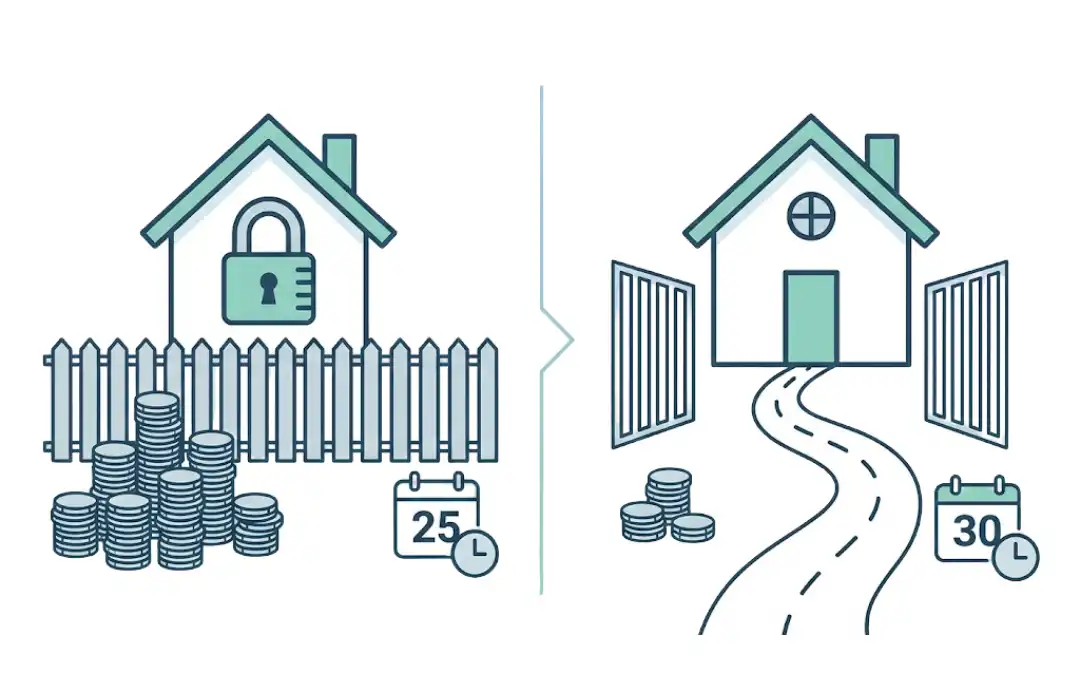
The biggest obstacle was never the monthly payment — it was the down payment cliff. Under the old rules, the moment a home’s price crossed $1,000,000, the mandatory down payment jumped from roughly 7.5% to a hard 20%. A $999,000 home required a $75,000 down payment. A $1,000,001 home required $200,000.
As of December 15, 2024, the federal government rewrote these rules — the most significant overhaul of Canadian mortgage policy in a generation. These changes remain fully in effect through 2026 and continue to reopen the market for high-income, lower-asset buyers — young professionals, dual-income households, and anyone who can afford the monthly payment but hasn’t had decades to save a $300,000 deposit.
This guide breaks down every lever available to Ontario first-time buyers under the 2025 rules, and the hidden costs that come with each one.
1. The $1.5 Million Insured Mortgage Cap
This is the headline change. The insurable limit — the maximum home price that can be purchased with less than 20% down — was raised from $1 million to $1.5 million.
How the Math Works Now
The minimum down payment is calculated on a graduated tier system:
- Tier 1: 5% on the first $500,000
- Tier 2: 10% on the portion between $500,000 and $1.5 million
- Tier 3: 20% on any amount over $1.5 million — homes above this threshold still strictly require 20% down
Worked Example: A $1.2 Million Brampton Home
Compare a standard detached home or high-end townhouse in Brampton listed at $1.2 million under the old and new rules.
Old Rules (pre-2025):
- Minimum down payment: 20%
- Cash required: $240,000
- Verdict: Out of reach for most first-time buyers
Current Rules (2025 onward):
- First $500,000 @ 5%: $25,000
- Remaining $700,000 @ 10%: $70,000
- Total down payment: $95,000
- Verdict: $145,000 less cash required upfront for the same home
The Trade-Off: Mandatory Insurance Premiums
There is no free lunch here. Putting less than 20% down means you must pay for CMHC Mortgage Loan Insurance.
On a $1.2M home with $95,000 down, the mortgage balance is $1,105,000. The insurance premium — roughly 4% — comes to approximately $44,200. This amount is added directly to your mortgage balance rather than paid in cash, but you pay interest on it for the full 25–30 year term.
2. The 30-Year Amortization: Breathing Room for Monthly Budgets
For years, any insured mortgage — meaning less than 20% down — was legally capped at a 25-year amortization period.
Current rule: All first-time home buyers purchasing any type of home, and all buyers (including investors) purchasing newly constructed homes, can now access a 30-year amortization on insured mortgages.
Why Five More Years Matters
Stretching repayment from 25 to 30 years lowers your required monthly payment, which matters for two reasons:
- Cash flow: A more manageable monthly budget from day one.
- Qualification: Mortgage approval is based on debt-to-income ratios (GDS/TDS). A lower required monthly payment reduces your debt ratio, which can allow you to qualify for a more expensive home on the same salary.
The Cost of Time
While monthly payments drop, total interest paid over the life of the loan rises substantially.
Example: On a $600,000 mortgage at 4.5% interest:
- 25-year term: Monthly payment = $3,320 | Total interest = $396,000
- 30-year term: Monthly payment = $3,030 | Total interest = $490,000
You save $290/month today but pay nearly $100,000 more in interest over the life of the loan. Many buyers take the 30-year term specifically to qualify and get into the home, then voluntarily increase their payments later to pay it down closer to a 20–25 year timeline.
3. The GST Rebate for First-Time Buyers on New Builds
If you are considering a pre-construction condo or a new subdivision home in Peel Region, this rule is significant.
The federal government introduced a 100% GST Rebate for first-time buyers on new homes valued up to $1 million.
- The phase-out: The rebate decreases on a sliding scale for homes priced between $1 million and $1.5 million.
- The impact: This measure can save eligible buyers up to $50,000 in tax on closing day for a new build.
- Important limitation: This rebate applies only to the federal portion of the tax (GST). You still need to budget for the provincial portion, though Ontario maintains its own separate rebate programs. See our guide on pre-construction home legal risks in Ontario before signing on a new build.
4. Secondary Suite Refinancing: The “Income Helper”
Introduced in January 2025, this program was designed specifically to increase housing density and is a genuine advantage for buyers who want to offset their mortgage with rental income.
The rule: Homeowners can access insured refinancing of up to 90% of the property value — capped at a $2 million property value — specifically to add a secondary suite, whether a basement apartment, garden suite, or laneway house.
Why This Matters for First-Time Buyers
- You can buy a home with the deliberate intention of adding a legal secondary suite later.
- Once you own the property, you gain access to lower-cost insured refinancing to fund the build.
- Projected rental income from the new suite can often be used to help you qualify for the mortgage, depending on the lender’s policies.
If you are planning to add a basement apartment in Brampton as part of this strategy, make sure the unit is legally compliant from the start — see our 2026 guide to legalizing a Brampton basement apartment, since an illegal secondary suite creates the same title and closing risks discussed throughout our real estate content.
5. What Has Not Changed: The Guardrails Remain Strict
The entry gates have widened, but the safety checks inside the system remain firm. Do not let the new rules create a false sense of security about affordability.
The Mortgage Stress Test Still Applies
You must still pass the OSFI Stress Test, proving you can afford your mortgage payment at either 5.25% or your contract rate plus 2% — whichever is higher. Even with a 30-year amortization, you are being tested on your ability to absorb a higher rate.
Closing Costs Still Cannot Be Financed
You cannot roll closing costs into your mortgage. You need liquid, available cash for:
- Land Transfer Tax: In Brampton and Mississauga, this is the Ontario provincial LTT only. In Toronto, buyers pay this tax twice — municipal plus provincial. See our full breakdown of how land transfer tax works and how Brampton buyers save.
- Legal fees: Typically $1,500–$2,500.
- PST on mortgage insurance: The 8% provincial sales tax on your CMHC premium must be paid in cash on closing day — for example, 8% of a $44,000 premium is $3,520.
The First-Time Home Buyer Incentive Has Ended
The former shared-equity program, where the government took a 5% or 10% equity stake in your home in exchange for lower payments, has been discontinued. If your 2026 purchase plan was based on this program, you need to rebuild your budget without it.
The Brampton Strategy for Buyers in 2026
Step 1: Get a New Pre-Approval
If your pre-approval predates these rule changes, it is obsolete. Work with a mortgage broker who understands the $1.5M insured cap and the 30-year amortization to accurately recalculate your real buying power.
Step 2: Target the New “Sweet Spot”
Homes priced between $1.0M and $1.2M are now the sweet spot for first-time buyers — previously requiring $200,000+ down, now accessible for roughly $75,000–$95,000 down. This segment is expected to see increased competition as more buyers qualify, so move decisively once you find the right property.
Step 3: Retain Your Lawyer Early
With less equity in the deal — 5–10% down instead of 20% — your financial margins are considerably tighter. There is far less room to absorb a mistake in the Agreement of Purchase and Sale. Ensure your lawyer reviews the Status Certificate (for condos) or completes the full title search (for freehold) with careful scrutiny before you go firm. See our guide to legal steps for buying a home in Brampton for the full process.
Conclusion: A Window of Opportunity — With Real Trade-Offs
These mortgage rules effectively trade equity for cash flow. The government is allowing buyers to take on more debt and repay it over a longer period to solve the immediate problem of high entry costs. For Ontario renters with strong incomes who have not been able to out-save market appreciation, this genuinely opens the market. But qualifying for a $1.5 million home with 10% down does not automatically mean it is the right decision for your finances.
Run the numbers carefully, stress-test your own monthly budget beyond what the bank requires, and ensure you have a legal team protecting your interests before you sign.
If you are preparing to buy in Brampton or the GTA under these new rules, contact GS Arora Law to have our real estate law team review your Agreement of Purchase and Sale and guide you through closing.
Disclaimer: The information provided in this blog is for general informational purposes only and should not be considered legal, tax, financial, or professional advice. Regulations and procedures may change over time and vary by jurisdiction. For guidance tailored to your specific situation, please consult a qualified professional.