
Crypto & Taxes in 2026: What Ontario Business Owners Need to Know
Book Consultation Book Consultation
29
NovCrypto & Taxes in 2026: What Ontario Business Owners Need to Know
Introduction: The Rules Have Settled — For Now
If you are an Ontario business owner holding or trading cryptocurrency, 2025 was a year of genuine regulatory whiplash — a proposed capital gains tax hike that was floated, then reversed, followed by the quiet rollout of a major new international reporting framework.
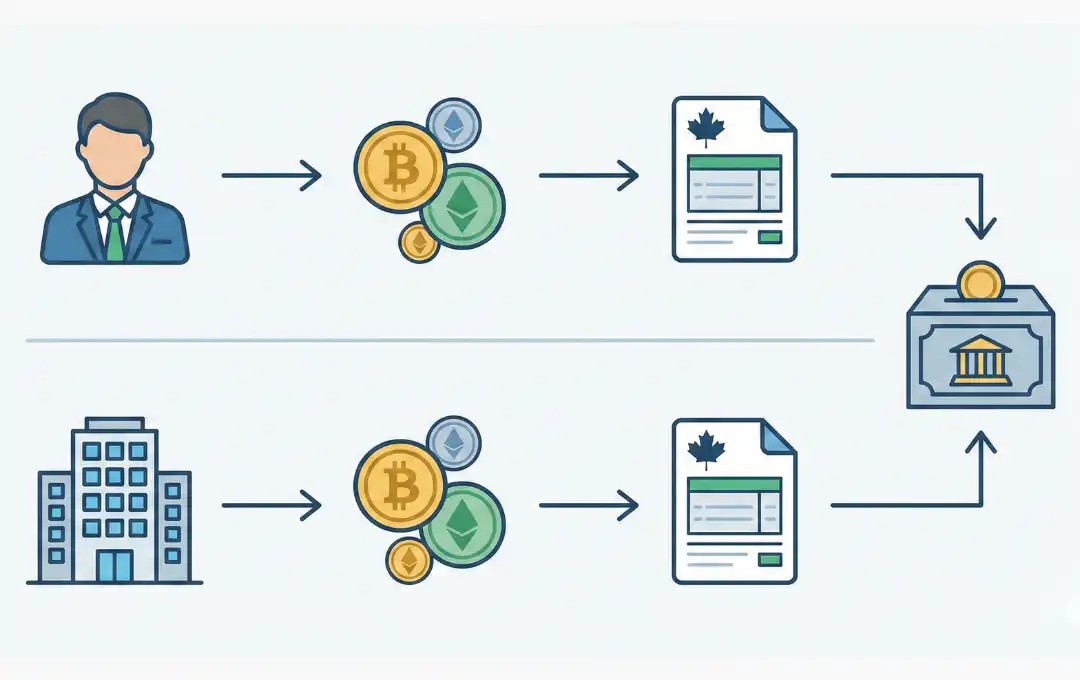
As of 2026, the dust has settled on the capital gains question, but a new compliance reality has begun: the Crypto-Asset Reporting Framework (CARF) is now live, and Canadian crypto platforms are actively collecting the transaction data that will be reported to the CRA starting in 2027.
This guide breaks down exactly how cryptocurrency payments, investments, and mining activities are taxed for Ontario businesses in 2026, and what the new reporting framework means for you going forward.
1. The Capital Gains Inclusion Rate: Confirmed at 50%
The most consequential tax event of the past two years was what didn’t happen.
In early 2025, the federal government proposed increasing the Capital Gains Inclusion Rate from 50% to 66.67% (two-thirds) for corporations and for individuals with gains exceeding $250,000 in a year. That proposal was formally cancelled on March 21, 2025, and it remains cancelled heading into 2026.
- For corporations: You continue to pay tax on only 50% of your capital gains.
- For sole proprietors: You continue to pay tax on only 50% of your capital gains, regardless of the total amount.
This remains significant relief for Ontario corporations and individuals holding crypto as a capital asset — the higher inclusion rate would have added nearly 9 percentage points to the effective tax rate on crypto exits above the threshold.
2. Classification: Business Income vs. Capital Gains
Before calculating any tax owed, you must correctly classify your crypto activity. The CRA assesses this based on the intent behind the activity and the frequency of transactions — the same test applied to stock trading and real estate flipping.
Generally, frequent trading with a profit-seeking intent, or crypto received as payment for goods and services, points toward business income. Long-term holding of crypto as an investment points toward capital gains treatment.
Warning: if your corporation’s primary activity is trading cryptocurrency, the CRA may classify it as a Specified Investment Business, which can deny access to the Small Business Deduction entirely and subject the income to a much higher upfront tax rate — approximately 50%.
3. Taxation for Ontario Sole Proprietors
If you operate as a sole proprietor — unincorporated — your crypto income is added directly to your personal income and taxed at your marginal rate.
If It’s Business Income
You report 100% of the profit on Form T2125.
- Advantage: you can deduct legitimate business expenses — hardware, electricity, home office costs.
- Disadvantage: it is taxed at your full marginal rate. In Ontario, the top combined marginal rate remains approximately 53.5% for income above roughly $253,000.
If It’s a Capital Gain
You report it on Schedule 3, and only 50% of the gain is added to your taxable income.
Example: You bought Solana for $10,000 and sold it for $50,000. Your gain is $40,000. Only $20,000 is added to your taxable income.
4. Taxation for Ontario Corporations
For incorporated businesses, the tax structure can be considerably more efficient — but it comes with real passive income traps.
Scenario A: Active Business Income (e.g., a Mining Operation)
If your crypto activity qualifies as an active business — a dedicated mining operation or a crypto payment processing service, for example — you qualify for the Small Business Deduction (SBD).
2026 combined rate: 11.2% on the first $500,000 of profit as of July 1, 2026 (down from 12.2%) — 9% federal plus 2.2% Ontario. Note that corporations with a fiscal year straddling July 1, 2026 will see a blended provincial rate closer to 2.7% for that transition year. See our full breakdown of tax consequences of incorporating in Ontario in 2026 for the complete rate schedule.
Income above the $500,000 threshold is taxed at the general combined rate of 26.5%.
Scenario B: Passive Investment Income (e.g., Holding Bitcoin in a Holdco)
If your corporation simply holds crypto as an investment and realizes capital gains on it, that income does not qualify for the small business rate at all.
Tax rate: investment income earned inside a corporation is taxed at a high upfront rate of approximately 50.17%, a large portion of which is refundable.
The refund mechanism: the government refunds a significant portion of this tax through the corporation’s RDTOH account, but only when you pay out taxable dividends to yourself as a shareholder. This structure exists specifically to prevent a corporation from being used purely to defer tax on passive investment holdings.
5. Mining, Staking, and GST/HST Treatment
Mining and Staking
Income recognition: you are taxed on the fair market value of the coins at the moment you receive them, not at some later date.
Example: You mine 1 BTC when it is worth $80,000. You have $80,000 of business income immediately, recognized in that tax year.
Inventory treatment: that 1 BTC becomes “inventory” with a cost base of $80,000. If you sell it later for $90,000, the additional $10,000 is a separate, later gain.
GST/HST Rules
- Mining: generally treated as an exempt supply. You do not charge GST/HST on mined rewards, but you also cannot claim Input Tax Credits on your mining rigs or electricity costs, except in narrow circumstances involving a specific known mining pool.
- Trading: treated as a financial service and exempt from HST. You do not charge HST on crypto trades.
See our companion guide on HST registration, filing, and ITCs for GTA businesses for the general ITC rules that still apply to any non-exempt business expenses tied to your crypto operation.
6. CARF Is Now Live: What Changed in 2026
This is the most significant update for 2026. The Crypto-Asset Reporting Framework (CARF) — an OECD-developed international standard — is no longer a future concern. Due diligence and data collection obligations began January 1, 2026.
What This Means in Practice
- Canadian crypto-asset service providers — exchanges, wallet providers, and certain custodial platforms — are now actively collecting client identity and transaction data in line with the OECD standard.
- First reports to the CRA are due in 2027, covering all 2026 calendar-year transactions.
- Once reporting begins, this data will also be exchanged internationally with other participating jurisdictions, similar to how the CRA already receives foreign bank account data under the existing Common Reporting Standard (CRS).
The Practical Impact for Your Business
If your business holds crypto through a Canadian exchange or custodial platform, that platform is now recording the transaction-level data that will land on the CRA’s desk in 2027. Any prior year’s activity that was not accurately reported becomes considerably harder to correct quietly once this reporting begins. If you have historical crypto activity you are unsure was properly reported, addressing it before CARF’s first reporting cycle in 2027 is materially better than waiting.
Summary Checklist for 2026 Crypto Tax Planning
- Confirm your classification — business income or capital gain — for every meaningful crypto disposition this year, and be consistent with your stated intent.
- Track your Adjusted Cost Base (ACB) using the weighted average cost method for every coin held, not just the ones you’ve sold.
- Keep corporate and personal wallets fully separate to avoid commingling assets — a clear audit red flag that the CRA specifically looks for.
- Review any historical crypto reporting gaps now, before CARF’s first data exchange to the CRA in 2027 makes voluntary correction a harder conversation.
- If your corporation holds significant passive crypto investments, revisit whether that activity is affecting your Small Business Deduction eligibility under the passive income rules.
Conclusion
The capital gains question has been settled — the 50% inclusion rate remains in place for both individuals and corporations. But 2026 introduces a genuinely new compliance layer: automated, structured reporting of crypto transactions to the CRA is now underway, with the first reports landing in 2027. For Ontario business owners holding or trading crypto, the practical takeaway is the same one that applies to every other area of tax compliance — get your classification, documentation, and structure right now, while there is still time to correct course before the data starts flowing.
If you need guidance on how your business should be structured to hold or trade crypto — or want a review of your historical reporting position before CARF’s first reporting cycle — contact GS Arora Law to speak with our business law team.
Disclaimer: The information provided in this blog is for general informational purposes only and should not be considered legal, tax, financial, or professional advice. Regulations and procedures may change over time and vary by jurisdiction. For guidance tailored to your specific situation, please consult a qualified professional.