
What Records Must Ontario Businesses Keep for CRA Compliance in 2026?
Book Consultation Book Consultation
10
DecWhat Records Must Ontario Businesses Keep for CRA Compliance in 2026?
Introduction: The Audit-Proof Business
For business owners in Brampton and across Ontario, the end of the year isn’t just about holiday parties and final sales pushes — it’s about preparing for tax season. In 2026, the Canada Revenue Agency has zero tolerance for disorganized bookkeeping.
Many entrepreneurs treat record-keeping as a low-priority administrative chore. This is a dangerous mindset. If the CRA audits your business, the burden of proof rests entirely on you. Without a complete, organized trail — paper or digital — to substantiate every dollar of income and every expense deduction, the auditor can and will deny your claims, leading to significant reassessments, penalties, and interest.
A well-maintained record-keeping system is not just a legal formality — it is your primary line of defence in an audit. This guide breaks down exactly what the CRA requires in 2026, the specific rules governing digital versus paper files, and the retention timelines every Ontario business must follow.
1. The Golden Rule: What Counts as a “Record”?
The CRA requires you to maintain “adequate records” that are reliable, complete, and allow an auditor to verify your tax obligations. This is not simply about saving receipts in a shoebox — it means maintaining a comprehensive financial history of the business.
For 2026, every Ontario business must maintain two categories of documentation.
A. Permanent Business Records
These are the foundational documents that define your business’s legal structure. They must be retained for the life of the business, plus an additional period — see Section 3 below.
- Incorporation documents: Articles of incorporation, bylaws, and any amendments
- Minute books: Minutes of directors’ and shareholders’ meetings, share registers, and formal resolutions
- General ledgers and journals: The master accounting records summarizing all financial transactions
For guidance on why these records matter beyond CRA compliance — particularly during a sale or real estate transaction — see our guide on why corporate minute books matter in real estate transactions.
B. Supporting Documents — The Proof
These are the day-to-day documents that prove the numbers in your general ledger actually reflect reality. Every transaction requires a source document behind it.
- Sales invoices: Copies of all invoices issued to customers
- Purchase receipts: Original receipts for all business expenses. A credit card statement alone is not sufficient — you need the detailed receipt showing what was purchased, the vendor’s name, the date, and the HST breakdown.
- Contracts and agreements: Leases, client contracts, employment agreements, and loan documents
- Bank statements: Monthly statements for all business bank accounts and credit cards, along with cancelled cheques and deposit slips
- Payroll records: T4 slips, PD7A remittance forms, hours-worked records, and details of all deductions — CPP, EI, income tax
- GST/HST records: Documentation supporting every Input Tax Credit claimed and all HST collected. See our companion guide on HST registration, filing, and ITCs for GTA businesses for what qualifies as a valid ITC record.
- Vehicle logs: A detailed logbook for any business vehicle, tracking total kilometres and business kilometres for each trip
2. Digital vs. Paper: The 2026 Standards
The era of mandatory paper mountains is largely over, but shifting to digital record-keeping comes with its own strict rules under CRA Information Circular RC4409.
Can You Destroy Paper Receipts After Scanning Them?
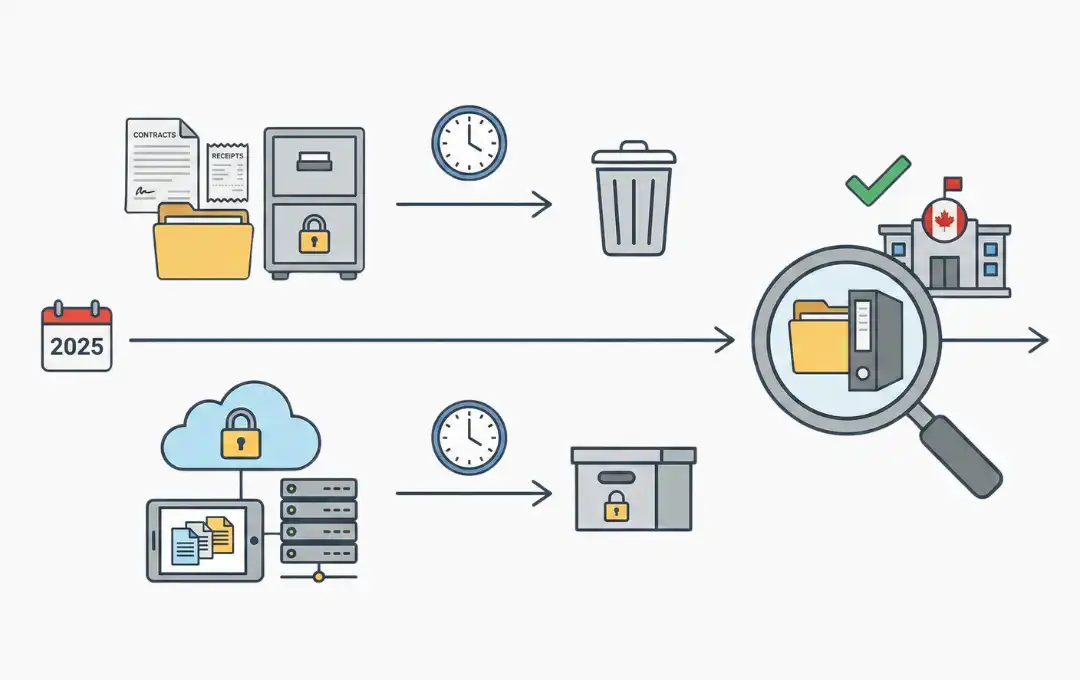
Yes — but only if your digital system meets a high standard. You may destroy paper originals if you use an imaging program that produces electronic images that are:
- An accurate reproduction: The digital copy must be identical to the original in every relevant detail.
- Intelligible: The image must be clearly readable by a CRA official reviewing it.
- Accessible: You must be able to locate and produce the record immediately upon request. A disorganized folder containing thousands of unsorted PDFs will not satisfy an auditor’s request for a specific document.
The risk: if you scan a receipt, discard the paper, and your hard drive later fails without a proper backup, you have no record at all. The CRA will disallow the associated expense — the digital convenience only holds up if your backup system does too.
CRA Requirements for Electronic Records
If you use accounting software such as QuickBooks or Xero, or otherwise maintain digital files, you are responsible for ensuring:
- Integrity: Records must be secure and protected from unauthorized alteration.
- Backups: You must maintain reliable backups stored at a secure, separate location — for example, cloud storage with servers located in Canada.
- Accessibility: You must be able to provide CRA auditors with access to your system and any necessary passwords, or supply the data in a standard, readable format on request.
3. The Retention Clock: How Long Must You Keep Records?
The general rule is straightforward, but several exceptions can catch business owners off guard.
The General Six-Year Rule
You must keep nearly all business records and supporting documents for six years from the end of the last tax year to which they relate.
Example for a corporation: if your corporate fiscal year ends December 31, 2026, you must retain those records until December 31, 2032.
Critical Exceptions to the Six-Year Rule
Late filing: If you file your tax return late, the six-year retention clock starts from the date you actually filed — not from the end of the tax year itself. Filing late extends how long you must hold onto everything related to that return.
Long-term assets (capital property): Records related to the purchase of long-term assets — real property, buildings, expensive equipment — must be kept indefinitely until you sell the asset. Once sold, you must then keep those purchase and sale records for an additional six years to substantiate the resulting capital gain or loss.
Minute books and share records: These must be retained for the entire life of the corporation, plus two years after it is formally dissolved.
Appeals and objections: If you are disputing a CRA assessment, you must keep all relevant records until the matter is finally resolved and every applicable appeal period has expired — even where this extends well beyond the standard six years. If you are currently in a dispute with the CRA, see our guide on when to call a tax lawyer for CRA disputes in Ontario.
CRA demand: The CRA can formally require, by registered letter, that you retain specific records for a longer period than the standard rule would otherwise require.
Conclusion: Order Is Your Best Defence
In 2026, a disorganized record-keeping system is a significant, unhedged risk for any Ontario business. The time and cost of implementing a secure, well-organized digital filing system with proper redundant backups is a small fraction of the cost of a failed CRA audit — in disallowed expenses, penalties, and accrued interest.
Treat your business records with the same discipline you apply to inventory or cash. In an audit, they are the only thing standing between your business and a substantial reassessment.
If your business needs guidance on setting up a compliant record-keeping system, or you are currently facing a CRA audit or reassessment, contact GS Arora Law to speak with our business law team.
Disclaimer: The information provided in this blog is for general informational purposes only and should not be considered legal, tax, financial, or professional advice. Regulations and procedures may change over time and vary by jurisdiction. For guidance tailored to your specific situation, please consult a qualified professional.