
Spousal Support in Ontario: When It's Payable, How Much, and How Long
Book Consultation Book Consultation
22
MarSpousal Support in Ontario: When It's Payable, How Much, and How Long
When is spousal support payable after separation in Ontario, and how can a family law attorney help you estimate what you might pay or receive?
The Myth of Automatic Alimony
When a relationship breaks down in Ontario, the immediate focus naturally shifts to two burning questions: Where will the children live? and How will I survive financially? While child support in Canada is a mathematical certainty based strictly on income and parenting time, spousal support (historically referred to as alimony) operates in a vast grey area. A widespread myth in 2026 is that if you make more money than your ex-spouse, you will automatically have to pay them support — or conversely, if you earn less, you are guaranteed a monthly cheque.
This is entirely false.
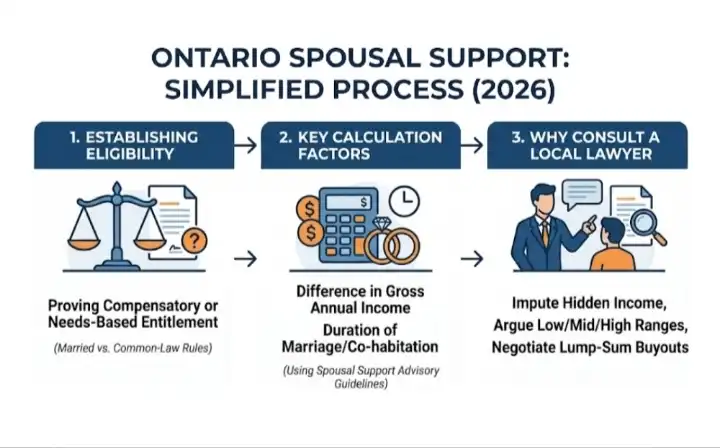
Spousal support in Ontario is never automatic. Before any dollar amount can be calculated, the spouse claiming support must first establish that they are legally entitled to receive it under the Family Law Act or the Divorce Act.
Whether you are the primary breadwinner concerned about financial exposure, or a stay-at-home parent facing uncertainty after a long marriage, understanding the mechanics of spousal support is critical. This guide breaks down exactly when spousal support is payable in Ontario, how the amount and duration are determined under the Spousal Support Advisory Guidelines, and why working with a Brampton family lawyer is the most important financial decision you can make post-separation.
Part 1: The Three Pillars of Entitlement — Why Support Is Owed
Before discussing how much you might pay or receive, the court must answer why support should be paid at all. In Ontario, entitlement to spousal support rests on three main legal pillars under the Divorce Act (for married spouses) and the Family Law Act (for common-law spouses).
1. Compensatory Entitlement
This is the most common foundation for spousal support claims. It recognizes that one spouse made economic sacrifices — in career, education, or earning capacity — for the betterment of the family or to advance the other spouse’s career.
A concrete example: you gave up a career in marketing to stay home and raise three children, allowing your spouse to work 60-hour weeks and become a high-earning executive. The law recognizes that you forfeited years of salary, pension contributions, and career advancement. Compensatory support exists to partially offset that economic loss, not as punishment for the higher-earning spouse, but as acknowledgement of the economic partnership that marriage represents.
2. Non-Compensatory (Needs-Based) Entitlement
This pillar is grounded in the economic reality of the separation itself. If the end of the relationship leaves one spouse facing severe financial hardship while the other maintains a high standard of living, the court has authority to intervene — even if neither spouse specifically sacrificed their career for the other.
For example: both spouses worked throughout the marriage, but one develops a chronic illness or disability after separation and can no longer maintain employment. Their standard of living drops dramatically while their former partner’s remains stable. A court may order support to address this basic economic disparity, anchored in what Ontario family law calls the “means and needs” of each party.
3. Contractual Entitlement
This arises when the parties previously signed a domestic contract — a prenuptial agreement, marriage contract, or cohabitation agreement — that explicitly governs spousal support upon separation. Provided the contract was entered into freely, with independent legal advice, and without unconscionable terms, Ontario courts will generally enforce it as written. This is one of the strongest arguments for having a properly drafted domestic contract before a relationship breaks down.
Part 2: Married vs. Common-Law — The Critical Difference in Ontario
It is essential to understand that in Ontario, the Family Law Act treats married and common-law couples very similarly when it comes to spousal support — but with one significant qualification that catches many people off guard.
If you are legally married, you can claim spousal support immediately upon separation, with no minimum duration of marriage required.
If you are common-law, you are eligible to claim or pay spousal support only if:
- You have cohabited continuously for a period of not less than three years; or
- You are in a relationship of “some permanence” and have a child together.
This matters enormously in Brampton and across the GTA, where long-term common-law relationships are common. If you lived with your partner for two and a half years and have no children together, there is generally no legal basis for a spousal support claim in Ontario — a fact that surprises many separating couples who assumed the same rules applied to them as to married spouses. For a deeper look at how property rights and financial obligations differ between married and common-law couples, our guide to common-law vs. married property rights in Ontario covers the full picture.
Part 3: How Much and How Long — The Spousal Support Advisory Guidelines (SSAGs)
Once entitlement is established, family law professionals in Ontario use the Spousal Support Advisory Guidelines (SSAGs) to determine both the monthly amount and the duration of support payments. Unlike the Federal Child Support Guidelines, the SSAGs are not statute law — they are highly persuasive formulas developed by federal researchers that Ontario courts rely on heavily in negotiation and at trial.
The SSAGs generate a range — Low, Mid, and High — rather than a single fixed number, which is precisely why legal representation matters so much at this stage.
The guidelines operate through two distinct formulas:
The “Without Child Support” Formula
Used when there are no dependent children receiving child support. The calculation hinges primarily on two variables: the difference between the parties’ gross annual incomes, and the total length of cohabitation (including any common-law period prior to marriage).
As a general rule of thumb, the duration of support runs approximately 0.5 to 1 year for every year of the relationship. A 10-year marriage would therefore generate a support duration range of roughly 5 to 10 years — though this is a starting point, not a ceiling.
The “With Child Support” Formula
When child support is also being paid, the calculation changes significantly. Under Canadian law, child support takes absolute priority. The SSAGs calculate each spouse’s Individual Net Disposable Income (INDI) — what remains after child support obligations and taxes are accounted for — and generate a spousal support range based on that remaining pool of income. The payee spouse typically receives enough support to bring their INDI to somewhere between 40% and 46% of the combined INDI, depending on the circumstances.
The Rule of 65 and Indefinite Support
When does spousal support last indefinitely? In Ontario, support is generally considered “indefinite” — meaning it has no predetermined end date, though it remains reviewable upon retirement or major life changes — in two scenarios:
- The marriage lasted 20 years or more; or
- The Rule of 65 applies: the length of the marriage (in years) plus the age of the recipient spouse at the time of separation equals 65 or more. For example, a 50-year-old leaving a 15-year marriage would qualify (50 + 15 = 65).
Indefinite support does not mean permanent and irrevocable. A payor who retires, suffers a job loss, or whose ex-spouse begins earning significantly more can apply to the court to vary or terminate support. Understanding how support intersects with other financial matters — such as pension division and RRSP assets — is equally important, which is why we recommend also reviewing our article on dividing pensions, RRSPs, and business assets in a Brampton divorce.
Part 4: Why You Must Consult a Family Lawyer — Not a Calculator
It is incredibly tempting to search for “Ontario spousal support calculator,” enter two salaries, and assume the resulting number represents your legal reality. This is one of the most dangerous traps in family law. Online calculators assume accurate income disclosure, simple tax situations, and clear-cut entitlement. Real separations are rarely that clean.
Here is why consulting a Brampton family law lawyer — not a website form — is the only way to protect your financial future:
1. Uncovering Hidden or Imputed Income
If your ex-spouse is self-employed, operates a corporation, or runs a cash-based business, their CRA tax return (Line 15000) will almost certainly understate their true income. Personal expenses run through the corporation — vehicles, meals, travel — artificially suppress the income figure. An online calculator will use that number uncritically. A skilled family lawyer, working alongside a forensic accountant where necessary, will seek to impute income based on actual lifestyle, corporate financials, and historical earnings, ensuring support is calculated on economic reality rather than creative bookkeeping.
2. Arguing the SSAG Range Strategically
The SSAGs deliberately produce a range, not a point. The spread between the Low and High figures can easily be $1,000 to $1,500 per month or more. No algorithm can advocate for you. A lawyer will build a legal argument based on factors specific to your case — the allocation of matrimonial property, debt obligations, the recipient’s health or retraining potential — to push toward the High end if you are receiving, or the Low end if you are paying. The special rules governing the matrimonial home in Ontario often play a direct role in these arguments, since home equity division directly affects each party’s post-separation financial position.
3. Negotiating a Lump-Sum Buyout
Many payors find the prospect of sending monthly payments to their former spouse for years deeply uncomfortable — and many recipients share the anxiety of depending on consistent payments from someone who may default, change jobs, or relocate. A family lawyer can calculate the present value of the ongoing support obligation and negotiate a one-time, lump-sum payment to resolve the matter entirely. When structured correctly, lump-sum spousal support payments can be received tax-free by the recipient, creating a meaningful financial advantage over monthly taxable payments.
4. The Local Court Advantage
Family law outcomes are not uniform across Ontario. Judges in Brampton, Toronto, and other jurisdictions each have track records, established preferences, and historical patterns in how they weight SSAG factors. A lawyer familiar with your local court will give you far more accurate guidance on what a judge is actually likely to order — something no national calculator or general legal website can offer.
Our family law team advises separating spouses throughout Brampton and the GTA on entitlement, SSAG ranges, lump-sum negotiations, and court strategy.
Frequently Asked Questions
When is spousal support payable in Ontario?
Spousal support is payable in Ontario only after a spouse establishes legal entitlement — either on compensatory grounds (career sacrifice), non-compensatory grounds (financial need), or through a domestic contract. Support is never automatic, regardless of the income difference between the parties. Both the Divorce Act and the Family Law Act govern entitlement depending on whether the parties were married or common-law.
How long does spousal support last in Ontario?
Duration depends on the length of the relationship and whether children are involved. As a general rule, support runs 0.5 to 1 year for every year of cohabitation. Indefinite (no fixed end date) support applies when the marriage lasted 20 or more years, or when the Rule of 65 is met — where the recipient’s age plus the length of the marriage equals 65 or more. Indefinite does not mean permanent; support can be varied or terminated if circumstances change significantly.
Do common-law spouses have the right to spousal support in Ontario?
Yes, but only under specific conditions. A common-law spouse can claim support if the couple lived together continuously for at least three years, or if they have a child together and the relationship was of “some permanence.” Without meeting one of these thresholds, there is generally no legal basis for a spousal support claim in Ontario.
What are the Spousal Support Advisory Guidelines (SSAGs)?
The SSAGs are a set of formulas used by Ontario family law lawyers and judges to calculate the amount and duration of spousal support. They are not legislation — they are persuasive guidelines that generate a Low-to-High range based on the parties’ incomes, the length of the relationship, and whether child support is also being paid. Because the SSAGs produce a range rather than a fixed number, legal representation is essential to argue where within that range the final order should fall.
Is spousal support taxable in Ontario?
Under Canadian tax rules, ongoing periodic spousal support payments are deductible for the payor and taxable income for the recipient. Lump-sum spousal support payments are generally not taxable for the recipient and not deductible for the payor. This tax treatment is a critical factor when deciding between monthly support and a lump-sum buyout — and it’s why proper legal and tax advice matters. For more on deducting family-related legal expenses, see our guide to claiming family-related legal fees in Canada.
Can spousal support be changed after it is ordered?
Yes. Spousal support orders and agreements can be varied if there has been a material change in circumstances — such as the payor losing their job, the recipient remarrying or significantly increasing their income, or the payor retiring. Changes are not automatic; one party must bring an application to the court or reach a new agreement with the other spouse.
What is the difference between spousal support and child support in Ontario?
Child support is a non-negotiable legal obligation calculated according to the Federal Child Support Guidelines based on the payor’s income and the number of children — it is not discretionary. Spousal support, by contrast, requires proof of entitlement first and is calculated using the non-binding SSAGs that generate a range. Child support always takes priority over spousal support in the calculation process.
Don’t Guess with Your Financial Future
Spousal support is one of the most consequential financial obligations — or financial lifelines — you will encounter after separation. A miscalculation, a missed entitlement argument, or an uninformed agreement can lock you into years of financial hardship in either direction.
Whether you are seeking to protect the wealth you have built or to secure the economic compensation you earned through years of familial sacrifice, you need an advocate who understands both the law and the numbers behind it.
Book a consultation with GS Arora Law to have your spousal support situation assessed by a family lawyer serving Brampton, Mississauga, and the broader GTA.
Disclaimer: The information provided in this blog is for general informational purposes only and should not be considered legal, tax, financial, or professional advice. Regulations and procedures may change over time and vary by jurisdiction. For guidance tailored to your specific situation, please consult a qualified professional.