
Power of Sale in Ontario: The Lender's Process and Your Rights as a Borrower
Book Consultation Book Consultation
09
JunPower of Sale in Ontario: The Lender's Process and Your Rights as a Borrower
Introduction
When a homeowner in Ontario falls behind on a mortgage, the lender’s most common remedy is not foreclosure — it is power of sale. Power of sale is faster, cleaner, and more lender-friendly than foreclosure, which is why almost every mortgage default in Ontario goes this route. For the borrower, it is also one of the most consequential legal processes they will ever face, and the timing of the decisions made inside the process determines whether the borrower walks away with equity, walks away with nothing, or stops the process before it ever completes.
Power of sale in Ontario is a legal remedy under the Mortgages Act that allows a lender to sell a defaulted borrower’s property to a third party, apply the proceeds to the outstanding mortgage debt, and pay any surplus to the borrower — but only after serving a Notice of Sale and waiting a mandatory 35-day redemption period during which the borrower can cure the default and stop the sale entirely.
This guide explains how power of sale actually works in Ontario in 2026, what the borrower’s rights and options are at each stage, the difference between power of sale and foreclosure, and when to call a lawyer.
What Power of Sale Actually Is
Power of sale is a remedy that lets a mortgage lender sell the mortgaged property when the borrower is in default, apply the sale proceeds to the mortgage debt, and pay any surplus to the borrower and any subsequent encumbrancers. The power exists either in the mortgage document itself, known as a contractual power of sale, or under sections 31 to 43 of the Mortgages Act, known as a statutory power of sale. Almost every modern Ontario mortgage relies on a contractual power of sale supplemented by these statutory rules.
The defining feature of power of sale, compared with foreclosure, is that the property is sold to a third party rather than transferred to the lender. The lender is paid out of the sale proceeds, the borrower’s interest in the property is extinguished, and any surplus goes to the borrower. If the sale proceeds don’t cover the full debt, the borrower remains personally liable for the shortfall — power of sale does not extinguish the borrower’s personal covenant under the mortgage.
The Notice of Sale and the 35-Day Clock
Power of sale in Ontario begins with a Notice of Sale served under section 31 of the Mortgages Act. The notice must be given by the lender to the borrower, to any guarantor, to any subsequent encumbrancer, and to any other person whose interest is registered on title. It must state the amount currently in default, the amount required to cure that default, and the date after which the lender intends to proceed with a sale.
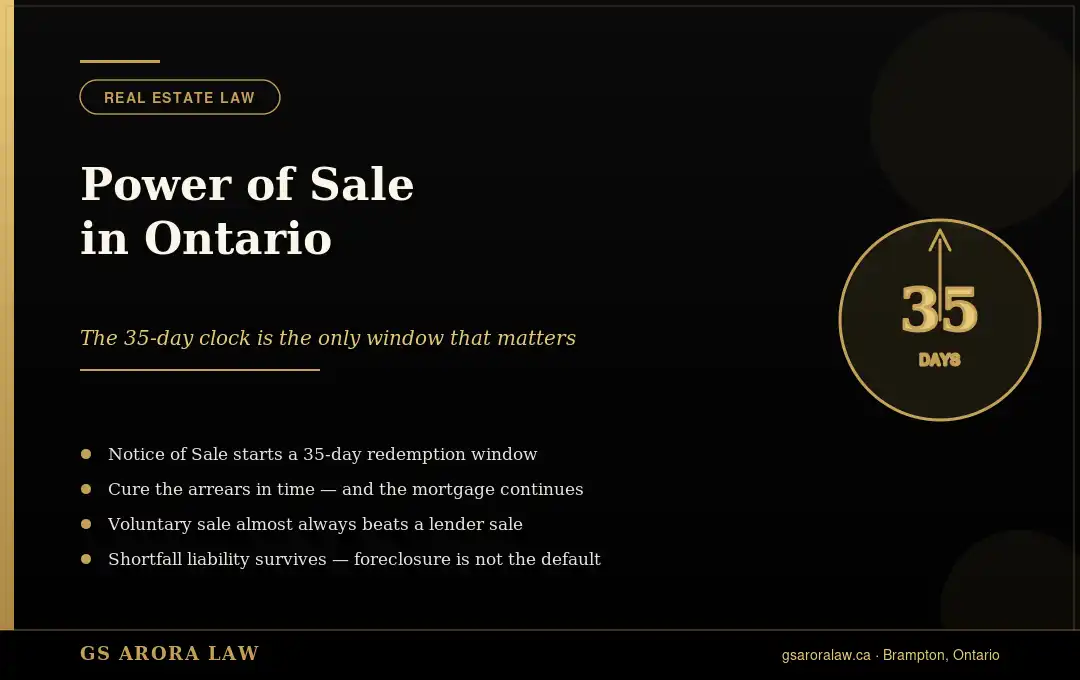
The number that matters most in this entire process is 35 days. After serving the Notice of Sale, the lender must wait at least 35 days before taking any further step toward selling the property — this is the borrower’s statutory redemption period. During those 35 days, the borrower can pay the full amount in default, plus the lender’s costs to date, and stop the process outright. Curing the arrears returns the mortgage to performing status as though the default never happened.
If the default is not cured within the 35-day window, the lender can proceed to sell. In practice, lenders move quickly at that point: they list the property, accept offers, and close with a third-party purchaser, with the proceeds then distributed according to the Mortgages Act priority rules.
The Borrower’s Redemption Right After 35 Days
Even after the 35-day notice period expires, the borrower’s right to redeem the mortgage — to pay the full outstanding balance and stop the sale — continues to exist until a binding sale actually closes. The longer the process runs, the more expensive it becomes to redeem, since interest, legal fees, listing costs, and real estate commissions all continue to accrue, but the underlying right does not disappear on day 36.
Borrowers with equity in the home and a way to access cash — a refinance through a private lender, a HELOC, family funds, or the sale of another asset — can still stop a power of sale even after the 35-day window closes, provided they act before a third-party sale closes. Tightened lending rules introduced in recent years have made some refinancing routes harder to access, which is why understanding current options matters; our guide to the 2025 mortgage rule changes for Ontario buyers covers how those changes affect refinancing eligibility. Borrowers without equity have a harder route, but the redemption right still exists on paper.
A borrower who is going to lose the home regardless is almost always better off selling it themselves before the lender does. A homeowner-controlled sale typically achieves a higher price than a power-of-sale listing, since the market tends to discount distressed listings. A real estate lawyer can structure a borrower-controlled sale with the lender’s cooperation, and lenders usually agree to this, since it gets them paid out faster and typically recovers more of the debt.
Where the Money Goes When a Power-of-Sale Property Closes
When a power-of-sale property sells, the proceeds are distributed in a specific statutory order under section 27 of the Mortgages Act. First come the lender’s costs of sale, including legal fees, real estate commission, and registration costs. Next are any prior charges — a mortgage or charge registered ahead of the selling lender. Third is the selling lender’s own debt, covering principal, interest, NSF charges, and other contractual amounts. Fourth are subsequent charges, such as second or third mortgages, registered liens, and judgments, paid out in order of priority. Whatever remains after all of that goes to the borrower as surplus.
If the sale price doesn’t cover the lender’s debt in full, the lender can sue the borrower personally for the shortfall under the mortgage’s personal covenant. Many Ontario power-of-sale lenders pursue shortfall claims aggressively; some don’t, particularly major banks where the loan is insured by CMHC, Sagen, or Canada Guaranty, but the underlying personal liability exists regardless of whether a particular lender chooses to pursue it. Where a shortfall claim follows a disputed sale price, the same legal remedies that apply to a failed real estate closing can sometimes come into play — see our guide to why real estate deals fail to close in Ontario for the broader remedies available to both buyers and sellers.
Power of Sale vs. Foreclosure in Ontario
Foreclosure is the older remedy, available under both the Mortgages Act and the Land Titles Act. In a foreclosure, the lender goes to court and obtains an order transferring title directly to the lender — the property is not sold to a third party, and the lender simply keeps it. Foreclosure takes longer, costs more, and forfeits the lender’s right to chase the borrower for any shortfall, since once the lender takes the property itself, it has elected that remedy and given up the personal covenant claim.
Power of sale is faster and preserves the lender’s shortfall claim, which is why Ontario lenders almost always choose it over foreclosure. A borrower facing default will see foreclosure proceedings only in unusual circumstances.
The Bona-Fide-Purchaser Problem and the Lender’s Duty of Care
A power-of-sale purchaser buys clean title. The borrower’s equity of redemption is extinguished by the sale, and the purchaser is protected under section 35 of the Mortgages Act. This means the borrower’s recourse after a power-of-sale closing is against the lender, not against the purchaser who bought the property.
The lender has a duty, under both the Mortgages Act and the common law, to act in good faith and take reasonable steps to obtain a fair market price for the property. In practice, this generally means proper marketing exposure through MLS listing, a reasonable listing period, and acceptance of a market-supported offer rather than an artificially low one. A lender that sells at a fire-sale price to a related party, or that fails to properly expose the property to the market, can be sued by the borrower or by subsequent encumbrancers for the difference between what it actually received and what a fair sale should have achieved. These claims are legally real but genuinely difficult to win without strong evidence of bad faith or negligence on the lender’s part.
What the Borrower Should Actually Do — and When
The single most important thing a borrower in default can do is stop hoping the problem will resolve itself and start working with a lawyer the day the Notice of Sale arrives. The 35-day clock is the only meaningful window in which the cheapest and most flexible options — curing the arrears, negotiating a forbearance, refinancing privately, or listing the property voluntarily — are all still realistically on the table. Wait until day 30 of that window, and most of those options are effectively gone.
A lawyer working on a power-of-sale file typically verifies that the Notice of Sale was properly drafted and served on the correct parties in accordance with the 35-day rule, reviews the mortgage to confirm the default and check for any procedural defects, and negotiates with the lender for a forbearance agreement that may extend the deadline or reduce the amount required to cure. Where appropriate, the lawyer also coordinates a refinance through a private lender — slower than a bank refinance, but possible in many cases — and, if a sale is genuinely unavoidable, helps the borrower run a voluntary sale ahead of the lender with the lender’s cooperation. Where the sale process itself was deficient, the lawyer can also pursue claims against the lender after closing.
Our Real Estate Law team handles exactly this kind of time-sensitive file for homeowners across Brampton and the GTA, coordinating directly with lenders during the redemption window rather than waiting until options have narrowed.
Frequently Asked Questions
How long do I have before my lender can sell my home under power of sale in Ontario?
The lender must serve a Notice of Sale and then wait a minimum of 35 days under the Mortgages Act before taking any further step to sell. During that window, paying the full amount in default, plus the lender’s costs, stops the process entirely.
Can I stop a power of sale after the 35-day period has passed?
Yes, in most cases. The borrower’s right to redeem the mortgage by paying the full outstanding balance continues until a binding sale with a third-party purchaser actually closes — it does not expire automatically after 35 days, though redemption becomes more expensive the longer the process runs.
What is the difference between power of sale and foreclosure in Ontario?
In a power of sale, the lender sells the property to a third party and can still pursue the borrower for any shortfall. In a foreclosure, the lender takes title to the property itself through a court order and gives up the right to chase the borrower for a shortfall, which is why Ontario lenders almost always use power of sale instead.
Am I still liable for debt if my home sells for less than I owe under power of sale?
Yes. Power of sale does not extinguish the borrower’s personal covenant under the mortgage. If the sale proceeds don’t cover the full debt, the lender can sue the borrower personally for the shortfall, although lenders with CMHC, Sagen, or Canada Guaranty-insured mortgages don’t always pursue this option.
Can I sue my lender if they sold my home for less than it was worth?
Potentially, if the lender failed in its duty to obtain a fair market price — for example, by not properly listing the property or selling it to a related party at a discount. These claims are legally recognized but require strong evidence of bad faith or negligence to succeed.
Final Takeaway
Power of sale is one of the few areas of Ontario law where doing nothing for two weeks can cost a homeowner the entire value of their home. The 35-day window following a Notice of Sale is the point at which the cheapest and most flexible options are still available — curing the arrears, negotiating with the lender, refinancing, or selling voluntarily — and that window narrows every day it goes unused.
If you have received a Notice of Sale, are already in arrears on your mortgage, or are worried that you might be, book a free consultation with GS Arora Law today. Every day inside the 35-day window matters.
Disclaimer: The information provided in this blog is for general informational purposes only and should not be considered legal, tax, financial, or professional advice. Regulations and procedures may change over time and vary by jurisdiction. For guidance tailored to your specific situation, please consult a qualified professional.