
Pre-Construction Home Legal Risks in Ontario: What Buyers Need to Know in 2026
Book Consultation Book Consultation
02
FebPre-Construction Home Legal Risks in Ontario: What Buyers Need to Know in 2026
Buying a pre-construction condominium or home in the GTA was, for years, treated as a low-risk investment. You paid a deposit, waited for construction, and took possession of a unit that had often appreciated significantly. In 2026, that assumption requires more scrutiny. Project cancellations, developer receiverships, and tightened financing conditions have shifted the risk profile of pre-construction contracts materially, and buyers entering the market need to understand exactly what the contract says before they sign it.
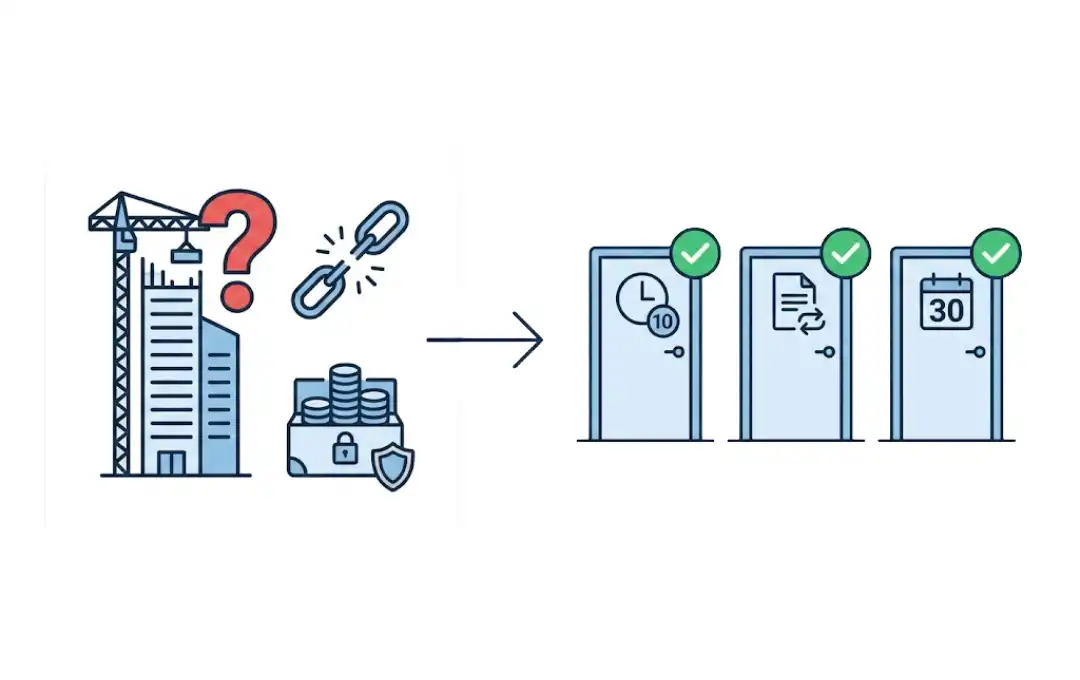
A pre-construction agreement of purchase and sale in Ontario is not a simple reservation. It is a multi-year legal contract that defines precisely when your deposit is protected, when you can legally cancel, and what happens if the developer fails. The three most important things to understand before signing: how your deposit is held, when your right to cancel expires, and what your options are if the project goes into receivership.
This guide covers each of those areas under Ontario law in 2026.
How Is a Pre-Construction Deposit Protected in Ontario?
Deposit protection for pre-construction purchases in Ontario operates on a two-tier system, and understanding the limit of each tier matters.
Tarion warranty coverage applies to both freehold and condominium pre-construction purchases. For condominium deposits, Tarion’s deposit protection is capped at $20,000. For freehold (non-condominium) homes, the coverage limits are higher and have been periodically updated — confirm the current limits at tarion.com before signing. Tarion is the backstop; it is not the primary protection for a large deposit.
The trust account requirement is the primary protection. Under Ontario’s Condominium Act, developers are required to hold pre-construction condo deposits in a designated trust account. The trust account holds your money independently of the developer’s operating funds. If the project is cancelled — by the developer under the terms of the agreement, or by a court in a receivership proceeding — the trust-held funds are returned to you. The trust requirement exists precisely because Tarion’s cap does not cover the full deposits that most GTA pre-construction units require.
Excess Condominium Deposit Insurance (ECDI) is the third layer. If a developer wants to draw on trust funds during construction — to pay for construction costs rather than waiting for completion — they are legally required to obtain ECDI from an approved insurer (such as Westmount Guarantee) to cover the amount drawn above the Tarion cap. If a developer draws on trust funds without ECDI and subsequently becomes insolvent, the portion of your deposit above $20,000 may not be recoverable. Before signing any pre-construction agreement, ask your lawyer to confirm whether the project carries ECDI coverage.
The Home Construction Regulatory Authority (HCRA) licenses builders under the New Home Construction Licensing Act and is responsible for builder conduct complaints. Checking a builder’s HCRA registration and complaint history before signing is a basic due-diligence step that buyers often skip.
What Are Your Legal Rights to Cancel a Pre-Construction Contract in Ontario?
Ontario law provides three specific circumstances under which a pre-construction buyer can cancel the agreement and receive a full refund of their deposit. Outside these windows, a buyer who walks away from a pre-construction contract may be liable to the developer for more than just the deposit.
The 10-day cooling-off period. From the date the buyer receives both the signed Agreement of Purchase and Sale and the Disclosure Statement (required under the Condominium Act), the buyer has 10 calendar days to cancel for any reason, with no penalty. This is the standard safety valve built into every pre-construction condominium purchase in Ontario. It is the appropriate window to have a real estate lawyer review the agreement in full — particularly the early termination conditions (the specific circumstances under which the developer can cancel on the buyer), the critical dates addendum, and the adjustment cost provisions. Our guide to understanding the Agreement of Purchase and Sale covers what to look for in that review.
The material change right. If the developer makes a significant change to the project after signing that would have caused a reasonable buyer not to enter the agreement, the buyer has the right to rescind the agreement and receive a full deposit refund. What constitutes a “material change” under the Condominium Act includes changes to the size or design of the unit, removal of promised amenities, changes to the project’s zoning or approvals, and changes to the common elements that materially reduce what the buyer agreed to purchase.
The critical timing rule: once you receive written notice of a material change, you have 10 days to deliver written notice of rescission. If you do not act within that 10-day window, you are deemed to have accepted the change and your right to cancel on that basis expires. Buyers who receive material change notices and delay reviewing them — or who assume their lawyer has received them when they have not — routinely miss this deadline.
The Outside Occupancy Date termination window. Every pre-construction contract contains a Statement of Critical Dates that specifies a Firm Occupancy Date and an Outside Occupancy Date (OOD). The OOD is the absolute latest date by which the developer must provide occupancy before the buyer’s right to terminate is triggered.
If the developer cannot provide occupancy by the OOD, a 30-day termination window opens for the buyer. The buyer must deliver written notice of termination within that 30-day window. If no notice is given within 30 days, the termination right expires — the buyer is locked into the contract, and the developer is instead required to pay delayed occupancy compensation, which under the Condominium Act is capped at $7,500 in total. For a unit that was expected years earlier, $7,500 is a minimal remedy for what can be years of delay.
Knowing your OOD in advance — and having a system to monitor it — is not optional. This is a hard deadline with serious financial consequences on both sides.
What Happens If a Pre-Construction Developer Goes Into Receivership in Ontario?
Developer receiverships have become a real risk in Ontario’s 2026 market, with several high-profile projects across the GTA involving court-appointed receivers after developers ran out of construction financing. Understanding what happens to your deposit and your contract in that scenario is important.
When a court appoints a receiver over a developer, the receiver takes control of all project assets — including the trust account holding your deposit. Everything stops: you generally cannot close, cannot cancel through normal contractual channels, and cannot access your deposit while the receivership is active. The receiver’s mandate is to maximize recovery for the developer’s creditors, not to protect individual buyers.
The receiver will assess whether to complete the project (often by bringing in a new builder), sell the project to a third-party developer, or apply to the court for authorization to cancel all purchase agreements and return deposits. Each path has a different timeline and a different outcome for buyers. In a court-authorized cancellation, the trust-held deposits are returned — but it can take 12 to 24 months from the time the receivership is initiated before the court authorizes the release of funds. During that period, your deposit earns no interest and you cannot access it.
The most damaging outcome occurs when a new developer acquires the project and is permitted by the court to terminate the existing purchase agreements and offer new contracts at current market prices. A buyer who signed at 2021 pricing may find their agreement cancelled and be offered a new contract at materially higher pricing — with no obligation to accept.
Buyers with pre-construction agreements in projects showing financial stress — delayed construction milestones, changes in developer principals, or publicly reported financing difficulties — should consult a real estate lawyer immediately about their options, including whether any existing cancellation right should be exercised before the receivership process starts. Our guide to appraisal shortfalls in pre-construction real estate in Ontario addresses the related financing risk when a completed unit appraises below the contract price.
What Closing Costs Apply to a Pre-Construction Home in Ontario?
Pre-construction closings carry a different — and often larger — set of closing costs than resale purchases. The most significant difference is HST: new residential construction in Ontario is subject to 13% HST on the purchase price. Builders typically net the federal and Ontario New Housing Rebates against the price in the contract, but the rebate eligibility conditions attach to the buyer, not the builder. If you are purchasing as an investment property and do not intend to occupy the unit as your primary residence, the rebate structure changes entirely and the HST exposure is substantially larger.
Additional pre-construction-specific closing costs include development levies, educational levies, adjustments for any increase in municipal charges between signing and closing, and a variety of builder-specific fees that are disclosed in the agreement and the disclosure statement. These can add $20,000 to $50,000 or more to the closing cost on a GTA condominium in 2026, beyond what a comparable resale purchase would require. Our guide to closing costs in Ontario for first-time buyers covers the general closing cost framework; pre-construction buyers should review the specific adjustment provisions in their agreement with a lawyer before closing.
How a Brampton Real Estate Lawyer Fits In
Pre-construction agreements in Ontario are typically drafted by the builder’s legal team, run 50 to 100 pages, and are presented to buyers as standard form contracts. They are not standard, and they are not non-negotiable on every point. A real estate lawyer reviewing the agreement during the 10-day cooling-off period can identify: the strength of the deposit protection, the breadth of the developer’s unilateral cancellation rights, the adjustment cost provisions that will increase your closing cost, and whether the critical dates addendum is realistic given the project’s current stage. Our real estate law team reviews pre-construction agreements for buyers across Brampton and the GTA, and can advise on the risks specific to a particular builder and project before you sign.
Frequently Asked Questions
Is a pre-construction deposit protected in Ontario?
Yes — in part. The deposit must be held in a trust account under the Condominium Act, and Tarion provides warranty coverage capped at $20,000 for condominium deposits (higher for freehold homes — confirm current limits at tarion.com). If a developer draws on trust funds during construction, they must carry Excess Condominium Deposit Insurance (ECDI) to cover deposits above the Tarion cap. If they draw funds without ECDI and go insolvent, the portion above $20,000 may not be recoverable.
Can I cancel a pre-construction contract in Ontario?
Yes, but only in specific circumstances: during the 10-day cooling-off period after receiving the agreement and Disclosure Statement; if the developer makes a material change and you deliver written notice within 10 days of receiving notice; or if the Outside Occupancy Date passes and you deliver written termination notice within the 30-day window. Outside those windows, walking away from a pre-construction contract can expose you to claims by the developer.
What is the Outside Occupancy Date in a pre-construction contract?
The Outside Occupancy Date (OOD) is the absolute latest date specified in the Statement of Critical Dates by which the developer must provide occupancy. If that date passes, a 30-day termination window opens for the buyer. If the buyer does not deliver written notice of termination within those 30 days, the right to cancel on that basis expires and the developer owes delayed occupancy compensation capped at $7,500 under the Condominium Act.
What happens to my deposit if a pre-construction developer goes bankrupt?
If the developer goes into court-appointed receivership, your deposit is frozen in the trust account while the receiver determines whether to complete, sell, or cancel the project. If the project is ultimately cancelled by the court, trust-held deposits are returned — but the process can take 12 to 24 months. Deposits drawn by the developer without ECDI coverage and used for construction before insolvency may not be fully recoverable above the Tarion cap.
What is a material change in a pre-construction contract in Ontario?
A material change is a significant alteration to the project — such as a reduction in unit size, removal of promised amenities, or loss of a key approval — that would have caused a reasonable buyer not to enter the agreement. Under the Condominium Act, a buyer who receives notice of a material change has 10 days to deliver written notice of rescission. Missing that deadline is deemed acceptance of the change.
Does HST apply to a pre-construction home purchase in Ontario?
Yes. New residential construction in Ontario is subject to 13% HST. Builders typically credit the federal and Ontario New Housing Rebates against the price in the contract for buyers who intend to occupy the unit as their primary residence. If you are purchasing as an investor and will rent the unit, the rebate structure and HST exposure are materially different — this must be confirmed with a lawyer before closing.
Final Takeaway
Pre-construction in Ontario in 2026 offers real opportunity and real risk. The buyers who are best protected are those who have their agreement reviewed during the cooling-off period, know their Outside Occupancy Date, and understand the deposit protection structure before they sign. Book a free consultation with GS Arora Law to have a pre-construction agreement reviewed before your 10-day cooling-off period expires.
Disclaimer: The information provided in this blog is for general informational purposes only and should not be considered legal, tax, financial, or professional advice. Regulations and procedures may change over time and vary by jurisdiction. For guidance tailored to your specific situation, please consult a qualified professional.
GS Arora, Lawyer & Notary Public. Brampton, Ontario.