
Title Insurance in Brampton, Ontario: What It Covers, What It Doesn't, and Why You Need It in 2026
Book Consultation Book Consultation
09
FebTitle Insurance in Brampton, Ontario: What It Covers, What It Doesn't, and Why You Need It in 2026
If you are buying a home in Brampton or the GTA in 2026, your lawyer’s closing statement will include a line item for title insurance — typically between $300 and $600 for a standard residential purchase. Most buyers pay it without question. A few ask whether it can be skipped to reduce closing costs.
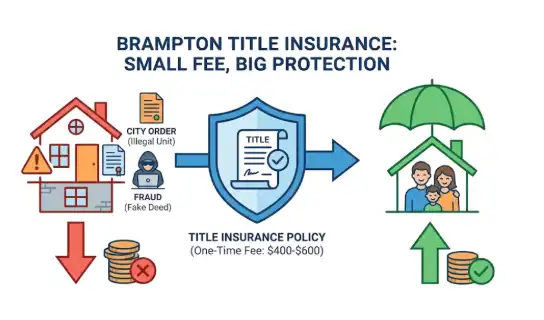
Title insurance is a one-time premium paid at closing that protects a homeowner’s ownership rights — their title — against fraud, title defects, certain by-law violations by a prior owner, and survey issues discovered after closing. It is not home insurance, it does not expire, and it does not require renewal. It remains in force for as long as you own the property.
In Brampton specifically, title insurance addresses two risks that come up more often here than in most Ontario markets: the illegal basement suite that a previous owner built without permits, and the escalating pattern of title fraud that has affected Peel Region properties in recent years. This guide covers both — and the limits of what the policy will actually do. For a full overview of coverage and exclusions across Ontario, see our companion guide to what title insurance covers and excludes in Ontario.
What Is Title Insurance and How Is It Different From Home Insurance?
Home insurance and title insurance are purchased around the same time and both appear as closing-related costs, which is why they are frequently confused. They cover entirely different things.
Home insurance covers physical damage to the property — fire, water damage, theft, and similar events. It is paid monthly or annually and must be renewed continuously. Your mortgage lender requires it.
Title insurance covers your ownership rights — the legal interest in the property documented in the provincial land registry under the Land Titles Act. It protects against defects in the chain of title, fraud committed against your ownership, certain violations by previous owners, and survey issues. It is paid once at closing and requires no renewal.
Within title insurance, there are two distinct policies issued on most residential transactions. The lender’s policy protects the mortgage lender up to the outstanding mortgage balance. It is mandatory when there is a mortgage. The homeowner’s policy (also called the owner’s policy) protects the buyer’s own equity in the property — everything above the mortgage. For a modest additional premium that is often included in the same package, the homeowner’s policy is the one that actually protects you. Ensure your lawyer is obtaining both.
Title insurance in Ontario is most commonly issued by Stewart Title or FCT (First Canadian Title), though other FSRA-regulated insurers also operate in the market. The specific policy language matters — not all policies are identical, and your lawyer should walk you through what your specific policy covers before closing.
Does Title Insurance Cover an Illegal Basement Suite in Brampton?
This is the most common title insurance question we receive from Brampton buyers — and the answer is yes, with a specific condition.
Brampton has one of the highest concentrations of secondary suites in Ontario. Many were built by previous owners without building permits, without passing the required inspections, and without any notation on the property’s municipal record. A buyer who purchases a home with a finished basement “in-law suite” and later receives an Order to Comply from the City of Brampton requiring remediation is in a position that title insurance was specifically designed to address — provided the violation existed before the date of closing, and the buyer had no actual knowledge of it at the time of purchase.
In that scenario, the owner’s title insurance policy can cover the cost of bringing the unit into compliance with the building code, the cost of removing the suite if the City orders demolition, and in some cases a payment for the reduction in the property’s usable value if the basement cannot legally remain a living space.
The critical limitation: title insurance covers enforcement by a government authority. If you discover that the basement was built without a permit and want to proactively legalize it, the policy does not respond — there is no Order to Comply, and therefore no insured event. The claim trigger is the government compelling you to act, not your own initiative to remedy a known issue. If you are interested in proactively legalizing a secondary suite, our guide to legalizing a Brampton basement apartment covers the zoning, permit, and inspection requirements.
Does Title Insurance Protect Against Real Estate Fraud in Ontario?
Yes — and this protection has become increasingly important in Brampton and across Peel Region.
Title fraud takes several forms. In the most serious scenarios, a fraudster uses forged identification or stolen identity to pose as the registered owner of a property, transfers the title into a new name, and either sells the property or registers a fraudulent mortgage against it and takes the proceeds. The actual owner — sometimes away on an extended trip, sometimes simply unaware — returns to find their home sold or a large mortgage registered against it without their knowledge.
Without title insurance, the legal process of restoring your name to title, discharging a fraudulent mortgage, and recovering what was taken can cost $50,000 or more in legal fees and take years. With an owner’s title insurance policy in place, the insurer bears the cost of the legal proceedings to restore your title and pays off the fraudulent encumbrance. You are made whole; the insurer pursues recovery from the fraudster.
This protection extends forward from your date of purchase — it covers fraud that occurs after closing, not just defects that existed before it. For a broader look at fraud prevention strategies for Ontario homebuyers, including what you can do before closing to reduce exposure, see our guide to protecting yourself from real estate fraud in Ontario.
Does Title Insurance Cover Survey and Encroachment Issues?
Yes, in most cases — and this is one of the reasons Ontario residential transactions no longer routinely require a commissioned survey at closing.
Prior to the widespread adoption of title insurance in Ontario in the late 1990s, a buyer’s lawyer typically required a current Real Property Report (RPR) — a surveyor’s document showing the location of the structure on the lot relative to the lot boundaries — before closing. If a fence, driveway, addition, or structure encroached on a neighbour’s property or violated a setback requirement, that would appear on the survey and need to be resolved before closing.
Today, most residential transactions in Ontario close with title insurance in place of an RPR. The policy covers losses arising from encroachments or survey issues that a current survey would have revealed. If your neighbour produces a survey six months after your purchase showing that your widened driveway crosses the property line by two feet, the title insurer responds — either by negotiating with the neighbour, paying for the encroachment to be removed, or compensating you for the loss in value.
This is not universal: some lenders still require an RPR on certain property types, and a survey may be advisable on rural, irregular, or older urban properties where boundary history is complex. Your lawyer’s recommendation on this point should be specific to your property.
What Does Title Insurance Not Cover in Ontario?
Title insurance is protection against unknown and pre-existing defects — not a warranty against everything that can go wrong with a property.
Known defects. If the seller disclosed in the agreement of purchase and sale that the basement was built without permits, or if the listing described it as an unregistered secondary suite, you accepted that risk at the time of purchase. The policy does not cover conditions you had actual knowledge of at closing.
Post-closing renovations by you. If you build a deck without a permit, add a structure that violates a setback, or make any change to the property after closing without required approvals, that is not an insured event. Title insurance covers the actions of previous owners and third parties — not your own.
Physical condition of the property. Structural defects, a leaking roof, a failing HVAC system, or any physical deterioration of the property are covered by home insurance or by the seller’s representations in the agreement of purchase and sale — not by title insurance.
Certain specific exclusions. Most title insurance policies in Ontario contain specific exclusions for Indigenous land claims, certain environmental conditions, and matters that would only be disclosed by a physical inspection of the property. Read the policy with your lawyer before closing.
How Much Does Title Insurance Cost in Brampton in 2026?
For a standard residential purchase in Brampton at a price in the $900,000 to $1,200,000 range, the one-time title insurance premium (for both the lender’s policy and the homeowner’s policy combined) typically runs between $350 and $650. The premium scales with the purchase price and is paid once at closing as a disbursement on your lawyer’s account.
There is no annual renewal, no deductible on most residential claims, and no ceiling on the insurer’s obligation to restore your title or defend your ownership rights under the policy terms. Against the cost of a contested title fraud case ($50,000+ in legal fees), a code-compliance order on an illegal basement ($30,000 to $60,000 in remediation), or a survey encroachment dispute ($5,000 to $15,000), the premium represents among the best value in the entire closing cost statement.
Our real estate law team arranges title insurance as a standard part of every residential closing in Brampton and across the GTA, and will walk you through your specific policy coverage before your closing date.
Frequently Asked Questions
What is title insurance in Ontario and do I need it?
Title insurance is a one-time premium paid at closing that protects your ownership rights against fraud, title defects, certain prior-owner building violations, and survey issues. In Ontario, virtually every residential purchase closes with a title insurance policy — your mortgage lender requires a lender’s policy, and your lawyer will also obtain a homeowner’s policy to protect your equity. It is not optional in any practical sense.
Does title insurance cover an illegal basement in Brampton?
Yes, if the violation by the prior owner existed before your closing date and you had no knowledge of it at the time of purchase. The owner’s title insurance policy responds when a government authority (the City of Brampton) issues an Order to Comply requiring you to remediate or remove the illegal suite. It does not respond to a proactive decision by the homeowner to legalize a known unpermitted space.
What is the difference between a lender’s and homeowner’s title insurance policy?
A lender’s policy protects the mortgage lender up to the outstanding loan balance. A homeowner’s (owner’s) policy protects the buyer’s own equity — the value of the property above the mortgage. Both are typically purchased at the same time for a combined premium. The homeowner’s policy is the one that directly benefits the buyer and should always be included.
What does title insurance not cover in Ontario?
Title insurance does not cover known defects the buyer accepted at closing, physical damage to the property (covered by home insurance), post-closing renovations or permit violations created by the current owner, or matters specifically excluded in the policy — such as certain environmental conditions or Indigenous land claims. Always review the exclusions with your lawyer before closing.
How much does title insurance cost in Brampton?
For a residential purchase in Brampton priced between $900,000 and $1,200,000, the combined lender and homeowner title insurance premium is typically $350 to $650, paid once at closing. The premium scales with the purchase price and is included as a disbursement on the lawyer’s closing account.
Does title insurance replace the need for a survey in Ontario?
In most Ontario residential transactions, yes — title insurance is accepted in place of a current Real Property Report, and most lawyers and lenders will close without commissioning a new survey. The policy covers losses from encroachments and boundary issues that an RPR would have revealed. On rural properties or properties with complex boundary histories, a survey may still be advisable; your lawyer should advise on this before closing.
Final Takeaway
Title insurance is not a premium line on the closing statement to negotiate away. In Brampton’s 2026 real estate environment — with secondary suite enforcement active across the city and fraud patterns that have touched multiple Peel Region properties — the owner’s policy is the single most cost-effective protection a buyer can obtain. Book a free consultation with GS Arora Law if you are buying in Brampton or the GTA and want your title insurance coverage confirmed before your closing date.
Disclaimer: The information provided in this blog is for general informational purposes only and should not be considered legal, tax, financial, or professional advice. Regulations and procedures may change over time and vary by jurisdiction. For guidance tailored to your specific situation, please consult a qualified professional.
GS Arora, Lawyer & Notary Public. Brampton, Ontario.