
11
FebHow Brampton Businesses Can Safely Hire Contractors in 2026
For years, Brampton small business owners have relied on a deceptively simple strategy: print an “Independent Contractor Agreement,” have the worker sign it, and assume the business is protected from payroll tax obligations and employment liability.
In 2026, that piece of paper is no longer a shield.
In Ontario, whether a worker is legally an employee or an independent contractor is determined by the economic and practical reality of the working relationship — not by what the contract says. With Administrative Monetary Penalties now enforceable on the spot and federal data-sharing actively triggering CRA audits, the cost of misclassification has never been higher for Brampton businesses.
This guide explains the 2026 enforcement landscape, the legal tests that actually govern classification, the safe harbors available to Ontario businesses, and the practical checklist you need before the first invoice is paid.
Part 1: The New 2026 Enforcement Reality — Why the Stakes Have Changed
The legal tests for employee versus contractor classification have not changed dramatically. What has changed is the speed, automation, and severity of enforcement when a business gets it wrong.
Immediate On-the-Spot Fines Under Ontario’s AMP Regime
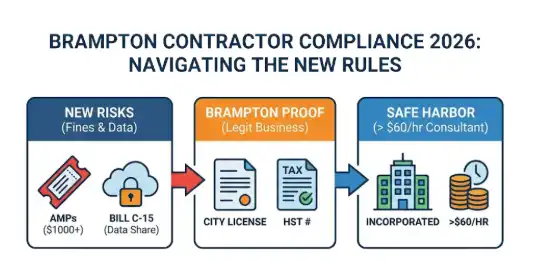
As of January 1, 2026, Ontario inspectors operating under the Occupational Health and Safety Act (OHSA) and the Employment Standards Act (ESA) have the authority to issue Administrative Monetary Penalties (AMPs) without initiating a court prosecution. Previously, the Ministry of Labour had to pursue a formal prosecution to impose financial consequences. Now, an inspector can issue a penalty — starting at $1,000 or more per affected worker — on the spot, in the same way a parking ticket is issued, if they determine your contractors are employees who have been denied safety training, overtime, or other statutory entitlements.
For a Brampton logistics company with 15 “owner-operator” drivers, that exposure can reach $15,000 in a single inspection — before any back-pay or CPP/EI liability is calculated.
The Federal Data Trap
Federal initiatives bridging the CRA and Employment and Social Development Canada (ESDC) have introduced an automatic cross-referencing trigger. If a worker your business classified as a contractor loses the engagement and applies for Employment Insurance — an entitlement available only to employees — that EI application is now cross-referenced against their history of filing as a self-employed contractor. The mismatch triggers an automatic audit of your business for unpaid CPP contributions, EI premiums, and income tax remittances going back up to four years.
The audit does not require a complaint from the worker. The data mismatch itself initiates it. This is why a compliant contractor agreement is necessary but not sufficient — the substance of the working relationship must match the legal classification. For a detailed breakdown of how the CRA evaluates this distinction and the financial exposure involved, our article on contractor vs. employee misclassification rules in Ontario covers the full CRA analysis.
Part 2: The Business Identity Test — Making Your Contractor Look Like a Business
One of the strongest practical defenses available to Brampton businesses in 2026 is ensuring the contractors you engage demonstrably operate as independent businesses — licensed, registered, and insured as such.
Require a City of Brampton Business Licence
Brampton maintains licensing requirements for both stationary and mobile businesses operating within the city. If you are engaging contractors for renovation, landscaping, cleaning, delivery, or any trade-based service, require them to produce their City of Brampton Business Licence before commencing work.
The logic is straightforward: a genuine employee does not hold a municipal business licence. A genuine independent business does. If a worker cannot produce one, a CRA auditor will use that gap as one factor among several to argue the person is a de facto employee.
Require an HST Registration Number on Every Invoice
Always require contractors to invoice you with a valid HST Registration Number from the CRA. If a contractor is a “small supplier” earning under $30,000 annually and therefore not required to register for HST, that status itself raises a classification flag — the CRA frequently treats non-HST registrants in ongoing service arrangements as disguised employees, particularly when they work exclusively for one business.
If a contractor cannot or will not provide an HST number, treat that as a significant compliance risk indicator before engaging them. Our guide to HST registration obligations for GTA businesses explains the registration thresholds and what both parties need to understand about their HST obligations in a contractor relationship.
Part 3: The ESA Business Consultant Safe Harbor
For white-collar engagements — IT development, marketing strategy, financial consulting, management advisory — Ontario’s Employment Standards Act provides a specific legislative exemption that many Brampton businesses fail to use correctly. Qualifying for this exemption is the most legally secure way to engage a high-level contractor in 2026.
The IT and Business Consultant Exemption — Three-Part Test
A worker is legally excluded from ESA protections (including termination pay, severance, and overtime) if all three of the following conditions are satisfied:
Incorporated entity: The contractor must provide services through a corporation — for example, “1234567 Ontario Inc.” — not as a sole proprietor operating under their personal name. This is non-negotiable for the exemption to apply.
Written agreement: The engagement must be governed by a written contract that explicitly identifies the worker as a consultant and states their rate of compensation.
Minimum hourly rate: The contractor must be paid at least $60 per hour, excluding bonuses, expenses, and reimbursements.
If all three conditions are met, the worker falls outside the ESA entirely for the duration of that engagement. This dramatically reduces your exposure to misclassification claims, wrongful dismissal liability, and the entitlements that attach to employee status under Ontario law.
Our business law team drafts ESA-compliant contractor agreements for Brampton businesses across all sectors, including technology, professional services, and management consulting.
Part 4: The Substance Over Form Test — Three Classification Killers
For contractors who do not meet the Business Consultant exemption — drivers, cleaners, general tradespeople, and other labour categories — you must satisfy the common law test for independent contractor status. In 2026, adjudicators focus heavily on three factors that, if mishandled, will defeat your classification regardless of what the contract says.
The Exclusivity Killer
The fatal error: Your contractor agreement contains language requiring the worker to provide services exclusively to your business.
Exclusivity is one of the clearest markers of an employment relationship. A genuine independent contractor operates a business — and a business has multiple clients. If your agreement prohibits outside work, or if the working relationship in practice results in the contractor working solely for you, adjudicators will use that exclusivity as strong evidence of employment.
The fix: Remove exclusivity language from your agreements entirely. Better still, maintain documented evidence that the contractor actively works for other clients — a website listing other projects, invoices from other customers, or their own business marketing materials. The paper trail matters as much as the contract language. Our guide to employment contracts and restrictive covenants in Ontario covers how exclusivity and non-compete provisions interact across both employment and contractor relationships.
The Tools of the Trade Killer
The fatal error: You supply the contractor with the primary tools or equipment required to do the work — the laptop, the vehicle, the cleaning supplies, the specialized software.
Tool ownership is a fundamental marker of business independence. A contractor who uses your equipment is economically indistinguishable from an employee in this respect. For a trucking or logistics company in Bramalea, the “owner-operator” model only withstands scrutiny if the driver genuinely owns or independently leases their vehicle, bears the cost of their own fuel and maintenance, and carries their own commercial vehicle insurance. If your business pays for the truck’s repairs and gas, the economic reality is employment regardless of the contract’s title.
The fix: Require contractors to provide their own tools, equipment, and software licences. Document this requirement in the agreement and verify it in practice.
The Profit and Loss Killer
The fatal error: The contractor is paid an hourly rate with no variation based on outcome, efficiency, or project result.
This is the most important of the three tests. A genuine independent contractor bears economic risk — the chance to profit if they work efficiently and the risk of loss if they make errors requiring unpaid remediation. A worker paid a flat hourly rate regardless of how long a project takes or whether they need to redo deficient work has no meaningful economic exposure. That structure describes an employee.
The fix: Structure contractor compensation as a flat project fee, a milestone-based payment, or a defined deliverable rate. If a contractor completes a project in less time than anticipated, they earn a higher effective hourly return — that is profit. If they make errors and must rework deliverables on their own time, they absorb that cost — that is risk of loss. The profit-and-loss dynamic must be genuine, not cosmetic.
Part 5: The Dependent Contractor Trap
Between the clear categories of employee and independent contractor sits a legally recognized third category in Ontario: the dependent contractor. This middle ground is where many Brampton businesses create serious long-term liability without realizing it.
A dependent contractor is a worker who possesses the technical hallmarks of self-employment — their own tools, their own business registration, their own insurance — but who derives 80 to 100 percent of their income from a single client over an extended period. Ontario courts have recognized this category explicitly, and the financial consequences of misunderstanding it are severe.
What You Owe a Dependent Contractor
You do not owe CPP contributions or EI premiums for a dependent contractor in the same way you would for an employee. However, Ontario courts have held that dependent contractors are owed reasonable notice of termination — the same common law entitlement that applies to long-service employees. In recent years, Ontario courts have awarded dependent contractors up to 24 to 26 months of reasonable notice pay upon termination, amounts equivalent to what a senior employee might receive.
How to Mitigate the Risk
Do not allow a contractor relationship to run continuously for years without structured breaks or renewal points. Include a specific notice period — typically four to eight weeks — in the contractor agreement for termination without cause, which courts will generally enforce to limit reasonable notice exposure if the agreement is properly drafted. Most importantly, actively encourage your contractors to develop and maintain other client relationships. A contractor who genuinely operates a multi-client business is far less likely to be characterized as a dependent contractor if the relationship ends.
The 2026 Contractor Compliance Checklist
Before issuing the first payment to any contractor, verify each of the following:
Business verification: Confirm they hold a City of Brampton Business Licence or equivalent municipal registration, and that they invoice with a valid CRA HST Registration Number.
ESA exemption check: For professional or IT engagements, confirm they operate through a corporation, a written agreement is in place, and the rate exceeds $60 per hour. If all three apply, document it.
Equipment audit: Confirm in writing that the contractor supplies their own tools, equipment, software, and vehicle. Do not provide these items without a formal rental or cost-recovery arrangement.
Exclusivity removal: Review the contract and remove any exclusive service language. Retain documentation showing the contractor works with other clients.
Certificate of insurance: Require the contractor to provide a Certificate of General Liability Insurance (CGL) naming their own business as the insured. Employees do not carry commercial liability insurance; legitimate independent businesses do.
Compensation structure: Ensure payment is project-based or milestone-based, not a recurring hourly rate with no outcome dependency.
Termination notice clause: Include a defined notice period in every contractor agreement to limit potential dependent contractor exposure if the relationship ends.
Frequently Asked Questions
What is the difference between an employee and an independent contractor in Ontario?
The distinction is determined by the economic and practical reality of the working relationship, not by the label in the contract. Key factors include whether the worker operates an independent business with multiple clients, whether they supply their own tools and equipment, whether they bear a genuine risk of profit and loss, and whether they are economically dependent on a single client. A signed contractor agreement is relevant but not determinative — courts and the CRA look through the document to the actual relationship.
What are Administrative Monetary Penalties and when can they apply to my business?
As of January 1, 2026, Ontario inspectors under the Employment Standards Act and Occupational Health and Safety Act can issue on-the-spot monetary penalties against businesses that misclassify employees as contractors and thereby deny them statutory entitlements. Unlike the previous system, which required a court prosecution, AMPs can be issued administratively — similar to a regulatory fine — without prior warning in some circumstances.
What is the ESA Business Consultant exemption and who qualifies?
The exemption allows Ontario businesses to engage contractors fully outside the scope of the Employment Standards Act — meaning no entitlement to termination pay, severance, or overtime — if the contractor provides services through an incorporated entity, operates under a written agreement that identifies them as a consultant with a stated rate, and is compensated at a minimum of $60 per hour. All three conditions must be satisfied simultaneously. Sole proprietors do not qualify regardless of their rate.
What is a dependent contractor and why does it matter?
A dependent contractor is a worker who is technically self-employed but derives the vast majority of their income — typically 80% or more — from a single client over an extended period. Ontario courts have ruled that dependent contractors are entitled to reasonable notice of termination, which in some cases has reached 24 to 26 months. The risk arises when a business allows a contractor relationship to continue for years without structured breaks, creating the economic dependency that defines this category.
Does my contractor need to charge HST?
A contractor earning more than $30,000 annually from business activities is required to register for and collect HST under the Excise Tax Act. If your contractor is not registered and not charging HST, this is a compliance flag — the CRA treats long-term, single-client arrangements with non-HST-registered workers as a strong indicator of misclassification. Always require an HST registration number on invoices.
Can I use a standard contractor agreement template downloaded online?
Not safely in 2026. The enforcement environment, the AMP regime, and the federal data-sharing initiatives that now automatically trigger audits when workers apply for EI have changed the risk profile significantly. A generic template does not address the ESA Business Consultant exemption criteria, the dependent contractor notice period, Brampton-specific municipal licensing requirements, or the exclusivity and tools provisions that determine classification under the current common law tests.
Protect Your Brampton Business Before the First Invoice
Contractor misclassification is no longer a problem that surfaces only in lawsuits. In 2026, it surfaces in automatic audits, on-the-spot fines, and CRA assessments that can reach back four years. The checklist and frameworks in this guide significantly reduce that exposure — but only when implemented through properly drafted agreements that reflect the actual working relationship.
Book a consultation with GS Arora Law to have your contractor agreements and existing workforce arrangements reviewed by a Brampton business lawyer before your next engagement begins.
Disclaimer: The information provided in this blog is for general informational purposes only and should not be considered legal, tax, financial, or professional advice. Regulations and procedures may change over time and vary by jurisdiction. For guidance tailored to your specific situation, please consult a qualified professional.