
Child Support in Ontario: How It's Calculated and What to Do When Payments Stop
Book Consultation Book Consultation
19
MarChild Support in Ontario: How It's Calculated and What to Do When Payments Stop
Navigating separation or divorce is emotionally exhausting, and when financial instability enters the equation, the pressure becomes immense. In Ontario’s 2026 economic climate — where the cost of housing, groceries, and raising children remains historically high — child support is not a luxury. It is a legal necessity.
A common misconception is that child support is a “reward” for the primary caregiver or a “punishment” for the paying parent. The legal reality is categorically different.
Child support in Ontario is the absolute legal right of the child — not of either parent. It is calculated using the mandatory Federal Child Support Guidelines and cannot be waived, negotiated away, or unilaterally altered by either party without a new court order.
This guide explains exactly how Ontario calculates child support, how different parenting arrangements affect the math, and the precise moment you need to stop waiting and call a Brampton family court lawyer to enforce your child’s rights.
Part 1: How Child Support Is Actually Calculated in Ontario
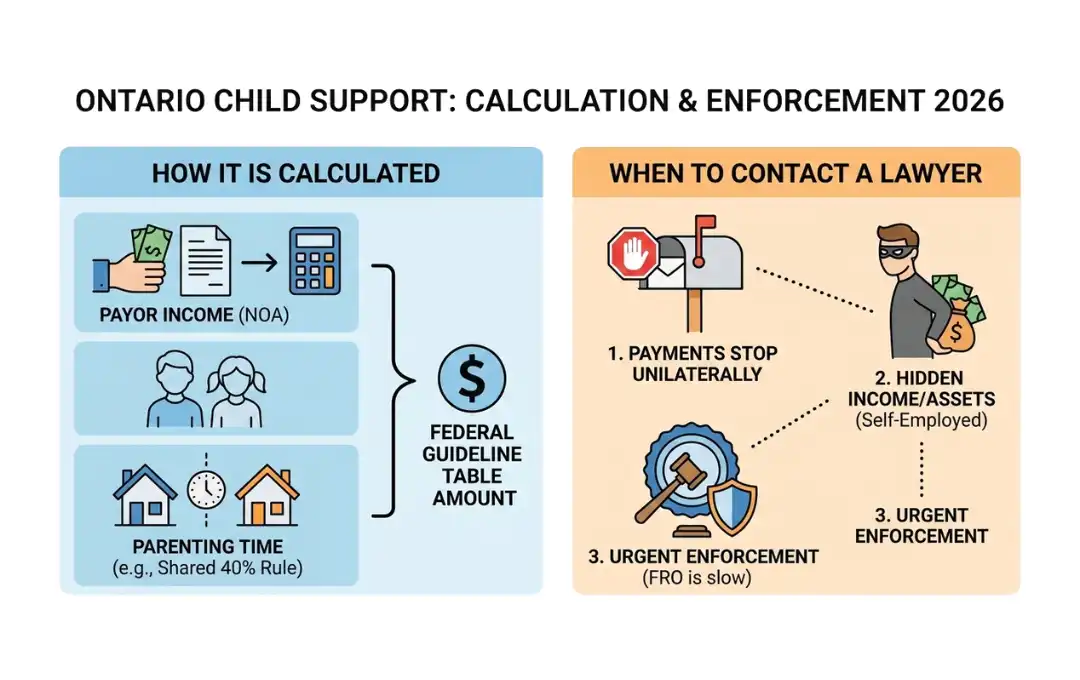
Child support in Ontario is not a number a judge picks arbitrarily. It is governed entirely by the Federal Child Support Guidelines, which produce a mathematically precise result based on objective inputs. The calculation has two distinct components.
The Table Amount (Section 3)
The Table Amount is the mandatory base payment covering the fundamental costs of raising a child: food, clothing, and shelter.
Three variables determine it: the paying parent’s gross annual income (Line 15000 on their CRA Notice of Assessment), the number of children, and the province where the paying parent resides. Ontario has its own table within the federal guidelines, and the amount is non-discretionary — a payor earning $85,000 gross annually with two children in Ontario pays a fixed table amount regardless of what either parent thinks is “fair.”
One point that surprises many parents: when one parent has primary care of the children more than 60% of the time, the receiving parent’s income is generally irrelevant to the Table Amount. The payor simply pays their fixed table amount based on their own income alone. Unlike spousal support, which involves both parties’ incomes and a range of discretionary factors, the Section 3 table amount is a formula, not a negotiation.
Special or Extraordinary Expenses (Section 7)
Children require more than basic living costs, and Section 7 of the Federal Guidelines addresses this. These expenses are shared in addition to the Table Amount and cover:
- Childcare costs (daycare, after-school care) required because of a parent’s work or education
- Medical and dental expenses not covered by insurance (orthodontics, therapy, prescription costs)
- Post-secondary education tuition, residence, and books
- Extraordinary extracurricular activities — competitive rep sports, elite arts programs, or activities with significant fees that go beyond ordinary recreational costs
Unlike the Table Amount, Section 7 expenses are split proportionally to both parents’ incomes. If Parent A earns $70,000 and Parent B earns $30,000, Parent A covers 70% of the orthodontist bill and Parent B covers 30%. This proportional sharing means both parents’ incomes matter — and full financial disclosure from both sides is required.
Part 2: How Parenting Time Changes the Calculation
The amount of time a child spends with each parent is not just a parenting issue — it directly alters the financial equation.
Primary Care (one parent has the child more than 60% of the time): The other parent pays the full Table Amount for their income level. Straightforward.
Shared Parenting — The 40% Rule: If a child spends at least 40% of their time with each parent over the course of a year, the court applies a “set-off” calculation. It determines what Parent A would pay Parent B under the tables, then what Parent B would pay Parent A, and the higher earner pays the net difference to the lower earner. The set-off amount is typically lower than the full Table Amount, which is why parenting time percentages are often disputed in separation proceedings.
Split Custody (two or more children, each living primarily with a different parent): Each parent pays the other the applicable Table Amount for the child not in their primary care. In practice, the higher earner pays the net difference.
It is worth noting that parenting time arrangements can shift over time — including situations where a parent seeks to relocate, which can dramatically alter the 40% threshold and therefore the support calculation. Our guide to parent relocation with children in Ontario covers how a move affects both custody arrangements and the support obligations attached to them.
Part 3: The Hidden Income Problem
The math is clean until one party decides to manipulate it. What happens when your ex-spouse is self-employed, operates a cash business, or suddenly quits a $100,000-per-year job to work part-time just before the support calculation is finalized?
Ontario family courts have zero tolerance for deliberate underemployment or income concealment to reduce child support obligations.
A judge has statutory authority to impute income — meaning the court disregards what the payor reports earning and substitutes a higher, realistic figure based on their historical earnings, their professional qualifications, their lifestyle, and their demonstrated earning capacity. If a dentist earning $250,000 suddenly claims $45,000 in personal income after incorporating their practice and running personal expenses through the corporation, a court will look at the corporate financials and impute the true economic income.
This is one area where legal representation is essential. The FRO (discussed in Part 4) will only enforce the number written on the existing order. It has no mandate to investigate hidden income. A lawyer is required to bring a Motion to Impute Income and compel full financial disclosure — corporate tax returns, shareholder loan accounts, and bank statements — through the court process. This same issue frequently arises in the context of dividing business assets and corporate holdings in a Brampton divorce, where corporate structures are used to obscure true net worth.
Part 4: When Payments Stop — What to Do Immediately
When the first of the month arrives and the payment does not, the temptation is to react emotionally. The correct move is to act strategically.
Critical misconception to correct first: You cannot withhold parenting time because the other parent has stopped paying support. In Ontario, child support and parenting time are completely separate legal issues. Blocking access will make you appear uncooperative to a judge and can seriously damage your position in any subsequent proceeding — even if you are entirely in the right on the support issue.
The Family Responsibility Office (FRO)
If you have a formal court order or a filed separation agreement, the Family Responsibility Office is the provincial enforcement agency for child support in Ontario. Its powers are substantial:
- Direct wage garnishment from the payor’s employer
- Bank account seizure
- Driver’s licence suspension
- Passport cancellation through the federal government
The FRO’s limitation is equally significant: it handles tens of thousands of cases simultaneously and can be very slow to act. If your situation is urgent — facing eviction, inability to afford groceries, or a payor who has abruptly left the province — the FRO timeline is often inadequate.
Part 5: When to Call a Brampton Family Court Lawyer
There are specific situations where waiting for a government agency is not a viable option and private legal intervention is required immediately.
You Have No Formal Order
The FRO cannot enforce a verbal agreement or a handshake deal. If payments have stopped and you never formalized the arrangement in a separation agreement filed with the court or a formal court order, you have no enforcement mechanism at all. A lawyer will file an application for a binding order and can seek retroactive child support going back to the date of separation in appropriate circumstances.
The Payor Is Hiding Income or Assets
If the paying parent is self-employed, paid in cash, or routing personal income through a corporation to show an artificially low personal income on their tax return, the FRO will only enforce what the current order says. You need a lawyer to bring a Motion to Impute Income, force production of full financial records, and obtain an amended order based on actual earnings.
The FRO Is Moving Too Slowly
If you are facing immediate financial hardship — imminent eviction, inability to pay for a child’s medical expenses, or complete loss of income — a lawyer can file an urgent motion in Brampton’s Peel Region Family Court for interim support or a contempt order. Courts take contempt of a child support order seriously and can impose significant consequences on a non-compliant payor, including fines and imprisonment in egregious cases.
The Payor Claims a “Material Change in Circumstances”
If your ex has unilaterally stopped paying because they claim a job loss, a reduction in income, or the birth of another child, they are breaking the law. A support order remains in full force until a new court order or agreement changes it. A lawyer will defend your current order, force the payor to prove their new financial reality with documentary evidence, and ensure any variation granted by the court is proportionate and properly calculated.
Our family law team advises parents across Brampton, Mississauga, and the broader Peel Region on child support calculations, FRO enforcement, income imputation motions, and variation applications.
Frequently Asked Questions
How is child support calculated in Ontario?
Child support in Ontario is calculated under the Federal Child Support Guidelines using the paying parent’s gross annual income (Line 15000 on their CRA Notice of Assessment), the number of children, and the province of residence. The resulting “Table Amount” covers basic living costs. Additional Section 7 expenses — childcare, medical costs, extracurriculars — are split proportionally between both parents’ incomes on top of the base amount.
Does shared custody reduce child support in Ontario?
Yes, in most cases. If a child spends at least 40% of their time with each parent over the course of a year, courts apply a set-off calculation — each parent’s notional table amount is calculated and the higher earner pays the net difference to the lower earner. The result is typically lower than the full Table Amount, which is why the 40% threshold is frequently contested in custody disputes.
Can child support be reduced if the paying parent loses their job?
Not automatically. A child support order remains legally in force until a new court order or signed agreement changes it. If a paying parent loses their job, they must apply to the court for a variation — they cannot simply stop paying. Courts will scrutinize whether the job loss was genuine or deliberate, and whether the payor is making reasonable efforts to find comparable employment before granting any reduction.
What can I do if my ex stops paying child support in Ontario?
If you have a formal order or filed separation agreement, register with the Family Responsibility Office (FRO), which can garnish wages, seize bank accounts, and suspend licences. If the FRO is moving too slowly or you have no formal order, contact a family lawyer immediately. A lawyer can file an urgent court motion, seek contempt findings against the non-paying parent, and obtain retroactive arrears going back to the date payments stopped.
Can a parent avoid child support by quitting their job?
No. Ontario courts will impute income to a parent who is deliberately underemployed or has quit work to reduce their support obligation. A judge will look at the parent’s historical earnings, qualifications, and earning capacity and set support based on what they are reasonably capable of earning — not what they choose to report.
Is child support taxable in Ontario?
No. Under current CRA rules, child support payments are neither deductible for the payor nor taxable income for the recipient. This differs from spousal support, which is generally taxable for the recipient and deductible for the payor when paid as periodic payments under a court order or written agreement.
Can I stop the other parent’s access if they are not paying child support?
No. In Ontario, parenting time and child support are completely separate legal obligations. Withholding access because a parent has not paid support is itself a violation of the parenting order and will seriously damage your credibility with a judge. The correct response to missed payments is enforcement through the FRO or a lawyer — not self-help remedies that put you offside with the court.
Do Not Wait to Enforce Your Child’s Rights
Child support arrears accumulate quickly, and the longer enforcement is delayed, the more difficult it becomes to recover the full amount owed. Whether you are dealing with a complex shared custody calculation, a self-employed payor concealing income, or a complete and abrupt stoppage of payments, waiting and hoping is not a legal strategy.
Ontario law is designed to protect the financial wellbeing of children — but it requires you to activate the right mechanisms at the right time.
Book a consultation with GS Arora Law to speak with a Brampton family lawyer about calculating, establishing, or enforcing child support in your specific situation.
Disclaimer: The information provided in this blog is for general informational purposes only and should not be considered legal, tax, financial, or professional advice. Regulations and procedures may change over time and vary by jurisdiction. For guidance tailored to your specific situation, please consult a qualified professional.