
Contractor vs. Employee in Ontario (2026): The CRA Test and the Cost of Getting It Wrong
Book Consultation Book Consultation
01
DecContractor vs. Employee in Ontario (2026): The CRA Test and the Cost of Getting It Wrong
By Gagandeep Singh Arora, Lawyer at GS Arora Law, Brampton, Ontario · Last reviewed: November 13, 2026
Many Ontario businesses use contractors to stay flexible: hire a “consultant”, pay the invoice, skip payroll. The problem is that a contract calling someone a contractor protects you very little. The CRA looks at how the work actually happens.
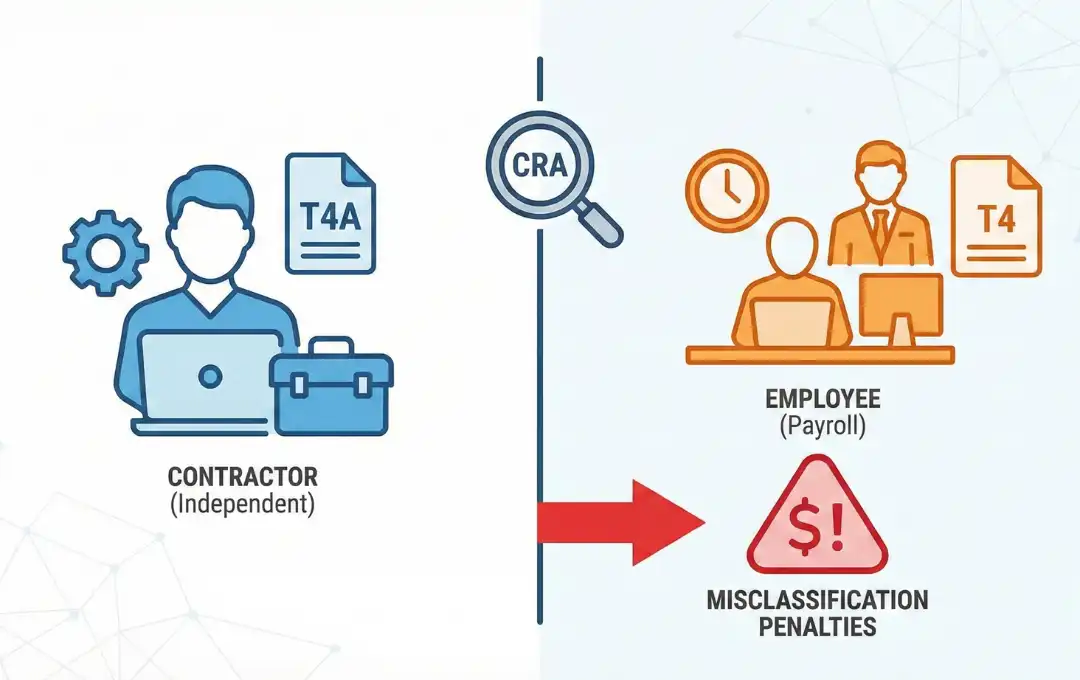
Quick answer: A worker is a contractor, not an employee, when they control how, when and where the work is done, use their own tools, can hire help, and carry real financial risk. If the day-to-day relationship looks like employment, the CRA treats it as employment, whatever the contract says.
Not sure where your workers fall? Book a free consultation and we will review your contractor relationships before the CRA does.
What Is the Difference Between a Consultant and a “Contract Employee”?
A consultant is genuinely self-employed: they decide how the work is done, supply their own tools, invoice for their services and can lose money on a job. “Contract employee” is a misleading label. In law, a worker is either an employee or an independent contractor. A contract cannot create a middle category.
How the CRA Decides: The Employee or Self-Employed Test
Canadian courts apply a multi-factor test (the Wiebe Door / Sagaz approach), and the CRA’s guide RC4110 Employee or Self-Employed? follows it. The CRA first asks what the parties intended, then checks whether the working conditions match.
| Factor | Looks like an employee | Looks like a contractor |
|---|---|---|
| Control | You set hours, methods and location, and supervise daily | You specify the result; they choose how and when |
| Tools | You supply the laptop, software, vehicle or workspace | They supply and pay for their own |
| Subcontracting | Must do the work personally | Can hire helpers or send a replacement |
| Financial risk | Fixed pay, no unreimbursed costs | Own costs, can lose money, liable for errors |
| Chance of profit | Hourly or salary regardless of results | Sets own prices, can profit from efficiency |
| Integration | Core to your business, ongoing, exclusive | Specialized, project-based, serves other clients |
Control in a remote world. Control is no longer about being in the office. Required Slack hours, daily stand-ups and approval before taking other clients all point toward employment.
A tool trap. If you reimburse a contractor for a laptop or software, the CRA may treat that as you providing the tool.
The Personal Services Business (PSB) Trap
Some businesses ask contractors to incorporate, hoping that removes the risk. It often does not. If the incorporated worker would be an employee if the corporation were ignored, and works for one main client, the CRA can treat the corporation as a personal services business under the Income Tax Act.
For a PSB, the corporation loses most business deductions and the small business deduction, so its income can be taxed at a combined federal-provincial rate above 44%. A PSB finding can also invite a closer look at your other contractor relationships. If you are weighing incorporation yourself, see the tax consequences of incorporating in Ontario and choosing the best business structure. Professionals should also read about professional corporations in Ontario.
What Are the Penalties for Misclassifying Employees in Ontario?
The consequences are retroactive. They fall into four buckets:
- CPP and EI premiums. If a worker is reclassified as an employee, the business can owe both the employer and the employee share of CPP and EI for the years in question. These amounts are generally hard to recover from the worker after the fact.
- Penalties. Failing to withhold carries a penalty of 10% of the amount that should have been withheld. It rises to 20% if the employer already has a failure to withhold in the same calendar year and the later failure was made knowingly or through gross negligence.
- Interest. Interest compounds daily from the original due date.
- Employment Standards Act, 2000 exposure. Employees are entitled to minimum standards such as at least 4% vacation pay, public holiday pay, overtime after 44 hours a week and termination pay. These can stack on top of the CRA assessment.
For example, a single long-term worker earning $70,000 a year over three years can produce a combined bill in the tens of thousands of dollars once premiums, penalties, interest and ESA claims are added up. That is an illustration, not a quote. Your numbers depend on the facts.
If a reassessment gets to that scale, read when to call a tax lawyer for a CRA dispute.
How to Get Certainty: Ask the CRA for a Ruling
If a relationship is unclear, you or the worker can ask the CRA for a CPP/EI ruling using Form CPT1. The request must be made by June 29 of the year after the year in question. A ruling covers the specific period and is final unless appealed within 90 days. It is a useful tool, but the CRA’s answer may not be the one you wanted, so talk to a lawyer before you file.
2026 Action Plan for Ontario Employers
- Review control. Manage deliverables and deadlines, not hours in the seat.
- Check tools and costs. Contractors should supply their own equipment and bear their own expenses.
- Allow subcontracting. Your agreements should let the contractor hire help or send a replacement.
- Insist on proper invoices. A fixed, salary-like payment with no invoice is a red flag. Once a contractor’s revenue passes the $30,000 small supplier threshold, they must register for GST/HST. See HST registration and filing.
- File T4As. Fees for services over $500 in a year are generally reported on a T4A.
- Keep records. See CRA record-keeping requirements for Ontario businesses.
- Fix the paper. Our guide to safely hiring contractors in Brampton covers contract language that supports contractor status. Also protect your IP: the work-made-for-hire trap. If a worker should really be an employee, review employment contracts and non-competes in Ontario.
Related: small business tax deductions and avoiding CRA audits.
How a Brampton Business Lawyer Can Help
Our business law team reviews how contractor relationships actually work day to day, rewrites agreements to match, flags PSB risk early and helps employers fix relationships that have drifted toward employment. We act for businesses in Brampton, Mississauga and across the GTA. Book a free consultation.
Frequently Asked Questions
What is the difference between a consultant and a contract employee in Ontario?
A consultant is genuinely self-employed. They control how the work is done, use their own tools, invoice for services and carry real financial risk. “Contract employee” is not a legal category. A worker is either an employee or an independent contractor, based on the substance of the relationship, not the label.
Does a signed independent contractor agreement protect me from a CRA reassessment?
No. The CRA looks at how the relationship works in practice: control, tools, financial risk and integration. A well-drafted agreement helps only if the day-to-day relationship matches it.
What test does the CRA use to decide if someone is an employee?
The CRA looks at intent and then at control, tools and equipment, subcontracting, financial risk, investment and chance of profit. No single factor decides the outcome.
What is a Personal Services Business and why does it matter?
A PSB is an incorporated worker who would be an employee if the corporation were ignored. The corporation loses most deductions and the small business deduction, and its income can be taxed above 44%. A PSB finding can also draw attention to your other contractors.
What are the penalties for misclassifying an employee as a contractor?
You may owe CPP and EI premiums for both employer and employee shares, a 10% penalty (20% for a repeat knowing or grossly negligent failure in the same year), daily compounding interest, and Employment Standards Act amounts like vacation, overtime and termination pay.
How far back can the CRA go?
Generally a limited number of past years, but the time limit can be extended if the CRA finds misrepresentation or deliberate non-compliance. Ask us about your specific years.
Can I ask the CRA to decide whether my worker is an employee?
Yes. File Form CPT1 for a CPP/EI ruling by June 29 of the year after the year in question. The ruling is final unless appealed within 90 days.
Do contractors need to charge GST/HST?
Once a contractor’s taxable revenue passes the $30,000 small supplier threshold, they must register and charge GST/HST. A contractor who never invoices is a warning sign.
Does making a contractor incorporate protect my business?
No. If the worker is still an employee in substance, the CRA can look through the corporation and treat it as a PSB.
Which businesses face the most risk?
Any business that pays individuals as contractors on a recurring basis, especially in IT, construction, trucking, consulting and gig work, where the lines between employee and contractor are often blurred.
Who should I call if the CRA starts an audit?
Speak to a lawyer before you respond to the auditor. Contact GS Arora Law.
Final Takeaway: Clarity Is Your Best Defence
How a relationship looks on paper matters far less than how it works. The cost of getting it wrong, including payroll premiums, penalties, interest and ESA back-pay, can threaten a small business. Fix it before an auditor does.
Don’t wait for the CRA to tell you who your employees are. Book a free consultation with GS Arora Law and we will review your contractor agreements and working relationships.
Sources: CRA: RC4110 Employee or Self-Employed? · Income Tax Act (Canada) · Canada Pension Plan · Employment Insurance Act · Employment Standards Act, 2000 (Ontario)
Disclaimer: The information provided in this blog is for general informational purposes only and should not be considered legal, tax, financial, or professional advice. Regulations and procedures may change over time and vary by jurisdiction. For guidance tailored to your specific situation, please consult a qualified professional.